- Who we are
Who we are

Over 100 industry awards, accolades, and achievements showcase our quality and commitment to client success.
- Services
Services
Technologies
- On Demand App Solutions
Who we are
Trusted by 500+ active clients.
- Contact Us


 +971 4 2417179
 +971 52 181 0546
 info@branex.ae
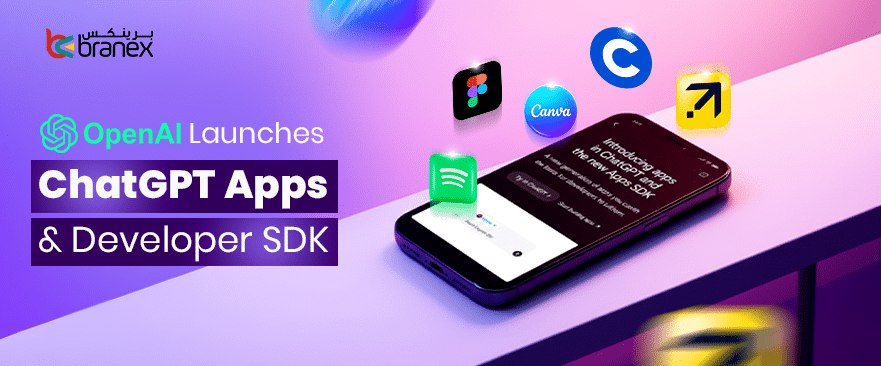
In recent events, OpenAI has turned ChatGPT into a full-fledged platform called ChatGPT Apps.
It’s no longer just a chatbot but a place where people (like marketers and developers) can come together and create complete apps. This rollout was first launched on October 6th for users residing in Europe and the United Kingdom. OpenAI’s successful launch has shifted ChatGPT from being merely a conversational tool to a comprehensive ecosystem. The Apps SDK is currently available for preview and allows developers and marketers to build context-aware experiences directly within ChatGPT.
This launch gives ChatGPT users a chance to interact with pre-launched apps like Booking.com, Canva, Coursera, Expedia, Figma, Spotify, and Zillow through its Free, Go, Plus, and Pro plans. These apps are built on the Model Context Protocol (MCP), where the new Apps SDK enables developers to design and connect their own apps, making them conversation-optimized and user-friendly. You can merge them with interactive features such as maps, playlists, and live data.
Read More: How is AI Transforming Mobile Apps.
Developers are now fully capable of testing and building apps by accessing Developer Mode.
Table of Contents
What are ChatGPT Apps?
ChatGPT apps are a new feature launched by OpenAI. They provide users with the ability to design their own apps that run directly within OpenAI’s AI-powered ChatGPT interface.
Previously, plugins were needed to connect an app with the AI-powered conversation interface. Now, you can simply use natural language to respond, create visuals, maps, or even pull up your favorite playlists. This allows users to perform actions directly in the chat.
All a user needs to do is type in an app’s name. For example, you could type, “Spotify, make a playlist for my trip to Dubai,” and Spotify will use OpenAI’s contextual suggestions.
Every app adapts to the conversation and integrates directly through natural language processing.
ChatGPT Apps Soft Launch & Availability
OpenAI has recently released ChatGPT Apps for users outside the European Economic Area, including Switzerland and the United Kingdom. This feature is available on Free, Go, Plus, and Pro plans.
The initial soft launch features a handful of partners such as Booking.com, Canva, Coursera, Expedia, Figma, Spotify, and Zillow, offering task-oriented experiences.
These integrations allow users to pull up playlists, book hotel rooms, use Canva and Figma for designs, access relevant courses from Coursera, and perform other essential tasks.
Additional partners OpenAI plans to add include Uber, Peloton, Target, AllTrails, and OpenTable in the coming years.
They also aim to extend Apps to other OpenAI models, such as ChatGPT Business, Enterprise, and EDU plans. For now, the company is awaiting regulatory approvals.
OpenAI is building the foundation of an expanding AI application ecosystem.
The idea is to integrate productivity and conversational computing deploying it in well segmented phases.
The Apps SDK – How Developers Design, Build & Integrate
The SDK is built on the Model Context Protocol (MCP) and provides a comprehensive outline of how developers create applications directly within ChatGPT through a single framework.
Also Read: What is AI Enablement? An Easy Guide for Businesses.
It’s open-source and requires direct API integration with context awareness interactions. Its open-source nature allows easy interaction by combining conversation with essential functionality.
The objective is to reduce the development friction and bridge conversational AI.
This way, the existing software ecosystems can function more accurately.
How ChatGPT Apps Benefit Users?
Multi-Tasking Right in the Chat Interface – The best benefit of ChatGPT Apps is how users can perform multiple tasks by simply having a conversation with the OpenAI’s interface. From booking hotel rooms, to designing social media posts and checking up the latest courses on Coursera, there’s plenty of things users can do. Now, the user doesn’t have to shift multiple tabs, or go through different apps. It will remove the burden of logging into these apps separately or copying information. ChatGPT will simply provide a one-stop productivity hub to the user so they can perform their operations instantly.
Productivity Boost: Booking, Designing, Learning and Planning – Another leading benefit for apps is to streamline everyday workflow. With OpenAI soft launch, businesses can design visuals in Canva, create travel itineraries with Booking.com or pull up a music playlist to have deeper focus or leisure. They can enjoy it without having to leave the chat whatsoever. It can help them to easily integrate functions in ChatGPT which will altogether save user time and accomplish more in just a handful of steps.
Create More Personalized and Context-Aware Interactions – While traditional apps don’t possess the capability of responding back, ChatGPT Apps are well integrated dynamically to respond to conversations. For instance, you can ask Spotify to create your “Dubai trip” playlist where you don’t have to manually access your Spotify account. ChatGPT will automatically check your previous preferences and the context of the request and will create a fully personalized experience. Here, suggestions & actions will feel much more natural, relevant and intelligent.
Reduce Friction vs Switching Between Apps – Instead of going through multiple platforms and different interfaces, ChatGPT Apps allow users to stay in a single environment. Whether it’s messaging and researching, designing and booking, and other relevant OpenAi can do a whole lot of things. It provides you room to minimize the friction, make task performance active, faster, smoother & much more interactive.
Also Read: How Agentic AI is Changing the Future of Intelligent Systems?
How ChatGPT Apps Benefit Developers & Businesses?
Easy Integration of Existing Apps – The Apps SDK allows existing services to directly connect with ChatGPT’s interface making the whole thing conversation-friendly.
Ultimately, it reduces the barrier to entry and open-up newer and better opportunities for innovation. Developers no longer require complex plugins or separate AI integrations.
Potential for Monetization & User Engagement – Businesses can make use of ChatGPT’s AI ecosystem to reach users in a heavily engaged environment.
It offers specialized tasks, services, or premium features well integrated directly within the chat. Companies who leverage it can better unlock new revenue streams.
Eventually, it keeps users constantly involved.
Reduced Development Complexity – The SDK you design will be capable of context management, setting interaction logic, and following the best integration standards.
It lets developers focus on working on the core features of the app. Ultimately, this reduces the technical workload, accelerates development process & makes it easier to launch.
Safety & Privacy Concerns (Developers Meeting Standards)
Launching ChatGPT apps have a list of safety and privacy concerns, however, we are only going to discuss a handful of them. The first concern revolves around user data handling where apps can access user inputs and context without the user consent. Even though it is to ensure that sensitive information isn’t misused, developers must follow strict data handling protocols & have consent approvals so it doesn’t lead to unintentional exposure of personal information.
Secondly, having third-party integrations such as Booking.com, Spotify, or Figma may require access to user accounts or external APIs. And while data is exchanged between these ChatGPT and these services, it has to be done through extremely secure channels. If developers are working on these apps, they need to ensure OAuth flows, tokens, and API keys are handled safely.
Users should always be informed which apps access which types of data and clear consent prompts along with supporting privacy policies are shown within ChatGPT. At the same time, apps must follow the GDPR, CCPA, and other regional privacy laws depending on where users are located. All apps must undergo testing in Developer Mode before release. and Developers must follow best practices for secure coding, data minimization, and responsible AI usage.
How the Community Responds?
According to the community, the current ChatGPT update shows a proper reflection of both enthusiasm and caution. This update is also viewed as the next step in the process of changing how ChatGPT transforms into a complete digital workspace. You can use it as a browser, or even treat it as an operating system depending on the requirement. With bare minimum context sharing to high interactivity, the ChatGPT focuses on glorifying review from different testers. However, individuals from the community also explain there’s a margin of frequent hallucinations within the app-generated content.
There’s a mixed sentiment, slightly optimistic. The SDK is broadly considered a building block of a new AI ecosystem, and the conversational apps transform it into a full-fledged assistant.
The idea is to have an assistant that thinks, acts and cooperates.
Concluding Thoughts
OpenAI’s ChatGPT Apps and Developer SDK transform ChatGPT into a versatile digital workspace, letting users multitask, access personalized experiences, and stay in a single chat interface. For developers and businesses, it’s a streamlined way to innovate and engage users.
While privacy and safety remain key, this launch sets the stage for AI that doesn’t just assist—it collaborates.