


Quick Answer: The cost of ecommerce website development Dubai businesses pay typically ranges from AED 8,000 to AED 55,000 in 2026 for a standard or professionally customised store. Basic stores start around AED 5,500, while advanced and enterprise builds can exceed AED 120,000.
Planning to build or revamp an online store? You’ll almost certainly get a different quote from every agency. Each one prices features and customer expectations differently.
The cost of ecommerce website development Dubai retailers invest in depends on the platform, the size of your catalogue, the design and the integrations. Let’s break down the cost by category.
Key Takeaways
- Most Dubai ecommerce stores cost AED 8,000 to AED 55,000; enterprise marketplaces can pass AED 180,000.
- Catalogue complexity, integrations and custom design move the price far more than page count.
- Shopify is usually the most budget-friendly start; WooCommerce, Magento and custom builds offer more control at higher cost.
- Budget for running costs too: hosting, apps, payment fees, maintenance and marketing.
- Choose an ecommerce website development Dubai partner with UAE payment, courier and Arabic experience.
Table of Contents
Why Does Ecommerce Website Development Dubai Cost Vary So Much?
Getting a different ecommerce website development Dubai quote every time you ask for an ecommerce website is nothing new. Most mid-range stores cost between AED 9,000 and AED 40,000 in Dubai. That gap is normal, and it usually comes down to what sits behind the storefront.
Here’s what moves the price most:
- Catalogue size and complexity. A store with 40 products works very differently from one with 4,000 SKUs, each with its own sizes, colours and stock rules.
- Template or custom design. A ready-made template takes far less time than designing a site from scratch.
- Platform and technology. Shopify, WooCommerce, Magento and a custom build each have different setup and upfront costs.
- Payment and shipping integrations. Every gateway and courier connection needs setup, testing and sometimes approval.
- Arabic and English support. A properly built bilingual store is more than a translated website.
- Advanced functionality and automation. Loyalty programmes, subscriptions and CRM syncing all add hours.
- Security, performance and scalability. A store built to handle sale-day traffic costs more than one that will never see it.
Page count rarely drives the price. A 15-page store with live inventory sync, three payment methods and a custom checkout can easily cost more than a 60-page brochure site. What you pay for in ecommerce website development Dubai is the shopping experience, the integrations and the backend operations.
Read more: Top Benefits of Professional Ecommerce Website Development Services
Ecommerce Website Development Dubai Cost by Project Type
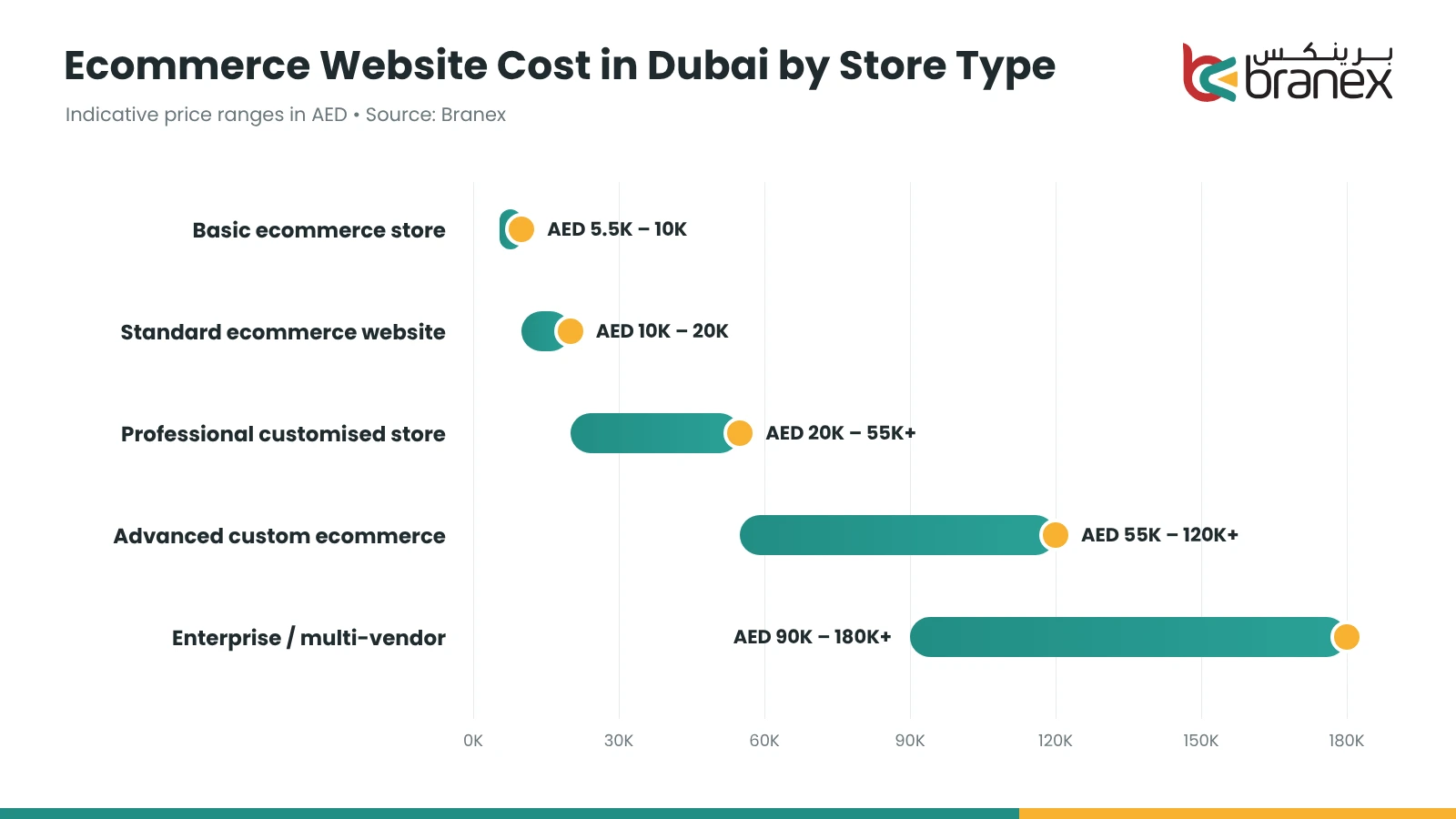
Treat each ecommerce website development Dubai tier below as an indicative band, not a fixed package. Projects often sit between two tiers, and enterprise builds can go well past AED 180,000 depending on their technical requirements.
| Ecommerce website type | Estimated cost (AED) |
|---|---|
| Basic ecommerce store | 5,500 – 10,000 |
| Standard ecommerce website | 10,000 – 20,000 |
| Professional customised store | 20,000 – 55,000 |
| Advanced custom ecommerce website | 55,000 – 120,000+ |
| Enterprise / multi-vendor marketplace | 90,000 – 180,000+ |
These are indicative market estimates, not fixed agency rates. Check them against your own project requirements.
Here’s a complete breakdown of every type of ecommerce website.
Basic Ecommerce Website: AED 5,500 – 10,000
A basic ecommerce website development Dubai package includes:
- A ready-made Shopify or WooCommerce theme
- A simple homepage and product catalogue
- A shopping cart and standard checkout
- Basic payment gateway setup
- Mobile-responsive design
- Limited product uploads
- Essential SEO configuration
Best for: startups, small retailers and businesses testing online sales for the first time.
Standard Ecommerce Website: AED 10,000 – 20,000
A standard ecommerce website development Dubai storefront goes beyond a template. It includes:
- A customised theme with branded layouts
- A larger product catalogue
- Product categories and filters
- Customer accounts and order management
- Payment and shipping configuration
- Basic promotional features and discount codes
- Analytics and conversion tracking
Best for: small and growing businesses that have outgrown a basic store and want a more professional, branded storefront.
Professional Customised Ecommerce Website: AED 20,000 – 55,000
This is the range where many established Dubai retailers land. It typically includes:
- Custom UI/UX design
- Advanced product filtering and search
- Arabic and English functionality
- Local payment gateways and buy-now-pay-later options
- Courier and inventory integrations
- Wishlists, reviews and loyalty features
- Advanced SEO and performance setup
- CRM integration and automated notifications
Best for: established retailers and brands with larger catalogues and more specific customer requirements.
Advanced Custom Ecommerce Website: AED 55,000 – 120,000+
When off-the-shelf tools stop fitting, ecommerce website development Dubai projects move to a more tailored build:
- Custom frontend and backend development
- Custom product configuration
- ERP and CRM integrations
- Multi-warehouse inventory management
- Advanced customer dashboards
- Subscription and recurring payment functionality
- Custom checkout workflows
- Enhanced security and performance testing
Best for: businesses with complex operations, high order volumes or requirements that standard platforms can’t support well.
Enterprise Ecommerce and Multi-Vendor Marketplace: AED 90,000 – 180,000+
In enterprise ecommerce website development Dubai projects, a marketplace has to work for many sellers at once:
- Multi-vendor registration and management
- Seller dashboards and commission systems
- Advanced inventory and order management
- Multiple payment methods
- Automated vendor payouts
- ERP and third-party API integrations
- Custom reporting and analytics
- Advanced security and infrastructure
Best for: large retailers, marketplace operators and businesses managing multiple sellers or complex sales operations.
Want to Build an Enterprise Ecommerce Website?
Contact our ecommerce web development team for a transparent, itemised proposal in AED.
Ecommerce Website Development Cost by Platform
Your platform affects the build cost, how flexible the store is later and what you pay every month afterwards. Here’s how the main options compare for ecommerce website development Dubai projects.
| Platform | Cost positioning | Best for |
|---|---|---|
| Shopify | Low to medium | Quick launches and simple operations |
| WooCommerce | Low to high | WordPress users who want control over content and SEO |
| Magento / Adobe Commerce | High | Large catalogues and multiple stores |
| Custom development | High to very high | Unique operations and complex integrations |
Shopify. Shopify is a hosted platform, so there’s no server management or security patching. Setup is quick: choose a theme, add products and connect payments. Costs include a monthly subscription, paid apps and sometimes a premium theme. It’s easy to run day to day, but you have to work within Shopify’s framework. Ideal for brands that want a fast, simple operation.
WooCommerce. WooCommerce is built on WordPress and gives you a lot more control. The number of plugins and custom features greatly influences setup costs, and you pay for hosting, premium plugins and maintenance separately. Flexibility is what draws people in. The flip side is that it’s up to you to keep it fast, secure and up to date. Ideal for businesses already on WordPress, or those who want more control over content and SEO.
Magento / Adobe Commerce. Built for large, complex catalogues with enterprise features. It needs specialist skills, which is why setup and hosting sit at the higher end. It’s powerful, but it’s not built for small shops. Ideal for big catalogues, multiple stores and heavy back-end needs.
Custom development. Frameworks such as React, Next.js or Laravel, a bespoke backend and API integrations let you build exactly what your operation needs. It’s the most expensive option and needs long-term maintenance, so it makes sense when off-the-shelf platforms can’t run your business effectively.
Read more: Best Ecommerce Platform in the UAE: Which One Should You Choose?
“If you build a great experience, customers tell each other about that. Word of mouth is very powerful.”
— Jeff Bezos, founder of Amazon
Key Features That Affect Ecommerce Website Development Costs
The number of features in your store doesn’t make development expensive on its own. What matters is how much time each feature adds to your ecommerce website development Dubai budget.
UI/UX Design: Ready-Made Theme vs Custom Design
A theme means licensing and configuring something that already exists. Custom design means wireframes, interface design and tailored product and checkout pages, which takes more design time and more testing. Mobile-first design adds effort either way. In Dubai, where most browsing happens on phones, it’s worth paying for.
Product Catalogue and Inventory Management
In ecommerce website development Dubai projects, cost increases with the number of products and SKUs, and even more with variations, attributes and categories. Bulk imports save time but require clean data. Stock tracking and inventory syncing across channels add to the effort as well.
Payment Gateway Integration
UAE providers include Telr, PayTabs, Stripe and Network International. Each integration involves account setup, technical configuration, transaction fees, testing and security measures, including PCI-compliant card processing. Gateway approval can take time, so allow for it in both your timeline and your budget.
Read more: Payment Gateways in the UAE for Ecommerce
Shipping and Delivery Integrations
Courier API connections let you display real-time shipping rates and configure shipping zones. Cash on delivery is still popular in the region and requires special handling. Order tracking and notifications keep customers updated, and a proper returns and refunds system keeps your support team from drowning.
Arabic and English Translation and Content Adaptation
A bilingual store needs more than translation. It requires a right-to-left (RTL) interface, Arabic typography and navigation, language switching and localised product information. Adding Arabic after the store is built is expensive, because left-to-right layouts are hard to retrofit. It’s cheaper to plan both languages from the beginning.
Advanced Ecommerce Functionality
Customer accounts and wishlists, loyalty programmes, subscription purchases, product recommendations, CRM and ERP integrations and marketing automation all add development hours. Choose the ones that will grow revenue now, and save the rest for later.
Read more: How AI Is Revolutionizing Ecommerce Website Development
Hidden Costs of Running an Ecommerce Website in Dubai
The ecommerce website development Dubai quote is only the first bill. Once the store is live, you pay to keep it running.
| Expense | What to budget for |
|---|---|
| Domain registration | Annual renewal |
| Hosting and server costs | Monthly or annual fees |
| Shopify subscriptions | Recurring platform plans |
| Premium themes and plugins | Annual licences or subscriptions |
| Payment processing | Setup and per-transaction charges |
| Website maintenance | Monthly support or annual AMC |
| Security and backups | Recurring technical expenses |
| SEO and digital marketing | Monthly marketing budget |
| Content and product photography | Initial and ongoing production |
A few of these deserve a closer look:
- Domain and hosting. Small line items, but they recur. WooCommerce and custom builds need proper hosting that can handle traffic spikes.
- Platform subscriptions. Shopify plans are monthly, and many premium themes and plugins renew yearly. Apps add up quickly.
- Payment processing. Gateways charge per transaction, and setup may carry a fee too.
- Security and backups. SSL, firewalls and regular backups protect you from the kind of outage that costs a weekend’s sales.
- SEO and marketing. A store with no traffic earns nothing, so a monthly digital marketing budget belongs in your plan.
- Content and photography. Good product images lift conversions. Expect an upfront cost, then ongoing spend as you add products.
Keep one distinction straight. Ecommerce website development Dubai expenses are what you pay to build the store. Operating costs like payment processing and advertising are what you pay to run the business. They aren’t development costs, but they shape the real total cost of owning an online store.
Read more: Top 7 Ecommerce Web Design Companies for Growing Brands
How Long Does It Take to Develop an Ecommerce Website?
Timelines matter when you’re comparing ecommerce website development Dubai proposals. If an agency promises three weeks for a complex build, ask how.
| Project type | Estimated timeline |
|---|---|
| Basic ecommerce store | 2 – 4 weeks |
| Standard ecommerce website | 4 – 6 weeks |
| Professional customised store | 6 – 12 weeks |
| Advanced custom ecommerce website | 3 – 6 months |
| Enterprise / marketplace | 4 – 8+ months |
Most ecommerce website development Dubai delays come from the same few places:
- Incomplete product information. Missing descriptions, prices or SKUs stall the build.
- Late content and images. Developers can’t finish pages that have nothing to show.
- Payment gateway approvals. These depend on the provider and can take longer than expected.
- Third-party integrations. ERP, CRM and courier systems often need extra testing time.
- Design revisions and approval cycles. Each round adds days, especially when feedback arrives slowly.
- Features added mid-project. New requests during development push back both the schedule and the budget.
How to Choose the Right Ecommerce Website Development Company in Dubai
Price matters, but choosing the right ecommerce website development Dubai partner is what makes the real difference. Before you sign, check whether the agency has:
- Relevant ecommerce projects. Ask to see live stores they’ve built, not just mock-ups.
- Platform experience. They should know Shopify, WooCommerce and custom platforms well enough to tell you honestly which suits you.
- UAE market knowledge. Local payment gateways, courier systems and delivery expectations differ from other markets.
- Arabic and English capability. Ask who handles RTL development and Arabic content. Our guide to bilingual website design in the UAE explains what to look for.
- Transparent pricing and scope. You should know exactly what’s in the quote and what costs extra.
- Ownership of your files and source code. Confirm that you own what you pay for.
- Post-launch support. Find out who fixes things after launch day, and how fast.
Not sure whether you need a template-based store or a custom platform? Read our comparison of custom vs template websites, or check the full web design cost in Dubai guide.
Talk Through Your Own Project
Let Branex be your ecommerce web development partner. Get a transparent quote built around your catalogue, platform and integrations.
FAQs About Ecommerce Website Development Cost in Dubai
Bottom Line
The cheapest ecommerce website isn’t automatically the most cost-effective, and a fully custom platform isn’t automatically the right investment. A cheap build that can’t handle your catalogue costs you in lost sales and rebuilds. An over-engineered one drains the budget you needed for marketing and stock.
Before you choose an approach to ecommerce website development Dubai, look at your current catalogue, how you sell today, what your operations need and where you expect to be in two years.
Let’s Build a Store That Fits Your Budget
Tell us about your products and goals, and we’ll recommend the right platform and scope for your business.