- Who we are
Who we are

Over 100 industry awards, accolades, and achievements showcase our quality and commitment to client success.

- Services
Services
Technologies

- On Demand App Solutions
Who we are
Trusted by 500+ active clients.

- Contact Us

 +971 52 905 2719
 info@branex.ae

Before choosing how to build your website, you should know that 75% of users judge a company’s credibility based on its website design.
A poorly designed or outdated website can reduce trust before a visitor even reads or engages with the content.
Custom web development isn’t just used for marketing; it’s a business asset. It influences how customers perceive your brand, how easily they find you online, and ultimately whether they choose to do business with your business.
That’s why the most common question businesses ask is:
Is a template-based website a better choice than custom development?
The answer isn’t as simple as “custom is better.” Templates might be the right choice for startups or small businesses.
Table of Contents
What Is Custom Web Development?
Custom Web Development is the process of designing and building a website or web application tailored to business needs. It doesn’t rely on a pre-built theme or template.
A custom website comes with more advanced layouts and features. These websites are custom websites, developed as per the expectations of clients.
Every component, from the user interface to the backend architecture, is created to support your long term business objective.
Think of it like the difference between buying a ready-made office space and constructing one specifically for your team’s workflow. Both provide a place to work, but only one is more optimized for how your business operates.
Key Components of Custom Web Development
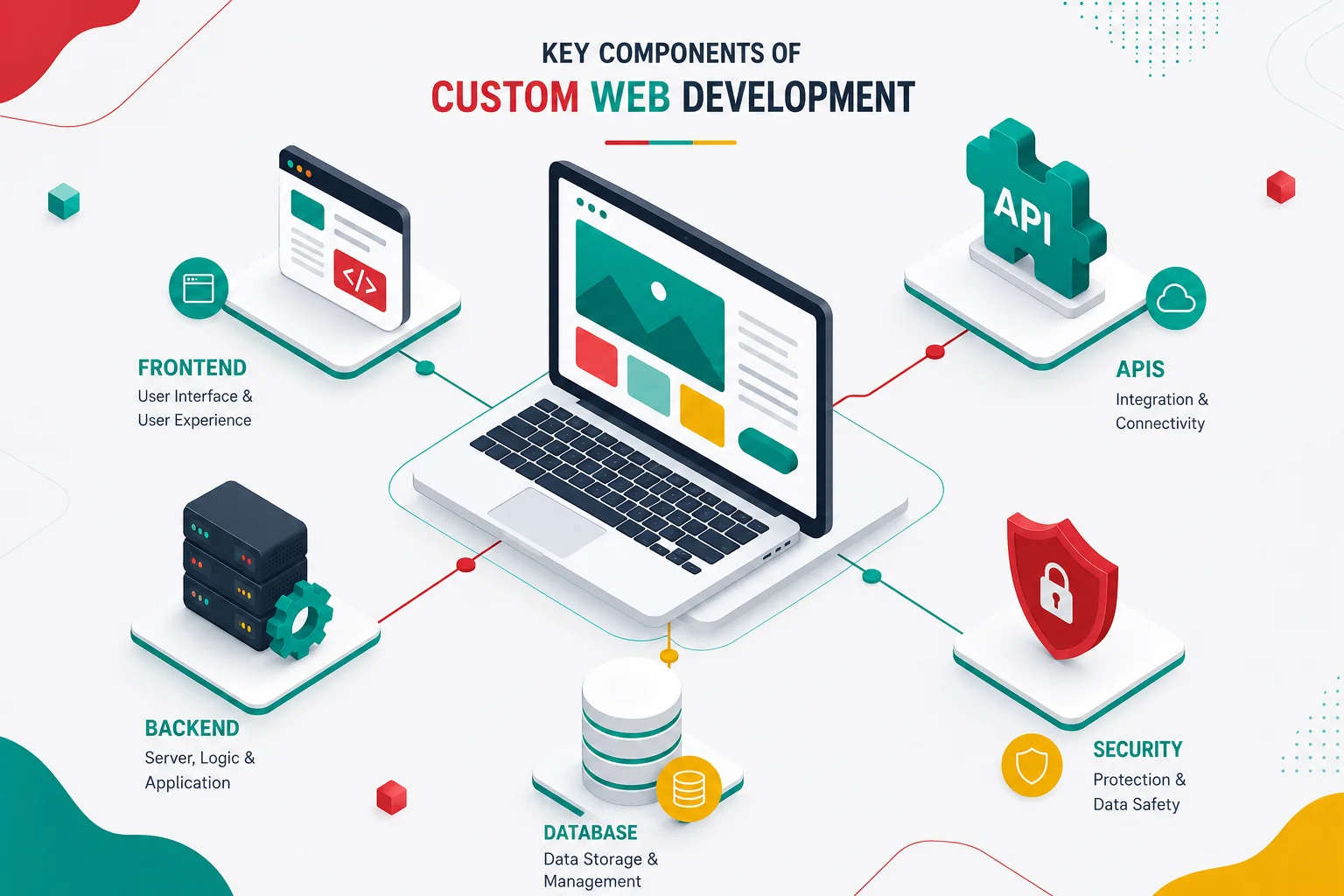
A custom website typically consists of several interconnected layers that blend in to create a seamless interface.
Custom Frontend Development
The frontend development is the core of the website. If a website design focuses on modern aesthetics and advanced features, it will most probably make a lasting impact.
Custom web development includes:
- Homepage layouts
- Navigation menus
- Landing pages
- Service pages
- Product pages
- Contact forms
- Interactive elements
- Mobile responsiveness
- Animations and transitions
With custom development, designers and developers aren’t restricted by a theme’s structure. Every page can be crafted to guide users toward a specific goal, whether that’s requesting a quote, booking a consultation, or completing the purchase.
Custom Backend Development
The backend powers everything happening behind the website. It offers functionality to the website, making it more robust and engaging.
Depending on your business, custom backend development includes:
- Customer accounts
- User authentication
- Order management
- Inventory tracking
- Appointment scheduling
- Content management
- Reporting dashboards
- Business automation
- Admin portals
A well-architected backend ensures your website remains stable, secure, and capable of handling increasing traffic and functionality over time.
Tailored Database Architecture
Every website stores information, but not every business stores data in the same way.
A custom database allows developers to structure information according to your operational needs rather than forcing it into predefined formats.
API Integrations
Modern businesses rarely rely on a website alone. Instead, websites need to communicate with multiple software platforms to automate processes and improve efficiency.
Common API integrations include:
- CRM systems
- ERP software
- Payment gateways
- Shipping providers
- Accounting platforms
- Marketing automation tools
- Customer support software
- Inventory management systems
Rather than manually transferring information between systems, APIs enable data to flow automatically, reducing administrative work and minimizing errors.
Custom Business Logic
One of the biggest advantages of custom web development is the ability to build unique functionality that fits your business needs. A custom website can easily make money for your business.
Some of the most common examples include:
- Membership portals
- Learning management systems
- Multi-step quotation tools
- Product configurators
- Customer dashboards
- Vendor management systems
- Online booking platforms
- Subscription management
Instead of relying on multiple plugins to replicate these features, developers build them as part of a unified application, resulting in cleaner, more maintainable code.
Why Businesses Invest in Custom Web Development
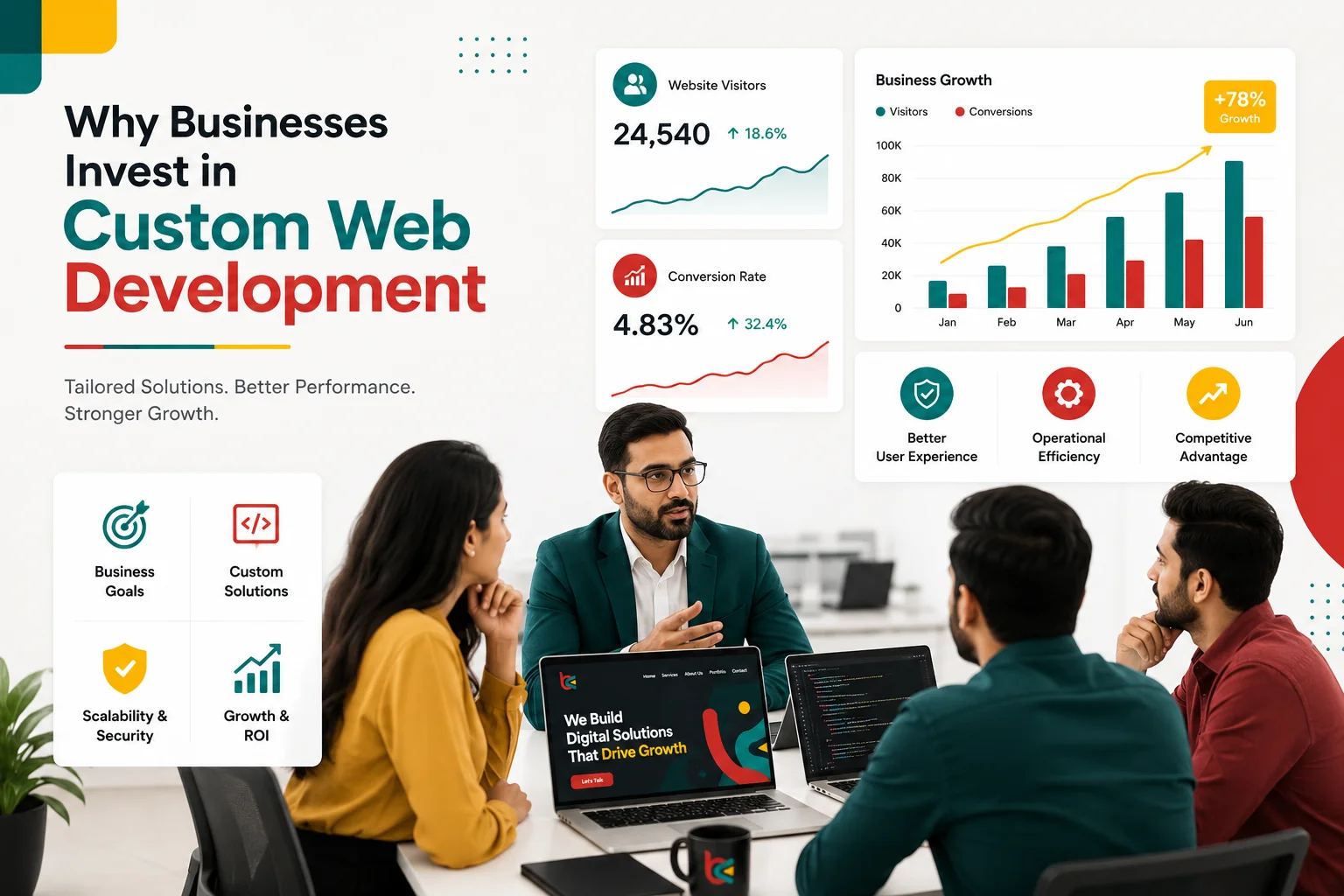
Not every business requires a custom-built website, but those with long-term growth ambitions often benefit from the flexibility it provides.
Businesses typically choose custom development when they need to:
- Differentiate themselves from competitors
- Support unique customer journeys
- Integrate with existing business systems
- Improve website performance
- Scale without rebuilding from scratch
- Strengthen security
- Enhance technical SEO
- Automate repetitive workflows
For example, an online marketplace needs buyer and seller dashboards, secure payment processing, messaging systems, and inventory synchronization. While features can be added to a template through plugins, managing them becomes increasingly complex as the platforms grow.
A custom solution allows all of these capabilities to be built into a single, cohesive system designed specifically for the business.
Is Custom Web Development Always the Best Choice?
Not necessarily!
One of the biggest misconceptions in the industry is that every business should invest in a custom website. In reality, the best solution depends on the current needs and future plans of a business.
If you’re launching a small local business, validating a startup idea, or creating a simple informational website, a well-built template may provide everything you need.
However, if your website is expected to become a core part of your operations, handling customer accounts, integrations, bookings, transactions, or proprietary workflows, investing in custom web development can reduce technical limitations and can make money for your business over the period of time.
Rather than asking, “Which option is better?” the more useful question is:
“Which solution best supports where my business will be in three to five years?”
That perspective often leads to a more strategic investment and helps avoid costly redesigns as your business evolves.
What Are Website Templates?
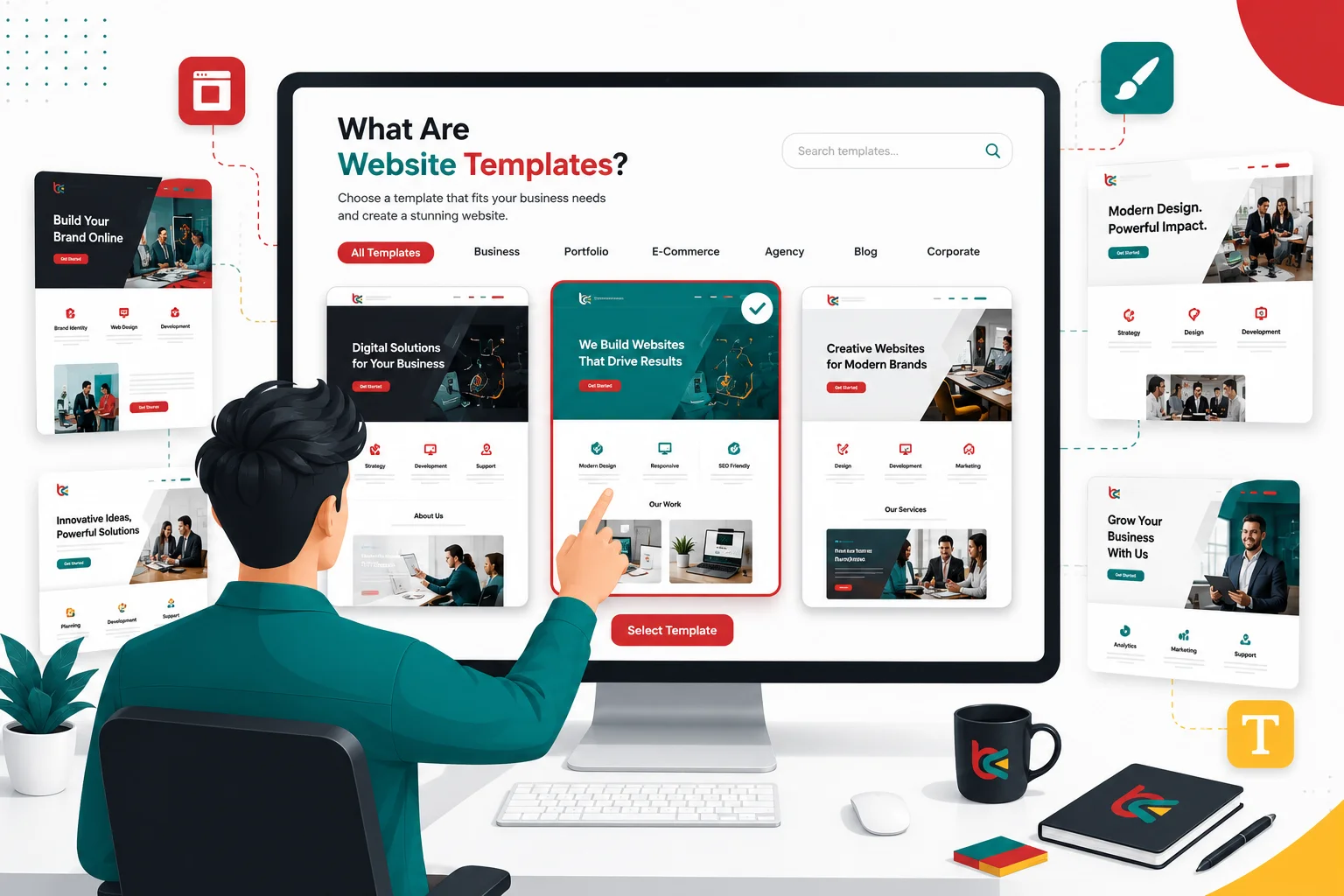
Website templates are pre-designed layouts and frameworks that allow businesses to launch a website without building everything from scratch. They typically include ready-made page designs, navigation menus, styling, and common features like contact forms, image galleries, blogs, and eCommerce functionality.
Instead of writing custom code, users can customize colors, fonts, images, and content to match their brand. This significantly reduces development time and upfront costs, making templates an attractive option for startups and small businesses.
Today, most template-based websites are built using one of the following platforms.
WordPress Themes
WordPress powers over 40% of websites on the internet, making it the world’s most widely used content management system (CMS). Its popularity stems from its flexibility and massive ecosystem of themes and plugins.
A WordPress theme controls the visual appearance of your website, while plugins extend its functionality. Whether you need an online store, appointment booking, multilingual support, or SEO tools, there’s likely a plugin available.
Shopify Themes
Shopify is designed specifically for eCommerce businesses.
Its themes include built-in features such as:
- Product catalogs
- Shopping carts
- Secure checkout
- Inventory management
- Payment integrations
For businesses that primarily sell products online, Shopify provides a fast and reliable way to launch without extensive development.
That said, highly customized shopping experiences, advanced pricing models, or complex integrations may require custom development beyond the capabilities of standard themes.
Wix
Wix is a hosted website builder known for its drag-and-drop editor and beginner-friendly interface.
It’s particularly popular among freelancers, local businesses, and entrepreneurs who want to manage their own websites without technical expertise.
While Wix makes website creation simple, it offers less flexibility than fully custom solutions when businesses need advanced functionality or integrations.
Webflow Templates
Webflow bridges the gap between traditional website builders and custom development.
Its visual designer generates clean HTML, CSS, and JavaScript while offering significantly more design flexibility than many other template platforms.
Many agencies use Webflow to build marketing websites because it combines visual editing with professional-grade responsiveness and content management.
Generate More Leads with Our Custom-Built Websites
The Limitations of Website Templates
While templates offer excellent value, they also come with limitations.
Understanding these limitations helps businesses determine when it’s time to consider a custom solution.
Limited Flexibility
Templates are designed to serve many different industries. As a result, businesses often need to adapt their workflows to fit the template instead of the other way around.
Design Similarities
Even after customization, visitors may recognize layouts they’ve seen elsewhere. This can make it harder for brands to create a distinctive online presence.
Feature Constraints
As businesses grow, they often require more features such as:
- Customer portals
- Custom dashboards
- Advanced reporting
- ERP integrations
- CRM automation
- Multi-vendor capabilities
Implementing these features through plugins alone can be extremely difficult, making the development process complex.
Ongoing Maintenance
Template websites depend on regular updates to:
- Themes
- Plugins
- CMS versions
- Security patches
Failure to keep these components updated may lead to compatibility issues or security vulnerabilities.
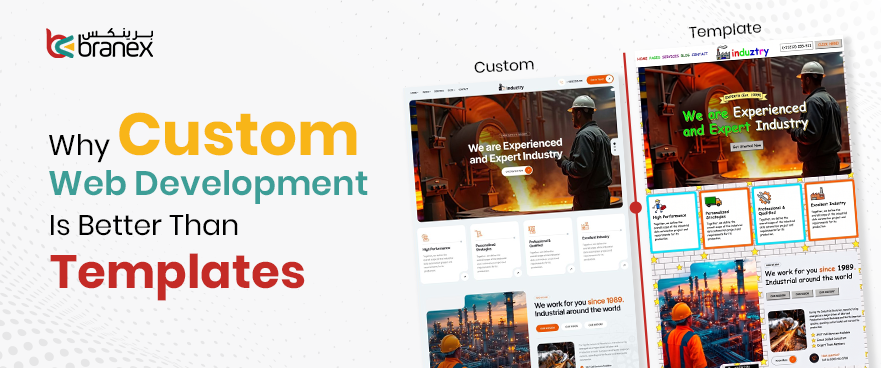
Custom Web Development vs. Website Templates
The best choice depends on your business goals, timeline, and long-term growth strategy.
The table below compares the two approaches across the areas that matter most to business owners.
| Feature | Custom Web Development | Website Templates |
| Initial Cost | Higher upfront investment | Lower upfront cost |
| Time to Launch | 4–16 weeks depending on complexity | A few days to two weeks |
| Design | Fully tailored to your brand | Based on pre-designed layouts |
| Performance | Optimized for your exact requirements | Depends on the quality of the theme and plugins |
| SEO | Complete control over technical SEO | Strong SEO is possible but may require additional optimization |
| Scalability | Easily accommodates new features and integrations | Can become restrictive as requirements grow |
| Security | Controlled codebase with fewer unnecessary dependencies | Relies on timely updates for themes and plugins |
| Integrations | Custom APIs and enterprise system integrations | Limited to available plugins or platform capabilities |
| Maintenance | Managed according to your development roadmap | Frequent theme, plugin, and platform updates |
| Ownership | Greater control over source code and architecture | Often tied to the chosen platform’s ecosystem |
| Customization | Virtually unlimited | Limited by the template and platform |
| Long-Term ROI | Higher for growing businesses | Better suited for smaller or short-term projects |
Template or Custom Development: A Better Choice?
There’s no simple winner.
If your goal is to launch a professional website quickly with standard functionality, a template is often the most practical solution.
However, if your website is expected to support business growth, automate operations, integrate with multiple systems, or deliver unique customer experiences, custom web development becomes a strategic investment rather than simply a development choice.
Many successful businesses follow a hybrid journey, starting with a template to validate their idea and later partnering with a web development company to build a custom solution once their needs outgrow the limitations of off-the-shelf platforms.
The important thing is to choose a solution based on your business strategy, not just your current budget.
Build a Website That’s Designed to Grow Branex!
At Branex, we don’t just build websites; we create scalable digital platforms that support long-term business growth. As a leading web development company in Abu Dhabi, our team specializes in delivering custom web development solutions tailored to your unique goals, industry, and operational requirements.
FAQs
1. Is custom web development worth the investment?
Yes, custom web development is often worth the investment for businesses that need a scalable, high-performing website tailored to their unique goals. While the initial cost may be higher than using a template, a custom website offers greater flexibility and better performance.
2. What is the difference between custom web development and template-based websites?
A template-based website uses a pre-designed layout with limited customization options, whereas a custom website is built from the ground up to meet your specific business requirements.
3. Is custom web development better for SEO?
Custom web development can provide a stronger technical SEO foundation by enabling clean code, fast-loading pages, mobile responsiveness, optimized site architecture, and structured data implementation.
4. When should a business choose custom web development over a template?
You should consider custom web development when there is a need for advanced functionality, seamless integrations, unique branding, or plans to scale over time. Moreover, if you need lead generation to support online sales, a custom solution for better long-term investment.