- Who we are
Who we are

Over 100 industry awards, accolades, and achievements showcase our quality and commitment to client success.
- Services
Services
Technologies
- On Demand App Solutions
Who we are
Trusted by 500+ active clients.
- Contact Us


 +971 52 905 2719
 info@branex.ae

A strong Google ranking does feel like a big achievement for brands.
Once your brand gets ranked on Google, you’ll eventually get more traffic. However, ever since AI overviews took over, the tables have turned.
Ask Google a question like “How do I improve my website’s SEO?” and you’ll see a detailed AI-generated answer before the traditional search results.
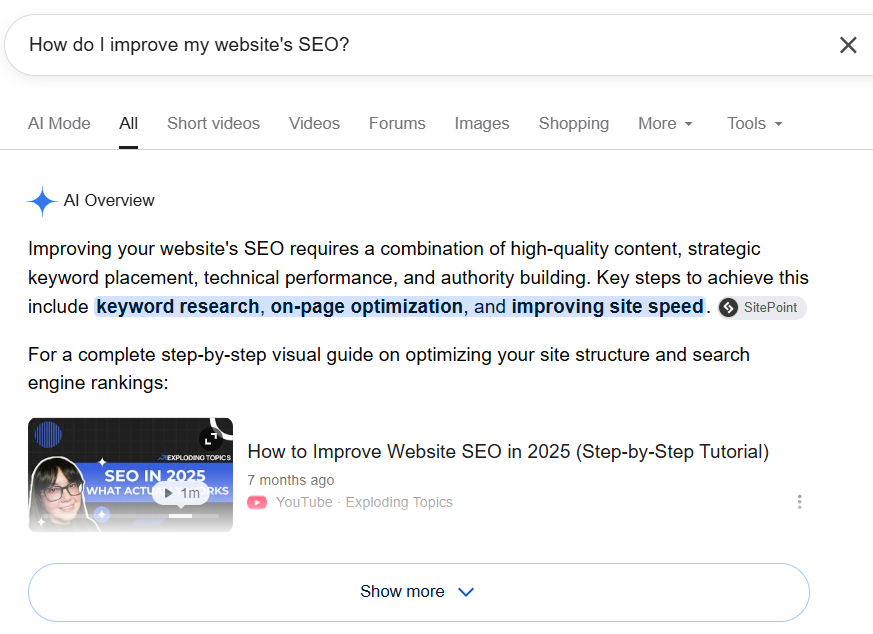
These summaries are known as Google AI Overviews. AI pulls information from multiple trusted websites and presents it in one easy-to-read response. For businesses, this changes the game. Ranking well is still important, but being cited as one of Google’s trusted sources has become more valuable.
This shift is known as AI search optimization. It is becoming an essential part of every SEO strategy. Instead of optimizing content only for ranking, brands are now focusing on Google’s AI.
It cites information that is trustworthy, understands user intent, and is credible.
So, how can you get your brand cited? Let’s break it down.
Table of Contents
What Are Google AI Overviews?
Google AI Overviews are AI-generated summaries that appear at the top of certain search results.
Powered by Google’s Gemini models, they combine information from multiple high-quality sources to answer complex questions directly on the search results page.
Unlike a Featured Snippet, which usually highlights a single webpage, AI Overviews synthesize insights from several trusted sources.
Users can still click through to the cited sources, but they often receive a comprehensive answer without needing to visit multiple pages.
For businesses, this creates both a challenge and an opportunity. While some searches may result in fewer clicks, being featured as a cited source can significantly increase your brand visibility.
AI Overviews vs. Traditional Search Results
| Feature | Traditional Organic Results | Featured Snippet | Google AI Overviews |
| Information Source | Single webpage | Single webpage | Multiple trusted websites |
| Format | List of links | Highlighted excerpt | AI-generated summary with citations |
| Best For | Direct website traffic | Quick answers | Complex, multi-step questions |
| Citation Style | Standard rankings | One source | Multiple sources |
The key takeaway is simple: Google isn’t replacing SEO. It’s changing how great content is discovered and presented.
How Google AI Overviews Generate Answers
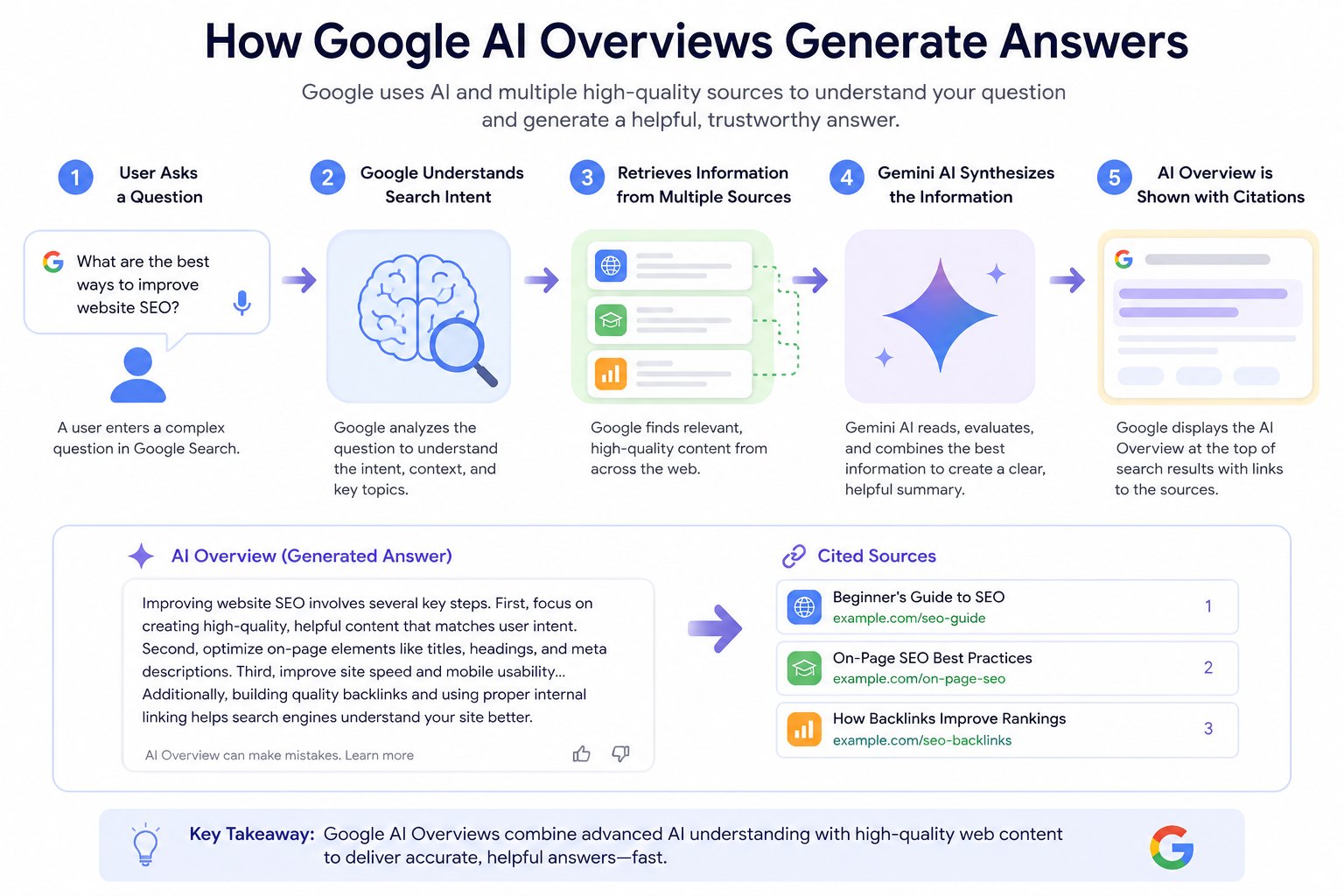
Although Google’s exact algorithm isn’t known, the process is generally as follows:
- A user asks a detailed question
- Google identifies the intent behind the search
- Its AI retrieves information from authoritative, relevant webpages
- The information is evaluated, compared, and synthesized
- Google generates a concise answer and cites supporting sources
Think of it as Google reading several articles, combining the most insightful ones, and presenting them in a single response.
That’s why keyword-focused content is becoming less effective. AI systems favor pages that provide complete, trustworthy, and well-defined answers.
Free resource: How to Build a Remarkable Brand in the Age of AI
Why Google AI Overviews Matter for SEO
AI Overviews are changing how users interact with search results, and businesses need to adapt.
Here are a few reasons why they matter:
- Greater visibility: Your brand can appear before traditional organic listings.
- Increased trust: Being cited signals that Google considers your content reliable.
- Higher-quality traffic: Users who click through are often further along in their decision-making process.
- Competitive advantage: Many businesses are still optimizing only for rankings, creating an opportunity for businesses adapting AI.
For companies investing in long-term SEO, success is no longer measured by keyword placement. Visibility within AI-generated answers is becoming equally important.
What Makes Google Choose Certain Websites?
One of the biggest misconceptions is that there is a shortcut to appear in AI Overviews. Whereas Google has consistently emphasized that its AI features rely on the same quality signals that power traditional search.
Here are the factors that matter most.
-
Helpful, People-First Content
Creating content for your readers will always put you at the top. Your content should solve a real problem rather than just integrating a keyword. The more useful your answer is, the more likely Google will reference it.
-
Strong Topical Authority
Publishing one article on SEO won’t establish you as an expert. Creating pillar topics and interlinking them while covering all the aspects will. This structures your site and signals that your website is a trusted authority.
-
Demonstrate E-E-A-T
Google not only understands the context but also values fresh and relevant content. If your content fulfills the requirements of E-E-A-T, Google will eventually reward it. Here’s what E-E-A-T stands for:
- Experience
- Expertise
- Authoritativeness
- Trustworthiness
Adding expert insights, citing reliable sources, and showcasing real-world experience all strengthen your content, making it easily citable.
-
Accurate and Updated Information
AI systems prioritize content that reflects the latest trends, statistics, and best practices. Regular updates help keep your content relevant and fresh.
-
Excellent User Experience
If a website has fast loading speeds, mobile-friendly pages, intuitive navigation, and clear formatting, all contribute to a better experience for users and search engines.
12 Proven Strategies to Rank in Google AI Overviews
1. Target Questions, Not Just Keywords
People rarely search using a single word anymore. Instead, they ask complete questions.
Rather than optimizing only for “SEO,” create content around questions like:
- How does SEO work?
- Why is SEO important?
- How can small businesses improve SEO?
- How do Google AI Overviews affect SEO?
This aligns your content with how users naturally search and how AI systems process information. To target the right questions, it’s important to look for professional SEO services UAE. Only a professional company knows how to properly conduct keyword research
2. Answer the Main Question Immediately
Don’t make readers scroll through several paragraphs before actually sharing the real answer.
Provide a clear, direct response within the first few sentences, then expand with supporting details, examples, and context.
This structure helps both readers and AI understand your content better.
3. Structure Content for Easy Reading
Well-structured content is easier for both humans and AI to interpret. Following a proper structure gives you an edge.
For a proper structure, you need:
- Descriptive headings
- Bullet points
- Numbered lists
- Comparison tables
- Short paragraphs
- Clear definitions
Organizing content helps improve engagement, making it easier for readers to find exactly what they are looking for.
4. Build Complete Topic Clusters
A single article can rarely establish authority on a competitive topic.
If your website wants to be recognized as a reliable source for SEO, for example, don’t stop at a single “SEO guide.” Build a cluster to support it.
You need to cover:
- Technical SEO
- On-page SEO
- Local SEO
- Ecommerce SEO
- Link building
- Keyword research
- Content optimization
- AI search optimization
- SEO analytics
Then interlink these pages through strategic linking.
This gives Google more context about your expertise and creates a stronger topical relationship between your content.
If you’re working with an SEO company, ask whether its strategy includes topic clusters and internal linking rather than simply producing a number of blogs every month.
5. Add Original Insights
Here’s a simple test for your next article:
If someone removed your brand name, would they know you wrote it?
If the answer is no, your content probably needs more original thinking.
AI systems can find thousands of pages saying roughly the same thing. Repeating those ideas in slightly different words doesn’t give Google enough reason to cite your website.
Instead, bring something new to the table.
You can use:
- Original research
- First-hand experience
- Customer data
- Expert interviews
- Case studies
- Surveys
- Industry observations
- Proprietary statistics
- Original examples
For instance, instead of writing “page speed is important for SEO,” show how improving page speed affected conversions on your own website.
That kind of information is much harder to replicate. Adding original information requires research.
6. Strengthen E-E-A-T Across Your Website
E-E-A-T isn’t a checklist that you have to complete overnight. It’s something your website demonstrates over time.
Start with the basics.
-
Add Author Bio
Include an author bio that explains the person’s relevant experience and expertise to make the content more relevant and authoritative.
-
Cite credible sources
When you use statistics or industry research, link back to the original source to create credibility.
-
Share real life experience
Don’t just explain what businesses should do. Show what actually happened when you implemented a strategy. Sharing real life experiences is what makes your content more trustworthy and citable.
-
Build transparent company information
An informative About Us page, contact details, editorial policies, and clear business information can all help establish trust and brand authority. For industries where accuracy matters, these signals become even more important.
7. Use Structured Data Where It Makes Sense
Schema markup helps search engines understand what your page contains. Depending on the content, you may use structured data for things such as:
- Articles
- Organizations
- Breadcrumbs
- Products
- Reviews
- Events
- Local businesses
But don’t treat schema as a shortcut into AI Overviews.
Adding structured data doesn’t guarantee that your content will appear in an AI-generated answer. It simply gives search engines additional information about your page.
Your underlying content still needs to be useful, accurate, and relevant. For structured data, it’s important to look for reliable sources.
8. Optimize for Semantic Search
Keyword stuffing becomes even less useful when search engines understand meaning rather than just matching exact wordings.
Imagine you’re writing about digital marketing.
A strong article follows a proper structure like:
Digital marketing → SEO → PPC → social media → content marketing → conversion optimization → analytics
These related concepts give Google more context about the topic.
This is a core principle of AI search optimization. Instead of asking, “How many times should I use my keyword?”, ask:
“What information the reader is actually looking for?”
This is a much better content strategy than just stuffing your content with keywords.
9. Build Authority Beyond Your Website
Your website isn’t the only place where Google learns about your brand. Think about what happens when your company is mentioned on:
- Industry publications
- News websites
- Podcasts
- Professional directories
- Partner websites
- Review platforms
- Industry events
These external signals can help establish your brand’s presence within a particular topic or industry.
This is particularly important for businesses competing in crowded markets like the UAE. A website with good content but little recognition outside its own domain may struggle to establish the same level of authority as a brand that’s consistently referenced across reputable sources.
Contact us to build brand authority and gain visibility in Google Overviews!
10. Keep Your Content Fresh
Publishing an article and forgetting about it for three years isn’t a sustainable SEO strategy.
Industries change. Statistics become outdated. Google updates its systems. New competitors publish better resources.
To compete against your competitors, it is important to keep your content updated.
For every article, it is important to check:
Are the statistics still accurate?
Have you quoted relevant examples?
Have industry recommendations changed?
Are there newer studies worth citing?
Can we add original insights?
You don’t need to rewrite an entire article every time. Sometimes replacing outdated statistics or adding a new section is enough to make it more informative.
11. Don’t Ignore Technical SEO
You can create the most insightful article on the internet, but it won’t help much if Google can’t properly access or understand your website.
Make sure your technical foundation is solid.
Your checklist should include:
- Mobile-friendly design
- Fast page loading
- Crawlable pages
- Correct indexing
- HTTPS
- Clean URL structures
- Logical internal linking
- XML sitemap
- Proper canonical tags
- Strong Core Web Vitals
Technical SEO doesn’t necessarily make your content worthy of an AI citation. But technical problems can prevent otherwise valuable content from being properly discovered and indexed.
12. Earn Relevant, High-Quality Backlinks
Links still matter.
But the goal shouldn’t be to collect hundreds of backlinks from random websites. A handful of relevant, trustworthy links can be far more valuable than a large number of low-quality ones.
Some sustainable approaches include:
- Publishing original research
- Creating useful industry resources
- Digital PR
- Expert commentary
- Data-driven content
- Industry partnerships
- Guest contributions on relevant publications
Here’s the important part: create something worth linking to first.
A genuinely useful report, study, calculator, or original resource gives other websites a reason to reference your content.
Free Resource: How to Build a Powerful Magnetic Brand Strategy that Sells?
SEO vs. AEO vs. GEO: What’s the Difference?
These three terms are often thrown around as if they’re completely separate disciplines. They’re not.
They overlap, but each focuses on a slightly different part of modern search.
| SEO | AEO | GEO |
| Search Engine Optimization | Answer Engine Optimization | Generative Engine Optimization |
| Focuses on organic visibility | Focuses on direct answers | Focuses on AI-generated responses |
| Targets traditional search engines | Targets answer-driven searches | Targets generative AI platforms |
| Emphasizes rankings and relevance | Emphasizes concise, direct answers | Emphasizes citations, authority, and context |
The smartest approach isn’t to choose one.
Your content should be built to perform across all three.
For example, a detailed article can rank organically through traditional SEO, answer specific questions for AEO, and provide useful, authoritative information that AI systems can reference through GEO.
That’s why modern AI search optimization should complement, not replace, your existing SEO strategy.
How to Measure Google AI Overview Performance
This is where things get interesting.
Traditional SEO gives you familiar metrics such as rankings, impressions, clicks, and CTR. AI search adds another layer to the picture.
Track:
- Organic rankings
- Search impressions
- Organic CTR
- Brand searches
- Referral traffic
- Conversions
- AI citations where measurable
- Visibility across AI search platforms
- Engagement from organic visitors
Google Search Console remains an important starting point for understanding your search performance.
However, AI Overview visibility isn’t always as straightforward to measure as a traditional blue-link ranking. So don’t obsess over one metric.
Instead, look at the bigger picture:
Are more people finding your brand?
Are qualified users reaching your website?
Is your organic visibility growing?
Are branded searches increasing?
Finding answers to these questions will help you create a more structured and customized brand strategy to rank your brand.
Bottom Line
Google AI Overviews have changed the search experience, but they haven’t changed the fundamental rule of SEO: be useful and relevant.
Here’s how you can rank in Google AI overviews:
- Create content that answers real questions.
- Back your claims with credible evidence.
- Show genuine expertise.
- Organize information clearly.
- Maintain the technical health of your website and update important pages as your industry evolves.
Most importantly, don’t chase every new AI-search tactic you see online.
Creating a sustainable AI search optimization strategy builds a strong foundation. Not only it reflect authority, context, and clarity, but provide real value to the readers.
Branex offers SEO services UAE to create a blend of traditional SEO tactics along with AI-focused strategies for a long-term search strategy. Get in touch to get started.