- Who we are
Who we are

Over 100 industry awards, accolades, and achievements showcase our quality and commitment to client success.
- Services
Services
Technologies
- On Demand App Solutions
Who we are
Trusted by 500+ active clients.
- Contact Us


 +971 52 905 2719
 info@branex.ae

A common saying we often hear in the age of marketing is…
Marketing is all about spending. The more budget you spend on ads and other marketing collaterals for your business, the more successful you’re going to become in scoring leads & buying business.
However, it’s not true;
Marketing is not actually about how much you’re spending, it’s about creating the conditions for other people to eagerly spread your idea.
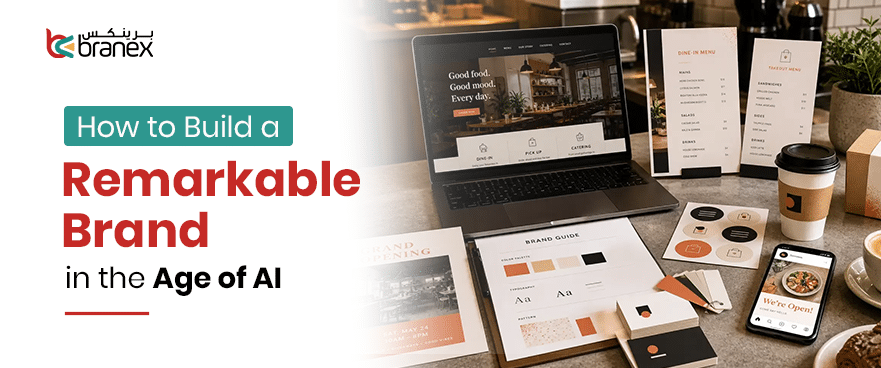
In an age of AI and hustle, we all want to build a brand that stands a class apart from the rest.
And we can definitely brag about how you can build a brand which comes off as generic yet polished just enough to satisfy AI engines and people, but we are not going to sell you that.
Actually, this article is going to take on an entirely different approach.
We are going to tell you how not to create such a brand and actually create one that’s different.
Storytelling – It’s How You Help Them Connect the Dots
Before, we discuss why brand needs a storytelling angle, here are two questions you need to ask:
- Who do you want to help your customers become?
- What are the customers hiring you to do?
These two questions are strongly related and your brand story lives in the space between them.
Remember, customers don’t just simply buy products or services, they buy a better version of themselves. They hire your functional solution to achieve an aspirational identity.
If you only tell a story about what they hire you to do, you become a replaceable commodity. But when you tell a story about who you help them become, you build an irreplaceable relationship.
Your narrative should frame the story in a way where your product does not appear as the hero, but as the catalyst that helps your customer become one while fighting their own battle.
A Brand is Not a Logo, a Brand is a Promise

Imagine if Hyat hotel tells you they are about to launch a new sneakers, we don’t have much idea what it would be like. However, if Nike says we are opening a hotel, we know exactly what it would be like.
Why? Because Nike has a brand and Hyat has a logo.
When Nike says they are opening a hotel, you can practically feel the design language before a single brick is laid. We are talking high-performance wellness centers, sleek and motivational aesthetics, cutting-edge fitness tech in the rooms, and a feeling that just staying there makes you more active. They don’t just sell rubber and foam, they sell the identity of athleticism and drive.
Hyat is an excellent hospitality chain, but its marketing revolves around the utility of accommodation. Hyat’s narrative is strongly tied to its physical service rather than a driving philosophy.
Their brand identity doesn’t stretch outside their vertical.
Brands Who Care, Are the Ones Standing Strong

Recently, I purchased a pair of glasses online for my mom because her old ones were broken. The product I received was a little off, like one lens was maybe a few mm shorter in diameter.
I just felt a bit off and placed a request for exchange.
Since it was online, I wasn’t really expecting them to respond or anything. But 20 minutes later, someone reached back and explained to me they had a conversation with their optician.
They will pick it up from my place and make it right.
So will I trust them next time? Well, of course. If I ever need glasses, these guys will be my go-to option.
When brands show up exactly as expected, it earns a micro-deposit of trust.
Now, just imagine, what if you received an automated AI response with a sequence of email guiding you to place a refund request, I guess half way down the line, you will just wish to get it over with.
Turn Yourself into a Market Driven Company
Back in 2017, I ran into my old mentor of marketing and I told him,
“I aspire to work for a marketing-driven company” and he said: “Do you want to work for a marketing-driven company, or a market-driven company?”
So I asked: “What’s the difference?” and he explained.
A marketing-driven company is run by a marketing department, whereas a market-driven company is there to serve the market.
It’s powered by the market in which you’re selling your digital products & services.
Imagine, five technically sound engineers sit together with the CEO of a company and decide to automate some of the most crucial sales & marketing tasks… What’s gonna happen?
They will fail badly. It’s because they aren’t experts in marketing.
Today, we deal with 10s of clients expressing how they shifted their entire marketing strategy to Claude rather than understanding what their customers really desired or want.
End result? They came to us asking to fix their marketing.
A Brand is Actually Built Around Its Team
Where most marketing companies are failing today is when their teams are worrying about the wrong things. Here’s what they are actually worried or more concerned about:
- What is my boss going to think?
- Will this put me in a hassle?
- Whether I am punctually doing my tasks?
- What goals do I need to achieve to get promoted?
- What metrics are we keeping track of?
When they actually need to think about is
- What are my customers’ pain points?
- How can I optimize the solution so they can receive better results?
- How can I make the product more interesting?
- What questions do we need to ask our customers to make the brand better?
If you want to build a brand, all you have to do is ask the right question.
It’s a real trap when you’re measuring the wrong thing.
Companies like Yahoo, (out of fear of meeting quarterly targets) would eyeball stock tickers all day, all 3000 employees trying to reach their target. Eventually, Yahoo failed, big time.
The Hard Truth About Building a Brand in the Age of AI
Here’s the hard truth… We all have access to Gemini, ChatGPT, Claude and other tools.
We use them everyday to design templates and create marketing frameworks. Sadly, it’s one of the reasons why many brands on the Internet pretty much sound like they are quite the same.
Branding, on the other hand, isn’t built through automation.
It’s built with intention, attention and with a goal to make customers feel better. In branding, you don’t chase trends, you set them and you consistently deliver on your promise.
While AI can help you write faster, design faster, execute faster, it cannot tell you what true value your brand should stand for. That part will still be your job.
You want to win your customer’s trust, and trust remains the one thing no algorithm can create for you.