


Quick Answer: To start an online store in the UAE, choose your products and business model, register on the mainland or in a free zone, get an e-commerce licence, build your website, connect payment gateways and delivery, and register for VAT and corporate tax where required. An experienced ecommerce development company in Dubai can handle the website, payments and launch.
Starting an online store in the UAE looks simple on paper. You find a product, build a website, add a payment option and start accepting orders.
In practice, there is more to it.
You need to decide what type of business you want to run, get the right licence and register your company. You also need to plan delivery, tax and marketing. Working with an experienced ecommerce development company in Dubai takes care of the website side, so you can focus on the business.
The good news is that you don’t need to figure everything out at once. Breaking the process into smaller decisions makes it easier to plan your budget and avoid unnecessary expenses.
Key Takeaways
- Every online store in the UAE needs a licence that covers e-commerce activity, even if you only sell through social media.
- Choose mainland or free zone setup based on where your customers are and how you will fulfil orders.
- Budget for running costs such as renewals, hosting, payment fees, delivery and marketing, not just the licence.
- Offer the payment methods UAE shoppers use most: cards, digital wallets, Buy Now Pay Later and, where it suits, cash on delivery.
- VAT registration is mandatory above AED 375,000 in taxable supplies. Corporate tax is 0% up to AED 375,000 and 9% above it.
Table of Contents
How to Start an Online Store in the UAE: A Quick Checklist
Here is a quick overview of the main steps involved in starting an online store in the UAE:
- Research the UAE market and decide what products you want to sell.
- Choose an e-commerce business model, such as holding inventory or dropshipping.
- Decide whether to register your business on the mainland or in a free zone.
- Get an appropriate commercial or e-commerce licence.
- Build your online store and upload your product catalogue.
- Integrate payment gateways and arrange delivery services.
- Understand your VAT, corporate tax and other compliance responsibilities.
- Test your website, prepare your marketing campaigns and launch.
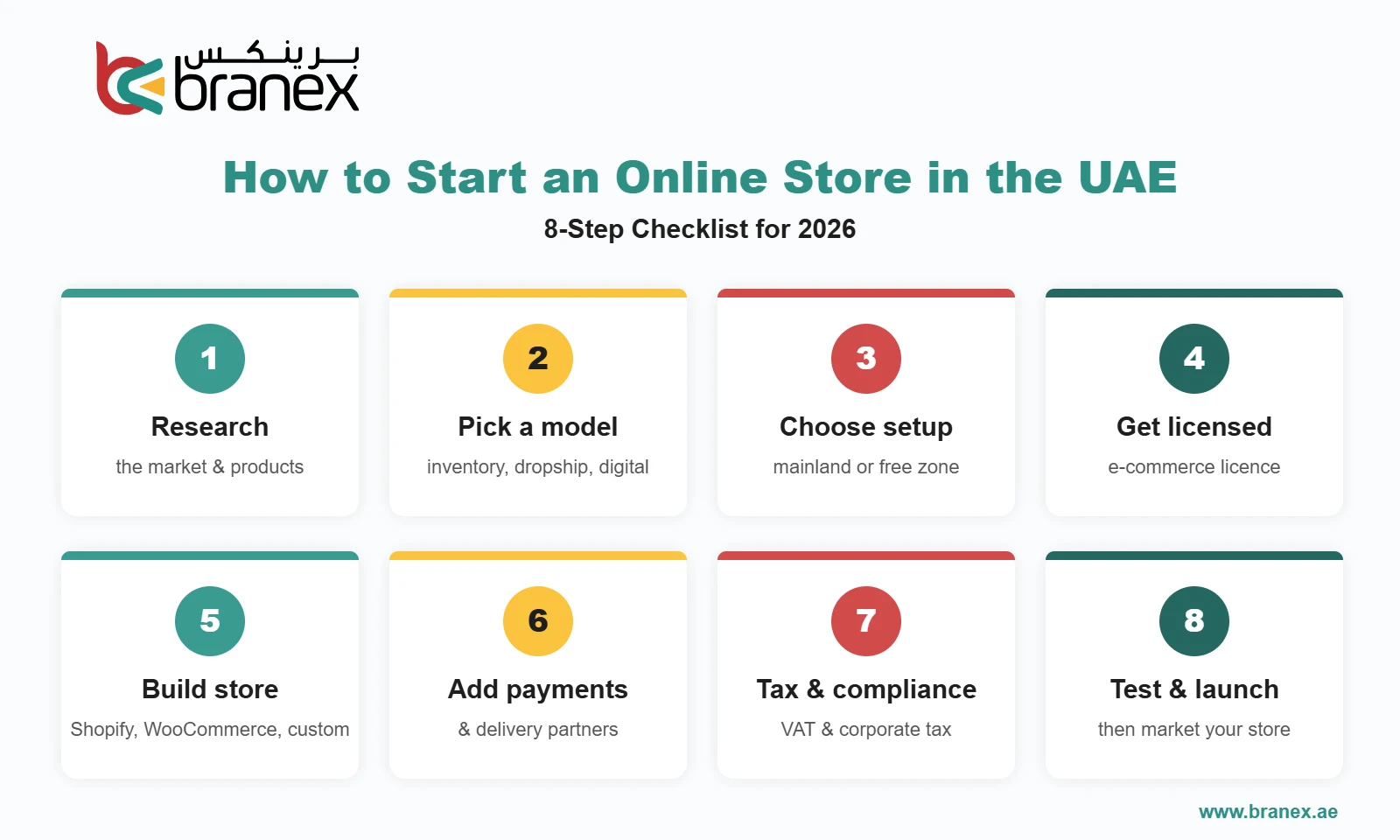
Each step involves decisions that affect your initial investment and day-to-day operations. Let’s look at each one in depth.
1. Find a Product and Business Idea That Makes Sense
Before spending money on a website, work out what your online store in the UAE will actually sell.
The UAE has a diverse customer base with different shopping habits, budgets and product preferences. An online store in the UAE selling luxury skincare will have different requirements from one offering affordable home accessories or electronic gadgets.
Start by researching the market:
Look for products people are already buying
Good market research puts you ahead. Explore popular categories such as fashion, beauty, electronics, home furnishings, groceries and personal care. Check marketplaces, social media discussions, customer reviews and competitor websites to understand what people are looking for.
Check what your competitors are offering
Look beyond their product ranges. Compare pricing, delivery charges, return policies, product presentation and customer reviews. Negative reviews are especially useful because they reveal problems your online store in the UAE could solve.
“Your most unhappy customers are your greatest source of learning.”
— Bill Gates, co-founder of Microsoft
Think about your target customers
Your target customers are probably UAE residents, tourists and business owners. Consider their purchasing power, preferred payment methods and delivery expectations.
Check whether your products have extra requirements
Some products, including certain food, cosmetics, healthcare and regulated goods, may need approvals or registrations before you can sell them. Check the requirements with the relevant authority before committing to suppliers or inventory.
2. Choose an E-commerce Business Model
The business model behind your online store in the UAE determines how you source products, manage stock, process orders and handle deliveries. It also affects how much money you need before opening your store.
Here are four common options.
| Business model | How it works | Main consideration |
|---|---|---|
| Inventory-based | You purchase and store products before selling them. | Requires investment in stock and storage. |
| Dropshipping | A supplier ships products directly to customers after an order. | Depends heavily on supplier reliability and delivery times. |
| Print-on-demand | Products are manufactured or customised after an order. | Suitable for personalised merchandise and niche products. |
| Digital products | You sell downloadable products, subscriptions or online resources. | Requires a suitable digital delivery and payment system. |
Which one should you choose?
If you want control over product quality, packaging and delivery, holding inventory may be a better fit. If you want to test demand without buying large quantities of stock, dropshipping could be worth considering.
Digital products are another option if you have something customers can buy and access online. Popular digital products include templates, courses and downloadable resources.
Don’t choose a model simply because it promises low startup costs. Look at profit margins, customer expectations and how much control you will have over the buying experience.
3. Decide Between Mainland and Free Zone Business Setup
Once you have a business idea and operating model, you need to decide where to register the company behind your online store in the UAE.
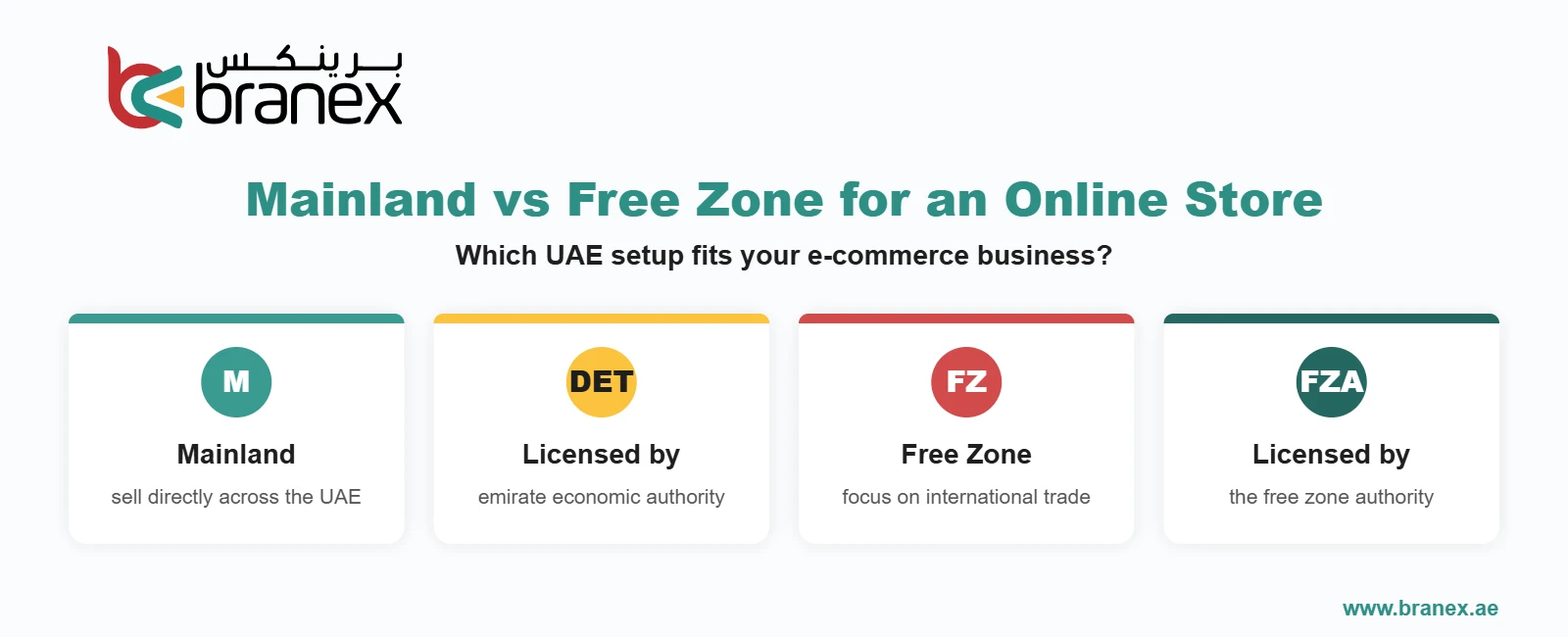
In the UAE, entrepreneurs generally consider two options: mainland and free zone registration. Both allow you to run an online store in the UAE, but they have different licensing authorities, costs and operating conditions.
Setting up a mainland e-commerce business
Mainland businesses are licensed by the relevant emirate’s economic authority. In Dubai, this is the Department of Economy and Tourism (DET).
A mainland setup may suit businesses that want to sell directly to UAE customers, work with local suppliers or build a broader local presence.
You need to select the appropriate business activity and obtain a commercial licence that permits e-commerce operations.
Setting up a free zone e-commerce business
Free zones offer specialised licences and packages for online trading, digital businesses and international commerce.
Depending on the authority and package, businesses may get access to office facilities, warehouse space, visa services and other administrative support.
Free zone registration can suit businesses focused on international customers, re-exports or operations within a particular free zone.
Mainland vs Free Zone: Which Should You Choose?
| Factor | Mainland | Free zone |
|---|---|---|
| Licensing authority | Emirate’s economic department | Relevant free zone authority |
| Business activities | Based on approved activities | Based on the free zone’s permitted activities |
| Local UAE sales | Subject to the licence and applicable rules | May require additional arrangements |
| International trade | Subject to applicable regulations | Suitable for international trade and re-exports |
| Office requirements | Depend on the activity and authority | Often includes flexible workspace options |
| Setup costs | Vary by emirate and requirements | Vary by free zone and package |
No single option works for every online store in the UAE. Consider where your customers are, how you plan to fulfil orders and whether you need a physical office or warehouse.
If most of your customers will be in the UAE, examine the mainland route carefully. If you’re building a business around international sales, compare free zones that support your product category and logistics needs.
4. Obtain the Right E-commerce Licence in the UAE
You have a business idea and know where you want to register. Now you need permission to operate your online store in the UAE.
An e-commerce licence allows a business to carry out approved commercial activities through digital channels. The specific licence and activity depend on what you’re selling and which authority registers your company.
In other words, selling through Instagram or another social platform doesn’t remove your licensing responsibilities.
What documents do you need?
Licence requirements for an online store in the UAE vary between mainland authorities and free zones, but you may be asked for:
- Passport copies of owners and shareholders
- Proposed company or trade name
- Details of the intended business activity
- Shareholder and company information
- Initial approval, where applicable
- Memorandum of Association, depending on the legal structure
- Office or facility documents, where required
- Additional approvals for regulated activities
How to Register Your E-commerce Business
The process generally follows these steps:
- Choose your business activity: Identify the products or services you intend to sell and confirm that the activity is permitted.
- Select your jurisdiction: Decide whether mainland or free zone registration better suits your business.
- Reserve your trade name: Submit a proposed name that meets the relevant authority’s requirements.
- Apply for initial approval: Obtain the approval needed to proceed with registration.
- Submit your documents: Provide the required shareholder, company and premises information.
- Obtain additional approvals: Complete any product-specific or activity-related approvals.
- Pay the fees and receive your licence: Once the application is approved, the authority issues your business licence.
Ready to Launch Your Online Store?
Get your licence sorted, and let our team build a fast, secure store that is ready to sell from day one.
5. How Much Does It Cost to Start an Online Store in the UAE?
There is no fixed price for launching an online store in the UAE. A small dropshipping business and an inventory-based store with a warehouse will have very different budgets.
When budgeting for an online store in the UAE, instead of focusing only on the licence fee, account for every expense involved in setting up and running the business.
| Expense | What you need to budget for |
|---|---|
| Business licence | Initial issuance and annual renewal |
| Company registration | Trade name, registration and administrative fees |
| Office or workspace | Flexi-desk, office or warehouse rental |
| Visa expenses | Establishment, visa and immigration charges |
| Website development | Design, development and required functionality |
| Domain and hosting | Website address, hosting and related services |
| Payment gateway | Setup and transaction fees |
| Inventory | Product purchases, packaging and storage |
| Shipping | Courier charges and fulfilment |
| Marketing | SEO, paid advertising and social media |
| Accounting | Bookkeeping, tax registration and compliance support |
Read more: Ecommerce Website Development Cost in Dubai: 2026 Pricing Breakdown
What Affects Your Startup Budget?
- Your business licence: Mainland and free zone authorities have different licence fees, packages and requirements.
- The number of visas: Immigration and visa costs depend on how many employees or owners need visas.
- Your website requirements: A simple store with a standard theme costs less than a custom e-commerce platform with advanced features. Our comparison of custom vs template websites explains the trade-offs.
- Your inventory arrangements: Buying and storing products needs more upfront investment than supplier-managed or digital-product models.
- Your marketing plans: Advertising, content production and influencer collaborations need their own budgets.
One point worth remembering: your setup budget is not the same as your operating budget. Licence renewals, hosting, payment processing, delivery and marketing continue to cost money long after your online store in the UAE is live.
6. Build an Online Store in the UAE That Makes Shopping Easy
Your website is where customers of an online store in the UAE browse products, compare prices and decide whether to buy. It needs to do more than display a catalogue.
A store can have excellent products and competitive prices, but a confusing checkout or poor mobile experience will still cost you sales. This is where a reliable ecommerce development company in Dubai adds real value. If you’re comparing partners, these questions to ask a web design company in Dubai will help.
The first decision is choosing how to build your online store in the UAE.
Which E-commerce Platform Should You Use?
Shopify
Shopify is a hosted e-commerce platform with ready-made themes, product management, checkout functionality and a wide range of integrations. It suits businesses that want to launch without managing their own hosting.
WooCommerce
WooCommerce is an e-commerce plugin for WordPress. It gives you greater control over design, content and store functionality, but hosting, maintenance, security and updates need to be managed. Our WordPress development services cover WooCommerce stores of every size.
Custom e-commerce development
A custom-built store may be the right choice if your business needs specific features, complex product configurations, custom integrations or a checkout process that standard platforms can’t support easily. Learn more about our custom web development services.
Read more: Web Design Cost in Dubai (2026): Complete Pricing Guide
What Should Your Online Store Include?
As a startup, every online store in the UAE should focus on these core features.
- Responsive design: Your website should work properly on mobile phones, tablets and desktops. Here’s why responsive web design matters.
- Clear navigation: Organise products into categories customers understand.
- Product pages: Include accurate descriptions, prices, images, sizes and other relevant details.
- Search and filters: Help customers find products without scrolling through the entire catalogue.
- Shopping cart: Make it easy to review products, change quantities and check the order total.
- Secure checkout: Keep the purchase process simple and protect payment information.
- Order management: Track purchases, stock levels, shipping and customer orders.
- Customer support: Provide accessible contact details and clear ways to ask questions.
- SEO features: Use search-friendly URLs, page titles, descriptions and structured product information.
If you’re targeting customers across the UAE, Arabic and English language options are worth considering. See our guide to bilingual website design in the UAE for best practices.
Need a Store That Converts?
Let Branex be your ecommerce development company in Dubai. We build Shopify, WooCommerce and custom stores with Arabic and English support.
7. Set Up Easy Payment Gateways for Convenience
Imagine a customer finds exactly what they want. An easy checkout makes it far more likely they will complete the purchase.
This small convenience reduces abandoned carts and generates more sales.
Your online store in the UAE should support payment methods that make sense for your customers and business model.
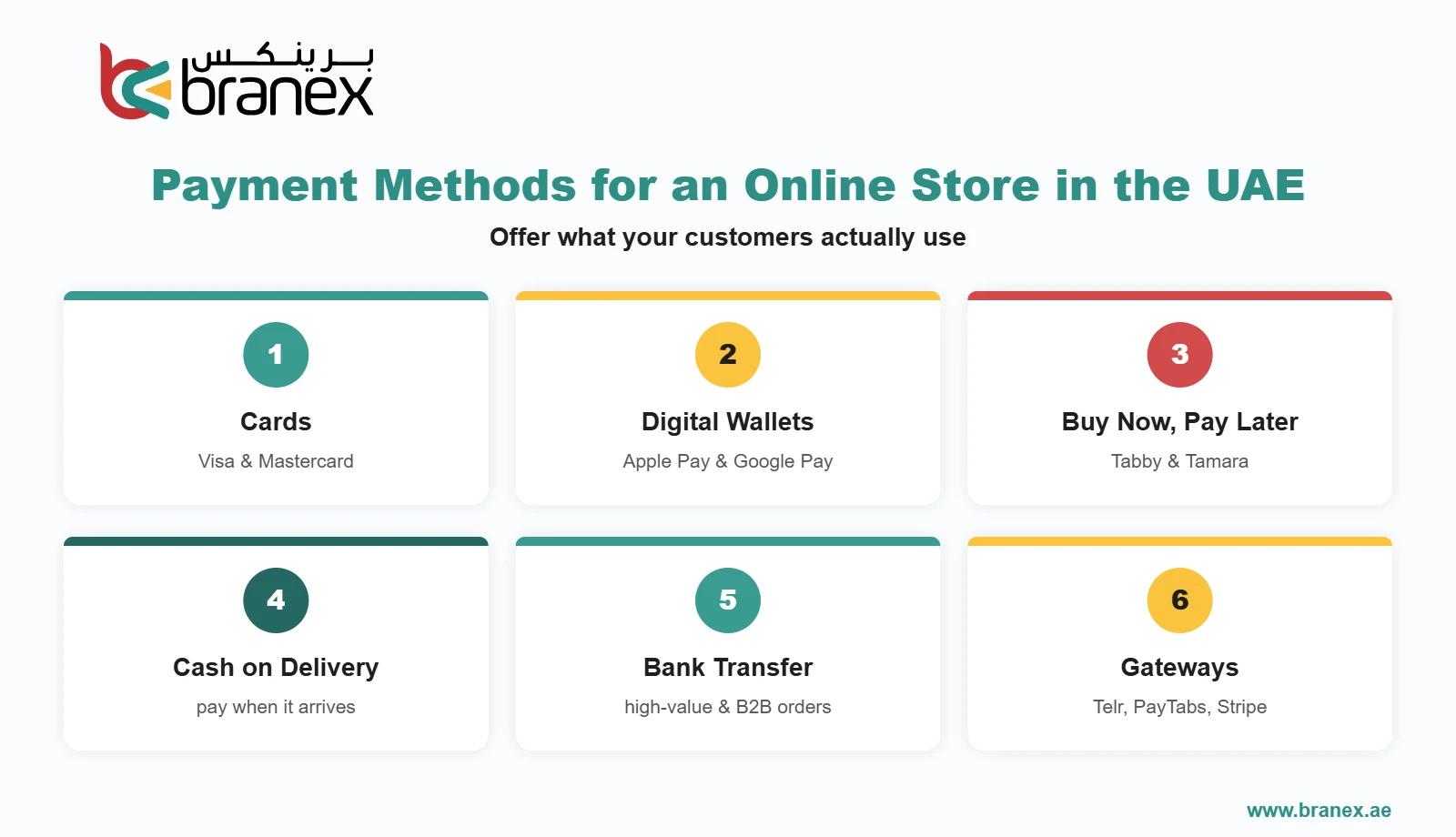
Which Payment Methods Should You Offer?
- Credit and debit cards: Visa and Mastercard are widely used for online transactions.
- Digital wallets: Options like Apple Pay and Google Pay let customers pay using supported devices and accounts.
- Buy Now, Pay Later: Services such as Tabby and Tamara let eligible customers split payments, subject to provider approval and merchant terms.
- Cash on Delivery: Some customers prefer paying when their order arrives. This can be useful for certain product categories, although it increases the risk of refused deliveries.
- Bank transfers: These may suit high-value orders or business-to-business purchases.
You don’t need to offer every payment option from day one. Start with the methods your customers are most likely to use.
How Do You Choose a Payment Gateway?
Payment gateways connect your website’s checkout to the payment processing system. Before selecting a provider, compare:
- Transaction fees: Check the percentage and fixed fee charged per transaction.
- Supported currencies: Make sure the provider supports the currencies you plan to sell in.
- Settlement periods: Understand how long it takes for payments to reach your business account.
- Platform compatibility: Confirm that the gateway integrates with your website platform.
- Security: Check its fraud detection, authentication and payment security features.
- Refund handling: Understand how refunds, chargebacks and disputed transactions are managed.
Providers such as Telr, PayTabs, Stripe and Amazon Payment Services are worth comparing. Check current UAE merchant eligibility and account requirements before you apply.
8. Arrange Shipping, Delivery and Order Fulfilment
Your job isn’t finished when a customer clicks the payment button. You still need to get the order to the right address, on time and in good condition.
Start by deciding how your online store in the UAE will handle fulfilment.
If you hold inventory, you can pack and dispatch orders yourself or work with a third-party logistics (3PL) provider. If you use dropshipping, your supplier may manage storage and shipping.
When comparing courier companies, look at:
- Delivery coverage across the UAE
- Same-day and next-day delivery options
- Shipping rates and additional charges
- Cash on Delivery support, if required
- Shipment tracking
- Returns and reverse logistics
- Handling of damaged or undelivered orders
Your delivery policy should also be easy to find.
Clearly explain delivery charges, estimated delivery times, return conditions, exchange procedures and refund timelines. Customers shouldn’t have to contact your support team just to find out whether they can return an item.
9. Understand VAT, Corporate Tax and Other Legal Requirements
Getting a business licence is an important step, but it isn’t the end of your compliance responsibilities.
Every online store in the UAE must also understand its tax obligations and consumer-facing responsibilities.
VAT registration
The UAE applies a standard VAT rate of 5% to taxable supplies.
VAT registration is mandatory when a UAE-based business’s taxable supplies and imports exceed AED 375,000 over the previous 12 months, or are expected to exceed that amount within the next 30 days.
Voluntary registration is available once the threshold of AED 187,500 is met.
If your business is VAT-registered, you must account for VAT correctly, issue the required tax invoices and submit VAT returns. You can find official guidance on the UAE Federal Tax Authority website.
Corporate tax
UAE corporate tax applies to businesses within its scope. The standard rates are:
- 0% on taxable income up to AED 375,000
- 9% on taxable income above AED 375,000
Free zone companies are not automatically exempt from corporate tax. A Qualifying Free Zone Person may benefit from the 0% rate on qualifying income if it meets the relevant conditions.
Other taxable income may be subject to the standard corporate tax rate. Businesses should also check their registration, record-keeping and filing responsibilities.
Other compliance requirements
Your online store in the UAE should also account for:
- Accurate product descriptions and pricing
- Clear terms and conditions
- Customer privacy and data protection
- Transparent refund and return policies
- Digital invoices for transactions
- Additional approvals for regulated products
- Applicable rules on advertising, promotions and direct marketing
The UAE’s e-commerce framework requires online traders to provide accurate information, protect customer data and sell only permitted products. These rules apply to websites and other digital sales channels.
10. Test Your Online Store in the UAE Before Launching
You’ve obtained the licence, built the website and connected your payment gateway. Before announcing the launch of your online store in the UAE, place a few test orders.
It is much easier to catch a checkout error before real customers start using the store.
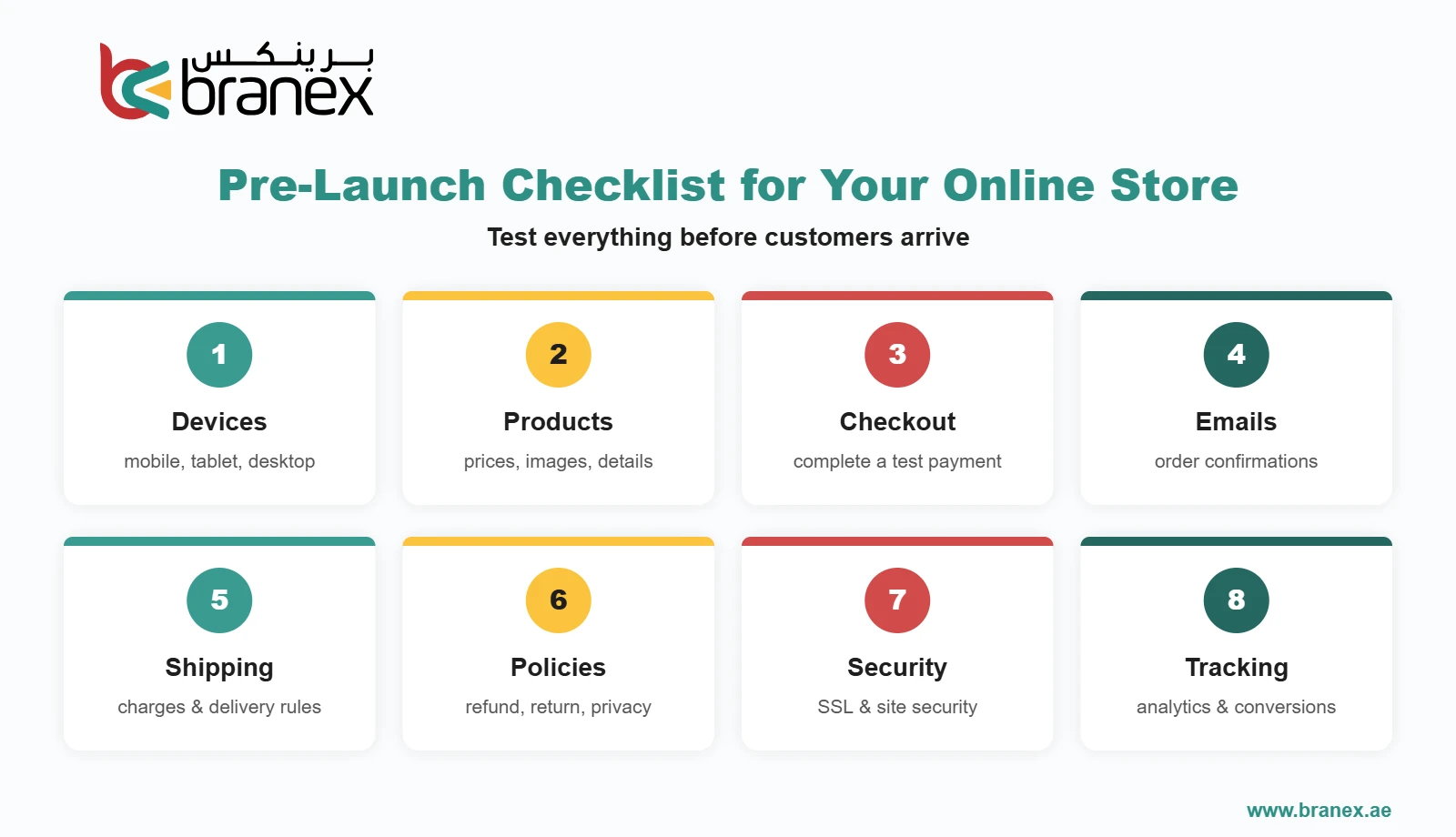
Use this checklist:
- Test the website on mobile, tablet and desktop
- Check product prices, descriptions and images
- Test the search, filters and shopping cart
- Complete a test payment
- Check order confirmation emails and notifications
- Verify shipping charges and delivery settings
- Review the refund, return and privacy policies
- Check website security and SSL certification
- Verify customer support contact information
- Set up website analytics and conversion tracking
Also check what happens when a payment fails, a product goes out of stock or a customer asks for a refund. These situations are a normal part of running an online store, not rare exceptions.
11. Bring Customers to Your Online Store in the UAE
A website going live doesn’t mean customers will automatically find it. You need to give people a reason to visit, browse and buy.
Start with a few marketing channels that match your online store in the UAE and its audience. A digital marketing agency in Dubai can help you plan and run them.
- Invest in SEO: Optimise product and category pages around the terms customers use when searching. Publish useful blog content that answers common buying questions.
- Use Google Ads: Paid search campaigns help you reach people actively looking for your products. Start with a manageable budget and monitor your cost per customer. These PPC marketing trends in Dubai are a good starting point.
- Build a social media presence: Instagram and TikTok work well for visually appealing products. Use product demos, customer feedback and helpful content rather than relying only on promotional posts.
- Work with relevant influencers: A creator whose audience matches your target customers may bring more relevant traffic than someone with a larger but unrelated following.
- Stay connected with existing customers: Email and WhatsApp help you share new arrivals, order updates and special offers, as long as you follow consent and marketing rules.
You don’t need every channel immediately. Find out where your customers spend time and focus your initial efforts there. If you’re planning the budget, see how much a digital marketing agency costs in Dubai.
Read more: Top 10 SEO Agencies in UAE That Deliver Real Results
FAQs About Starting an Online Store in the UAE
Final Word
Starting an online store in the UAE involves several decisions, but it doesn’t have to be complicated. Begin with a clear product idea, choose a business model that fits your budget and register under the right licence.
Then give the website of your online store in the UAE the attention it deserves. Customers should be able to find products, understand what they’re buying, pay securely and receive their orders without hassle.
Let’s Build Your Online Store in the UAE
Partner with Branex, a trusted ecommerce development company in Dubai. We build stores that do more than list products. They give customers a reason to buy.