- Who we are
Who we are

Over 100 industry awards, accolades, and achievements showcase our quality and commitment to client success.
- Services
Services
Technologies
- On Demand App Solutions
Who we are
Trusted by 500+ active clients.
- Contact Us


 +971 52 905 2719
 info@branex.ae
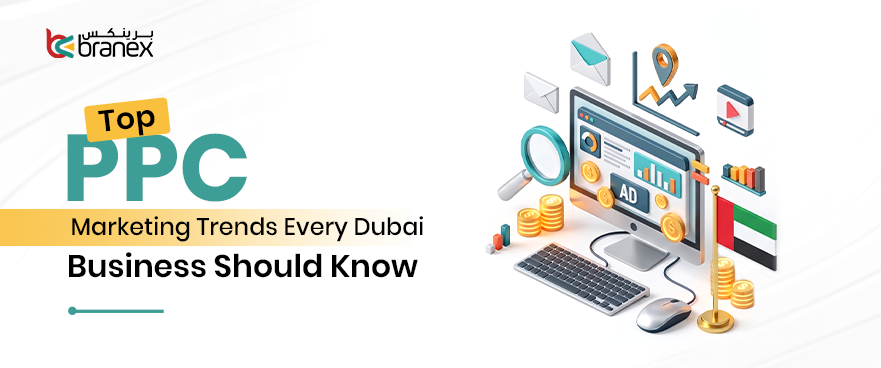
If your cost-per-click is climbing faster than you could ever think it needs to be fixed.
Running a PPC advertising in Dubai today is more than just bidding for keywords. Ever since the AI shift took place it is getting more competitive to scale a business.
PPC is not a checklist that you can complete and forget about. To turn paid search from a campgai into a predictable revenue engine, you need more than standard tactics, you need a modern blueprint built for the UAE’s unique digital ecosystem.
A PPC campaign that worked in Dubai 12 months ago may not work the same way today.
Let’s unlock PPC marketing trends that every business in Dubai to create a PPC campaign that generate real revenue.
Table of Contents
Trend #1: AI and “Keyword-Less” Search Are Changing Google Ads
For years, PPC managers built campaigns around huge list of keywords.
A business selling office space might create separate ad groups for:
- office for rent Dubai
- office space Dubai
- serviced offices Dubai
- furnished office Dubai
- office for rent Business Bay
That approach still has a place, but particularly for high intent keywords. But Google is moving beyond the idea that every useful search needs to be explicitly entered as a keyword.
Its latest AI Max for Search campaigns can expand search-term matching using broad match, landing-page content and keywordless technology. It can also customize ad assets and use Final URL Expansion to direct users to pages that better match their searches.
Performance Max takes the idea further by allowing campaigns to access Search, YouTube, Display, Discover, Gmail and Maps from one campaign while optimizing toward the advertiser’s selected goal.
Why this matters in Dubai
Dubai’s search behaviour is unusually varied.
The same buyer might search:
“luxury apartment Dubai”
and later:
“2 bedroom apartment Palm Jumeirah sea view”
Another customer may use voice search:
“Find a digital marketing agency near me in Dubai.”
A rigid keyword list can miss some of those variations.
That is where broader intent-based matching can help.
But there is a catch: giving Google more freedom makes your campaign inputs more important, not less.
If your website talks about ten different services, your conversion tracking counts every form submission as a lead and your location targeting covers the entire UAE, automation has plenty of room to make expensive assumptions.
What to do
Before expanding into AI-driven targeting:
- Clean your conversion actions.
- Separate valuable conversions from low-value enquiries.
- Give Google strong landing pages to work with.
- Build negative keyword lists around obvious irrelevant searches.
- Use brand controls and exclusions where necessary.
- Review search-term and asset-level performance regularly.
- Feed qualified-lead or revenue data back into the account where possible.
For a luxury real estate brand, for example, automation should not become an excuse to appear against every vaguely related property search.
Use automation to expand a good campaign, not to compensate for a badly structured one.
Want to automate your marketing campaign and drive more conversions?
Get in touch with our expert PPC team today.
Trend #2: Hyper-Localization and Multicultural Targeting Are Becoming Essential
“Target Dubai” sounds specific.
For many businesses, it isn’t.
Dubai contains dozens of distinct commercial and residential areas, and customer intent can change dramatically from one location to another.
A restaurant targeting tourists around Downtown Dubai has a different audience from a clinic serving residents in Jumeirah. A B2B company operating from Dubai Internet City may have little reason to spend heavily on searches coming from areas outside its sales territory.
This makes hyper-local PPC targeting increasingly important.
Start thinking beyond the city name
Depending on the business, campaign segmentation goes beyond than just adding a city name. As a business owner it’s important to understand business niche and focusing on the right :
| Business | Useful location focus |
| Restaurant | Downtown, Marina, JBR, nearby residential areas |
| Real estate | Property-specific communities |
| Home services | Actual service radius |
| Retail | Store catchment area |
| B2B services | Business districts and relevant commercial areas |
| Healthcare | Clinic catchment areas |
| Hospitality | Tourist-heavy locations and hotel clusters |
Google’s current Search capabilities also provide more granular controls around geographic intent, including location-of-interest controls within AI Max.
Then there is language
Dubai’s customer base is multicultural. English may be the practical language for one campaign, while Arabic should be central to another.
But translating an English ad word-for-word into Arabic isn’t a localization strategy.
The wording, offer, terminology and even the way a benefit is presented should reflect the audience.
For example, a campaign targeting Arabic-speaking consumers should have Arabic landing-page content rather than an English page with an Arabic headline pasted on top.
The same applies to creative.
A better Dubai targeting structure
Instead of:
One campaign → Dubai → everyone
consider:
Campaign → customer segment → relevant locations → relevant language → relevant offer
Then compare actual business outcomes.
A physical retailer might discover that customers within a few kilometres of its branches generate the strongest returns. A real estate company might find that community-specific campaigns outperform generic “Dubai property” campaigns.
Don’t assume.
Analyze the account data to show you where the valuable demand is.
Trend #3: Privacy-First Tracking Is Making First-Party Data More Valuable
There was a time when marketers could rely heavily on browser cookies and platform pixels to understand what happened after an ad click.
That model is under pressure.
At the same time, advertising platforms increasingly need advertisers to provide stronger first-party signals to understand what happens beyond the initial website interaction.
This matters enormously for lead-generation businesses.
Imagine someone clicks a Google ad for a Dubai software company and fills out a form.
Google sees:
Click → Form submission
But the sales team knows:
Form submission → Unqualified → Lost
or:
Form submission → Qualified → Sales call → AED 40,000 contract
Those are very different outcomes.
Google’s own guidance now recommends enhanced conversion measurement and CRM/offline data for advertisers trying to improve lead quality. It specifically recommends using meaningful stages such as qualified leads, converted leads, booked appointments or quote requests as conversion goals where appropriate.
What Dubai businesses should build
Your data loop should look more like:
Ad click → Website/WhatsApp → Lead → CRM → Qualified lead → Sale → Revenue
rather than stopping at the form.
For larger organisations, server-side measurement and tools such as Google Tag Manager Server-Side and Meta’s Conversions API can form part of that measurement architecture.
Meta’s Conversions API is designed to send web, app and offline events from a server rather than relying solely on browser-based tracking.
But technology alone doesn’t solve the problem.
The real advantage comes from knowing which customer actions matter and passing those signals back into your advertising platforms responsibly and with appropriate consent.
Build first-party data intentionally
Useful sources can include:
- Customer lists
- CRM records
- Purchase history
- Website enquiries
- WhatsApp conversations
- Appointment bookings
- Newsletter sign-ups
- Preference forms
- Product quizzes
- Downloadable guides
For a Dubai property company, for example, “downloaded brochure” is useful.
But “booked viewing” is considerably more valuable.
Your PPC setup should eventually know the difference.
Trend #4: Social Commerce Is Turning Paid Social Into a Sales Channel
Dubai’s consumers are already deeply connected to mobile and social platforms.
This changes the whole dynamics of social platforms.
Instagram and TikTok are not necessarily just places where a customer first discovers a product.
They can be part of the buying journey.
A fashion brand, beauty retailer or consumer electronics store can direct someone from:
Video → Product → Consideration → Purchase
without relying on a long traditional funnel.
Product catalogues should be connected to advertising
For ecommerce businesses, product feeds and catalogues allow platforms to understand what is actually available for sale.
That creates opportunities for:
- Product-focused ads
- Dynamic retargeting
- Product recommendations
- Collection formats
- Catalogue campaigns
- Social-first promotions
But the creative matters just as much as the catalogue.
A polished 30-second corporate commercial isn’t automatically the best-performing ecommerce ad.
In many categories, a simple video showing:
Problem → Product → Demonstration → Result
can be more useful.
Think:
“Here’s how this skincare product looks after seven days.”
rather than:
“Introducing our revolutionary skincare collection.”
The first gives the viewer something to evaluate.
What to test
For Dubai ecommerce campaigns, test:
- UGC-style videos
- Founder videos
- Product demonstrations
- Customer reviews
- Before-and-after formats where appropriate
- Short product comparisons
- Creator collaborations
- Arabic and English creative variations
Then judge them on purchases and revenue, not just views or likes.
Read more: Graphic Design Trends in UAE 2026
Trend #5: WhatsApp Is Becoming Part of the Paid Lead Funnel
For many Dubai businesses, the biggest problem with paid advertising isn’t generating the click.
It’s what happens after the click.
A prospect clicks an ad.
The website loads.
They scroll.
They find the form.
They fill it in.
Then they wait for someone to call.
For high-consideration purchases, that delay can create unnecessary friction.
Click-to-WhatsApp advertising offers a different route.
Meta and WhatsApp officially support ads on Facebook and Instagram that open a WhatsApp conversation directly with the business. The format can be used for lead generation, sales and customer interactions, with measurement options including Meta Pixel, Conversions API and offline conversions.
That is particularly relevant to Dubai categories where customers naturally want to ask questions before buying.
Think:
- Real estate
- Automotive
- Clinics
- Education
- Travel
- Events
- Home services
- Marketing agencies
- Luxury products
- Professional services
But don’t confuse “message” with “lead”
This is where many WhatsApp campaigns go wrong.
A WhatsApp conversation isn’t automatically a qualified enquiry.
Build a simple qualification flow.
For example:
Ad
↓
“Hi, I’m interested in a 2-bedroom apartment in Dubai Marina.”
↓
Automated response
“Great. Are you looking to buy or rent?”
↓
Qualification
Budget / preferred location / timeline
↓
Sales representative
Personal follow-up
↓
CRM
Lead status + source + value
Meta supports Click-to-WhatsApp campaigns and WhatsApp Flows can also be used in eligible setups to collect information or guide users through actions such as appointment booking.
The important part is the handoff.
If someone messages at 10:00 a.m. and receives the first meaningful response at 6:00 p.m., the technology hasn’t solved the sales problem.
Fast response is part of the PPC strategy.
Budget Optimization: How to Deal With Rising CPCs in Competitive Dubai Niches
You don’t need to win every auction.
That is an important distinction in expensive PPC markets.
Real estate, financial services, healthcare, hospitality and professional services can attract valuable search traffic, and expensive competition.
The wrong response is often:
“Our CPC is increasing. We need to increase the budget.”
The better question is:
“Which searches are producing enough commercial value to justify the CPC?”
Move from click economics to customer economics
Suppose a campaign produces:
| Metric | Campaign A | Campaign B |
| Clicks | 1,000 | 500 |
| Average CPC | AED 8 | AED 15 |
| Leads | 70 | 40 |
| Qualified leads | 8 | 18 |
| Customers | 2 | 7 |
| Customer value | AED 20,000 | AED 105,000 |
Campaign B looks more expensive at the click level.
It may be dramatically stronger at the business level.
That is why Google continues to expand value-based bidding. Its current documentation describes value-based bidding as optimizing toward conversion value rather than simply maximizing conversion volume, with Target ROAS available when advertisers have a defined return target.
For ecommerce, that can mean feeding actual purchase values into campaigns.
For lead generation, it means moving toward meaningful lead stages and assigning sensible values.
Don’t jump into Target ROAS blindly
Google recommends having multiple distinct conversion values and enough reliable value data before adopting value-based bidding. It also recommends uploading value data consistently before making the switch.
So the progression should be:
Accurate tracking
→ Reliable conversion data
→ Qualified-lead/revenue values
→ Value-based bidding
→ Budget expansion
Not:
New campaign
→ Target ROAS
→ Hope
Where should the budget go?
A practical Dubai PPC account might divide investment across:
High-intent Search
Capture people actively looking for the product or service.
Remarketing
Bring back visitors who already showed interest.
Performance Max / broader campaigns
Find additional demand once enough reliable conversion information exists.
Social prospecting
Create demand and introduce products to relevant audiences.
The exact split should depend on the business and historical performance
Your 90-Day PPC Action Plan
You don’t need to rebuild your entire account tomorrow.
Use the next 90 days to make the campaign more commercially useful.
Days 1–30: Fix the Foundation
Audit:
- Conversion tracking
- Search terms
- Location settings
- Negative keywords
- Landing pages
- Mobile experience
- Lead quality
- CRM attribution
- WhatsApp response process
Remove conversions that tell the advertising platform the wrong story.
Days 31–60: Test the New Opportunities
Choose the trends that actually fit your business.
For example:
B2B company:
First-party CRM data + qualified-lead tracking + Search expansion
Real estate:
Community-level targeting + WhatsApp + lead qualification
Ecommerce:
Product catalogue + short-form video + value-based optimization
Local business:
Neighbourhood targeting + mobile ads + WhatsApp enquiries
Don’t activate every new feature at once.
Run controlled tests so you know what changed.
Days 61–90: Scale What Produces Business Value
Now compare:
- Cost per qualified lead
- Customer acquisition cost
- Revenue
- ROAS
- Lead-to-sale rate
- Location performance
- Creative performance
- Search-term quality
- WhatsApp-to-sale rate
Then move budget toward the areas producing meaningful commercial results.
This is also the point to review whether your PPC management structure is keeping pace with the account.
If the team is still spending most of its time manually changing bids while nobody is reviewing CRM quality, landing pages or revenue attribution, the campaign is being managed at the wrong level.
Read more: The Real Cost of PPC advertising in Dubai
Final Word
The biggest change in Dubai PPC isn’t one new Google Ads feature or one social platform.
It’s the way the entire paid-search funnel is being rebuilt.
Keywords are becoming less rigid. Campaign systems are making more decisions automatically. First-party customer information matters more. Location and language need greater attention. Social platforms are becoming closer to storefronts, while WhatsApp can remove several steps between an advertisement and a sales conversation.
For businesses investing in Paid Search UAE, the opportunity is not to switch on every new feature.
These practical PPC marketing trends Dubai businesses need to pay attention to.
The platforms will keep changing but your campaign should be built to change with it.