- Who we are
Who we are

Over 100 industry awards, accolades, and achievements showcase our quality and commitment to client success.
- Services
Services
Technologies
- On Demand App Solutions
Who we are
Trusted by 500+ active clients.
- Contact Us


 +971 4 2417179
 +971 52 181 0546
 info@branex.ae

Your logo isn’t your brand. Your color palette isn’t your strategy. In a world screaming for attention, most businesses are just white noise, invisible, replaceable, and frankly, boring.
Did you know that 71% of consumers will abandon a brand if they feel it’s lost its authenticity? It’s because they are not algorithms, they are living souls.
“People don’t buy what you do; they buy why you do it,”
said Simon Sinek.
Building a brand isn’t just about ad spend, it’s about having that real connection. You have to move beyond pitching and actually mattering. Because at the end of the day, the only question you need to ask is… Are you building a commodity or a culture?
If you want to move your brand from being a commodity to something magnetic, then this article will provide you with a clear roadmap.
We hope that after reading it, you don’t get left behind.
Table of Contents
What is a Brand (And Why Most Brands Fail to Sell)?
“A brand is the gut feeling people get when they come across your website, or your business.”
A brand comes off as a promise, it comes off as something in whom they can put their faith in. In branding you don’t care about the demographics, you care about the psychographics.
For example, let’s take Mike. He constantly daydreams about possibilities. Mike has money to spend but he only wants to spend on things that make a difference.
Mike is just someone whom you can’t win with features. The only way to win Mike is through conviction. Your brand has to earn Mike’s trust first, then hard sell otherwise…
Mike will skip your product like he did several others before you.
The moment people like Mike think, “Yeah, I guess I’ll give it a try!” you’ve already won.
So branding isn’t just what you create, it’s how you make your customers feel.
3 Core Pillars of a Strong Brand Strategy
Define “Smallest Viable Audience”
Marketing is no longer a battle for attention. It’s a generous act of solving a problem for a specific group of people.
If you want to be magnetic, you must stop trying to sell everything to everyone.
Instead, define your “Smallest Viable Audience” and obsess over their tensions, fears and dreams. When you solve a specific problem for a specific person, you cease to being just a vendor and become a part of their identity.
To bring this “Smallest Viable Audience” concept to life, look no further than Procter & Gamble (P&G), specifically their transformation of the Olay brand.
In the late 1990s, Olay was struggling.
It was seen as “Oil of Olay,” a brand for “grandmas.” P&G realized they couldn’t win by trying to be a generic moisturizer for every woman on the planet.
Instead, they practiced radical empathy by obsessing over a very specific demographic, the “independently affluent” woman in her mid-30s who was just starting to notice her first fine lines.
So what P&G did? It dug into the specific tensions of this group.
They decoded that these women didn’t just want to “look young”, they wanted to feel sophisticated and proactive.
Olay’s branding moved away from the “old lady” brand image of previous decades, encouraging women to embrace their current skin.
Campaigns like “Face Anything” urged women to be unapologetically bold and confident regardless of societal labels.

By solving a specific psychological need they stopped being a commodity.
They became a partner in that woman’s daily ritual.
If there’s one thing that Olay taught us, it’s when you stop shouting at the masses and start whispering to the few who truly care, it is when you create that “magnetic” pull.
“If you try to satisfy everyone, you satisfy no one.”
Relentless Contextual Content
You cannot be magnetic if you are invisible.
And the only way you can be seen among your audience is by following the infamous Gary Vaynerchuk’s “Jab, Jab, Jab, Right Hook” philosophy.
The philosophy states that you must provide a mountain of free value (insights, entertainment, or education) before you ever ask them for a dollar.
And the content you design must fit the platforms which means no one-stop shop solutions. Because what works on a deep-dive LinkedIn post will fail if it comes off as a TikTok skit. What you really need to do here is respect the medium.
When you respect the medium, respect the user’s time, you will simply out-provide the competition. To achieve that, you will have to shift your mindset from creation to distribution. It’s not anymore about making great content; you have to make great content for the specific digital room you are standing in.
The “Jab, Jab, Jab, Right Hook” Philosophy

The “Jab, Jab, Jab, Right Hook” philosophy is all about making that content.
Most brands go straight for the sale which is a huge mistake.
It’s like asking her hand in marriage on the very first date. Jeez! Your brand’s love life ends even before it begins. Brand magnetism requires the opposite.
You must out-teach, out-entertain, and out-give the competition.
Here’s what the Jabs and the Right Hook comes off as:
The Jabs are the high-value, zero-ask content. It’s where you give your best secrets away for free.
The Right Hook is where you slide frictionless call-to-actions (CTAs) after you have built a massive goodwill.
If you’re wondering where I learned the concept, all thanks to Gary Vaynerchuk.
Here’s a video covered by FightMediocrity explaining the same philosophy:
Respect the Medium
Do not fall into the trap of “lazy syndication”. It’s when you post the exact same link and caption on every platform.
Users behave differently on every app. They can smell generic broadcasts from a mile away.
| Platform | The Vibe | The Content Type |
| Professional, cerebral, career-focused. | Text-heavy thought leadership, data-driven carousels, industry hot-takes. | |
| TikTok / Reels | Fast, raw, entertaining, audio-driven. | Behind-the-scenes, quick tips, relatable skits, visual hooks. |
| Community-first, anti-marketing, skeptical. | Deep-dive guides, AMAs (Ask Me Anything), participating in threads without a link. |
A good example of a brand that lives and breathes contextual content is Liquid Death.
This brand sells water in a tallboy beer can.

If they acted like a standard water brand, they would post pictures of mountains and hydration facts. But they did not do that…
Instead, they sold water like they are in an entertainment studio. On Instagram, they post memes. On YouTube, they create comedic shorts.
It’s because this brand understands that people open social media to be entertained. After all, who comes to social media to be told to drink more water?
They respect the medium and its algorithm, and in return, built a cult-like following.
Same goes for Nike. They don’t just post the same commercial everywhere. They understand that a runner on Strava has a different mindset than a teenager scrolling TikTok or a professional on LinkedIn.

A jab they offer on TikTok is showing a raw vertical video of a kid practicing a crossover in a driveway as “edutainment” content.
This fits the bill for the aesthetic of the “For You” page.
Another jab is where they talk to “ambitious professional” personas on business of sport , leadership, and corporate social responsibility on LinkedIn.
Similarly, throughout the year, they provide inspiration by posting “Just Do It” energy for free, thousands of times a year on digital platforms.
And only after months of hard work of building emotional equity, they suddenly drop their limited-edition sneaker.
Just because they provided so much value upfront, the “ask” doesn’t feel like an intrusion.
What does it feel like then? It feels like an OPPORTUNITY.
As Gary puts it:
“Give away 95% of what your competitors charge for! And then when you sell, reap the benefits”
The Trust Architecture
In a world of deepfakes and AI-generated noise, trust is the only currency that hard sells.
As of 2026, 81% of consumers say they need to be able to trust a brand to do what is right before they buy.
And you can’t establish that with just a professional looking logo.
You need a framework of radical consistency.
The 4 Part Framework – Building Radical Consistency
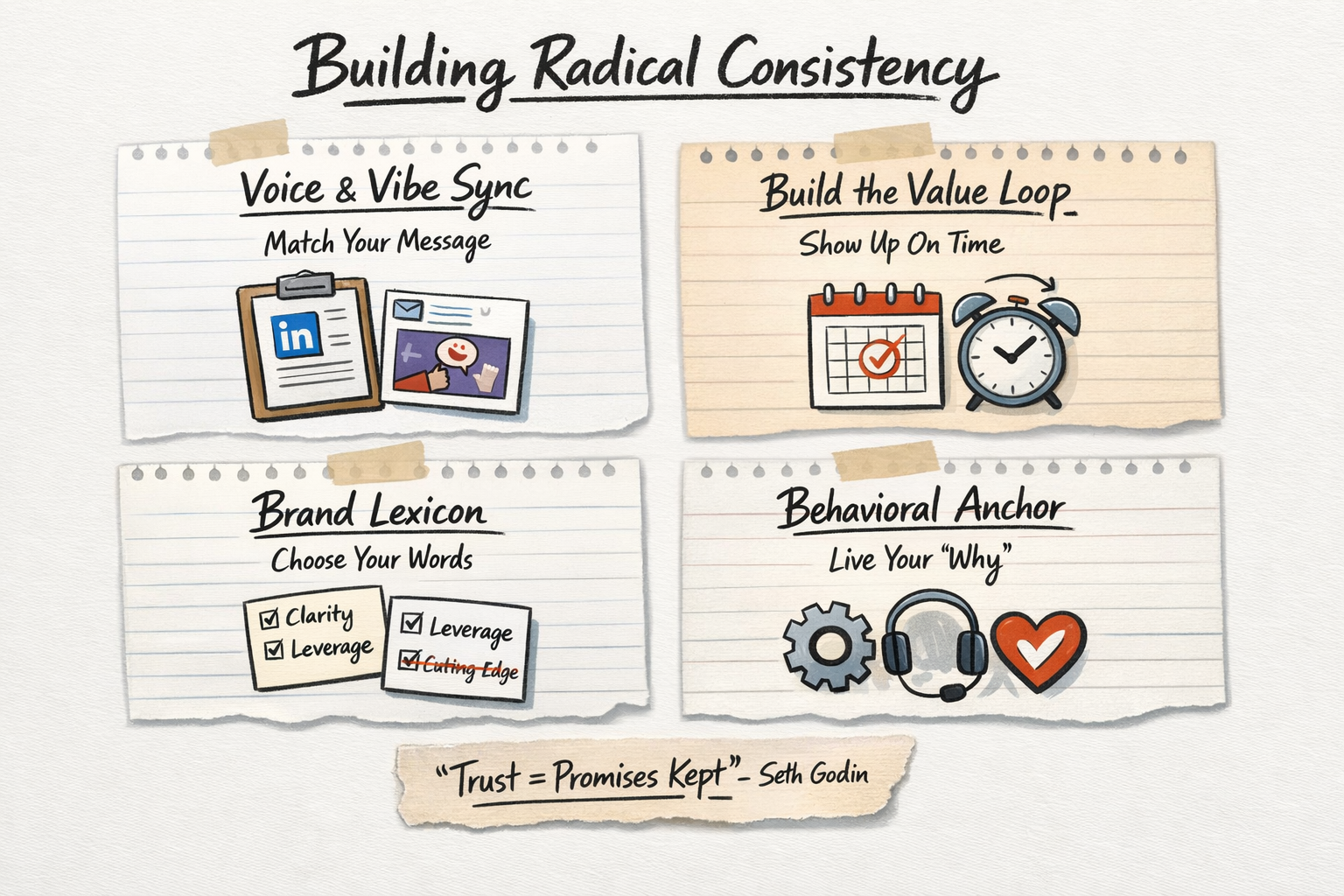
What is the Framework of Radical Consistency?
The Framework of Radical Consistency is the antidote to “brand schizophrenia.”
It fixes the feeling when a company’s Instagram looks like a party, but their customer service feels like a DMV office.
In terms of a “magnetic” brand, consistency isn’t just about using the same font.
It’s more about the predictability of experience.
When you’re consistent, you reduce the “cognitive load” of customers. Such a framework means they don’t have to wonder if you will deliver, they will know.
The Voice & Vibe Sync
This is the surface level. It’s where trust begins.
If your LinkedIn is professional and data-heavy, but your email newsletter doesn’t reflect that, maybe because it’s full of memes and slang, you’re creating what we call “brand friction.”
Here’s one rule you need to religiously follow: Whether it’s a 404 error page or a high-level pitch every touchpoint of your brand must feel like it was written by the same person.
Create a “Brand Lexicon.”
Define the words you always use and the words you never use.
For example, many brands focus on core value words like “clarity, precision, signal, leverage, momentum, outcome, proven, structured, system, framework, engineered…” and so on.
When they don’t want to dilute positioning, weaken trust or sound generic, they cut words like, “cutting edge, world class, best in class, next gen, game changing, revolutionary, seamless…” and more.
Build the Value Loop
It means show up exactly when and where you said you would.
If you promised your readers a “weekly deep dive” on AI trends, and you skip two weeks… you lose magnetism. Your brand won’t just dip, it will literally go dead.
Remember, it is better to do one thing consistently than five things sporadically.
Even if it’s just one post a month you’re committed to, make sure it’s the best post your audience reads all year.
The Behavioral Anchor
This is the deepest level.
It’s where your internal culture meets your external marketing.
If you claim to be “customer-first” but have a 48-hour response time for support tickets, you are losing customer trust.
Your “Why” must be visible in your operations, not just your slogans.
You can test it by auditing your micro-moments.
- How do you handle refunds?
- How do you talk to a hater in the comments?
- Does your automated email reply sound like a standard outlook template?
- When you miss a deadline, do you lead with an authentic apology?
- Is it easy to leave (if a person doesn’t like your brand)?
Every one of these moments is an opportunity to prove your “Why.”
As Seth Godin puts it:
“Trust is the product of promises kept.”
When your Voice, your Value, and your Behaviors are in a straight line, you stop being a “business” and start being a Magnetic Brand, One That Sells.
Let’s wrap it up in a fantastic checklist, a radical consistency audit table that serves as the “litmus test” for whether a brand is magnetic or not.
| Brand Touchpoint | The “Magnetic” Approach | The “Commodity” Approach | The Audit Question |
| Error Pages (404) | Uses the brand’s unique voice to guide the user back. | Generic “Page Not Found” system text. | Does our 404 page sound like us? |
| The Refund Process | Frictionless, empathetic, and maintains the relationship. | Hidden forms, slow replies, and “penalty” tone. | Is it as easy to leave as it was to join? |
| Social Media Comments | Conversational, human, and stays in “character.” | Defensive, corporate, or ignored entirely. | Do we sound like a person or a legal team? |
| Post-Purchase Email | High-energy validation; makes the buyer feel like a hero. | A dry, automated PDF invoice with no personality. | What does the user feel 10 minutes after buying? |
| The Unsubscribe | Respectful, simple, and “door is always open” vibe. | “Are you sure?” pop-ups and 5-step hurdles. | Are we holding them hostage or earning them? |
| Adversity/Mistakes | Radical ownership and transparent “how we’ll fix it.” | Passive voice (“Mistakes were made”) and silence. | Do we lead with ‘sorry’ or ‘technical difficulties’? |
| Email Newsletters | Anticipated, generous, and feels like a letter from a friend. | A “blast” of promotions, sales, and “we-we-we” talk. | Would they miss this if it didn’t arrive? |
| The “About” Page | A manifesto for the customer’s future and the brand’s “Why.” | A dry history of the company and a list of awards. | Is this about us, or about the people we serve? |
| Onboarding/Welcome | A “Red Carpet” experience that clarifies the next 3 steps. | A generic “Your account is active” automated email. | Do they feel like a hero or a line item? |
| Pricing Transparency | Clear, honest, and easy to find without a “demo.” | Hidden “Request a Quote” buttons for simple services. | Are we hiding our value or standing by it? |
| Internal Culture | Employees speak the same “Brand Language” as the ads. | Staff are disconnected, scripted, or indifferent. | Do our people believe the hype we sell? |
| Community Spaces | Active facilitation, moderation, and genuine peer support. | A “Ghost Town” forum or a comments section full of spam. | Are we building a crowd or a community? |
| Packaging/Unboxing | A sensory experience that reinforces the brand’s premium/quirky “vibe.” | A brown box with a packing slip and plastic bubble wrap. | Does “unboxing” feel like a gift or a chore? |
| Wait Times | Proactive communication and “educational” waiting periods. | “Your call is important to us” on a 20-minute loop. | How do we respect the user’s most finite asset—time? |
| Data Privacy | Clear, human-readable explanations of why data is collected. | 40 pages of “legalese” designed to confuse the user. | Do we treat their data with the same care as our own? |
| The “Goodbye” | A graceful, “no-hard-feelings” exit that leaves the door open. | Guilt-tripping copy (“Are you sure you want to miss out?”) | Do we care about the human or just the subscription? |
It’s Your Choice – Commodity or Culture?
Most companies spend their lives shouting into a void. They literally beg for clicks, a like or a lead. What are they doing wrong? They are playing a game of numbers.
But you? Not you. If you’ve read the article then you have experienced a mind shift.
You’re playing a game of connection.
Building a magnetic brand isn’t about the size of your marketing budget, it’s about having the guts to say, “I am for these people, and I am definitely not for those people.”
It’s those obsessions over micro moments, until your “Why” is so loud, it drowns out the noise of your competitors.
So stop trying to hack the algorithm & start honoring the human.
Be radical. Be consistent. Be generous.
Because in a world of infinite choice, the only way to be chosen is to be irreplaceable.
The market doesn’t need another vendor. It’s waiting for a leader.
Are you ready to pull?
Contact Branex, and let us design the perfect magnetic brand strategy for your business.