- Who we are
Who we are

Over 100 industry awards, accolades, and achievements showcase our quality and commitment to client success.
- Services
Services
Technologies
- On Demand App Solutions
Who we are
Trusted by 500+ active clients.
- Contact Us


 +971 52 905 2719
 info@branex.ae

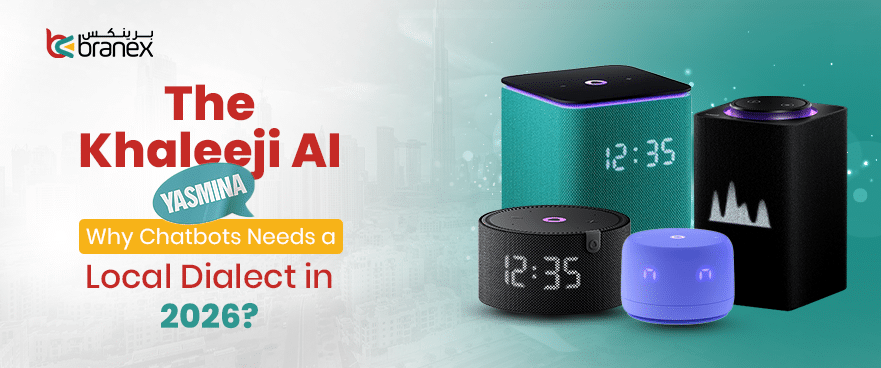
“Yasmina” The Khaleeji AI – Why Chatbots Need a Local Dialect in 2026?
2026 is here, and we are living in quite an exciting time for the Gulf.
The Arabic-speaking community in the UAE has evolved beyond just feeling impressed by chatbots that speak perfect formal Arabic. They somehow can’t ignore the fact that a bot that sounds technically on point often falls short in meeting the subtle nuances of the local Arabic dialect. Even though supported by some of the high-end GPT language models, these AI chatbots still fall short in meeting cultural values.
A recent study by the Gulf Cooperation Council (GCC) found that 90% of real-world Arabic spoken interactions occur in rich local dialects such as Najdi, Emirati, and Khaleeji.
Technology like AI chatbots is having difficulty understanding cultural Arabic nuances, such as distinguishing between Khaleeji and Kuwaiti dialects.
With everyday conversations taking place on social media and other digital platforms, Arabs now favor dialect mastery in their communication, especially when using AI chatbots.
AI now has a new task: master dialects so they do not sound like formal Arabic. It’s a roadblock that many generic models are now experiencing, and with “Yasmina,” the tides are forever shifting.
Tech innovators at Yango Group have developed a robust AI model trained to understand and respond in local dialects, delivering a much more culturally relevant, locally fluent user experience.
So what’s “Yasmina” and what’s the whole hype about? And why has it become more important than ever to have a chatbot speaking in the local dialect in 2026? Let’s discuss.
Table of Contents
What is “Yasmina”, The Khaleeji AI?

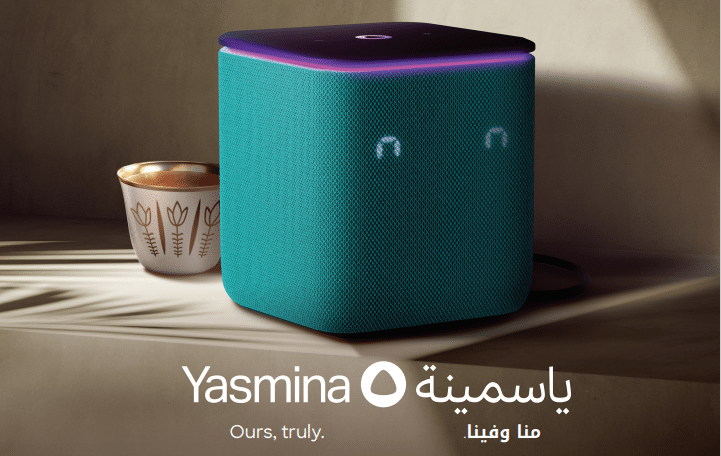
Yasmina is a bilingual AI voice assistant developed under the leadership and supervision of Yango Group.
What makes Yasmina special is how it’s trained to understand and respond in different regional Arabic nuances. The AI bot can easily tell the difference between the Saudi “ايش” and the Kuwaiti “شنو”.
If a Kuwaiti talks to Yasmina, it will provide them with assistance in their specific dialect. Likewise, if someone from Riyadh or Jeddah speaks to Yasmina, she will respond in the Saudi-specific dialect.
It’s how Yasmina’s Large Language Model (LLM) is trained to respond.
It has been trained on region-specific datasets which include speech patterns, idioms, and even local slang from countries such as Saudi Arabia & UAE.
The adoption comes from pre-trained datasets belonging to 100s of individuals living in Riyadh, Jeddah and Dammam.
You see, Yasmina isn’t just your average Arabic-speaking AI; it doesn’t simply translate Arabic to English or vice versa but understands the context & responds.
The LLM model speaks fluently in Khaleeji Arabic.
The Problem with Generic AI Chatbot Responding in Arabic
Believe it or not, the Gulf’s Arabic-speaking community often feels frustrated when asking chatbots questions in Arabic but they don’t account for cultural nuances.
They are tired of receiving responses in the same old formal standardized Arabic format, one that sounds too academically perfect. With all the verbs written correctly, words pronounced clearly, and complex sentences well-structured, one may still feel distant or disconnected reading it.
For someone who commonly doesn’t speak Arabic, this may not sound much at all; however, for an Arab, they can frankly tell the difference when the content appears as AI gibberish.
It’s the same as reading machine-generated English.
The problem isn’t with Arabs, it is how the AI is treating the Arabic language. Arabic is a culturally rich language with a spectrum of dialects each with its own emotional tone & cultural value.
Different Arab countries speak different dialects of the Arabian language.
For example, if a Saudi in Riyadh says “what’s happening,” they would probably say “ايش السالفة؟” but the same would sound differently when spoken by a Kuwaiti saying “شنو السالفة؟” a clear nuance that often gets missed by a generic AI model. These subtleties often force the AI losing its conversational touch and leading to more awkward exchanges.
For Arabs, it means hurting their experience because they value their own dialects.
People in the Gulf region often want AI tools speaking in their own local dialects. If the AI tool isn’t capable of delivering that, they would instantly resort to a different experience. They would rather choose human intelligence over a machine learning algorithm. Formal arabic may sound technically correct, but it just doesn’t form that connection which a locally aware individual with cultural awareness could. This requires an AI bot with an ability to speak localized dialect.
The Benefits of Dialect Savvy AI
When AI chatbots start speaking in the local dialect, the results go beyond just sounding “friendly.” They transform the entire user experience. Here are some of the benefits of having a dialect-savvy AI.
Greater Accessibility – it makes technology accessible to users belonging to diverse linguistic backgrounds. Whether you’re a native speaker or a non-native speaker, an elderly individual or a young gun who prefers a bit of a more relaxed and casual accent, dialect-savvy AI can adapt to any of them.
Improved Accuracy – A dialect-savvy AI reduces errors when it comes to speech-to-text transcription. Whether you’re using nonstandard Arabic grammar or a standardized grammar with varied pronunciation, a dialect-savvy AI such as Yasmina will understand the context carefully and offer you the best response.
Natural Interaction – You can have more natural and comfortable conversations. The AI will understand conversational nuances, such as Gen-Z slang, which is predominantly used by youth in the Gulf. It has code-switching capability that automatically enables the Arabic dialect to adapt to a specific dialogue, so the algorithm responds naturally.
Expanded Market Reach – You can also broaden overall market reach by training an AI bot that is capable of speaking in diverse Arabic dialects. It will help your organization tap into underserved regions and interact with more customers from diverse regional backgrounds.
Higher Conversion Rates – Businesses can achieve better conversions with an AI dialect-savvy bot working across their customer support, social media platforms, and eCommerce solutions. Customers can feel more engaged when purchasing products on your website or through your solutions, and may feel more comfortable overall with a bot that speaks natively.
Industrial Implementations – It can be used to monitor seniors with serious health issues such as high blood pressure, diabetes, or asthma. People will feel more comfortable speaking to a dialect-savvy AI to set up check-in calls and ensure personal well-being. It can also help financial organizations understand complex financial products and related matters.
How Yasmina Learns?
Yasmina AI isn’t all about translating words into Arabic and vice versa, but it’s a full fledged technology teaching people how to communicate in Arabic in everyday life. Behind the scenes, Yasmina’s learning process is based on regional data which reflects real world conversations across the Gulf. Yasmina’s model is trained using a mix of crowdsourced language data. This data is predominantly acquired using locally recorded audio samples and natural conversational exchanges. It includes patterns of everyday speech, common expressions, regional idioms and even popular slang which is used in Riyadh, Jeddah, Dubai, Oman, Kuwait and many other households. The chatbot learns how people naturally hold conversations and the AI then develops a more authentic understanding. It reads and replicates the dialect and tone to answer intent.
As far as Khaleeji Arabic is concerned, this Arabic type is rich and dynamic and used in everyday communication. The language is constantly evolving and the slang changes more quickly than expected. The younger generations are always exploring new things with dialects introducing new phrases. One of the common observations has been watching people start with half a sentence in Arabic and finish the rest in English. To teach AI such practices often becomes challenging because of all of the code-switching. Yasmina’s system learns when “لايك” means social media engagement, when “أوكي” signals agreement. And it may be observed when tone alone changes the meaning of the entire sentence which again requires continuous learning. Yasmina’s model is powerful enough to adapt the following changes and beyond.
Ethical and Privacy Considerations
Collecting information for bot training often comes with its own set of responsibilities.
If you collect any voice samples or gather any conversational data, you must obtain clear user consent and handle it in accordance with strict privacy regulations. The objective is to ensure you capture only linguistic patterns rather than personal identities. You must carefully maintain complete anonymity, and you must store the collected data in a secure data storage location. Ethical AI practice plays a key role in ensuring that Yasmina is trained on data sets that make the AI bot culturally intelligent, while also winning user trust and protecting privacy.
Yasmina’s intelligence doesn’t come from textbooks, it comes from the voices, habits and cultural rhythms of the people it assists. It’s what takes Yasmina beyond average Arabic-speaking AI.
It sets it apart as a truly Khaleeji conversational partner.
If your audience speaks in dialect, your AI should too. The future of digital experiences in the Gulf belongs to brands that sound local, feel familiar, and understand culture beyond just words. Yasmina AI is just the first of many AI solutions that embrace dialect-savvy conversations and help users feel truly understood. At Branex, we help businesses build AI-powered digital experiences tailored to local audiences and evolving customer expectations.