- Who we are
Who we are

Over 100 industry awards, accolades, and achievements showcase our quality and commitment to client success.
- Services
Services
Technologies
- On Demand App Solutions
Who we are
Trusted by 500+ active clients.
- Contact Us


 +971 4 2417179
 +971 52 181 0546
 info@branex.ae
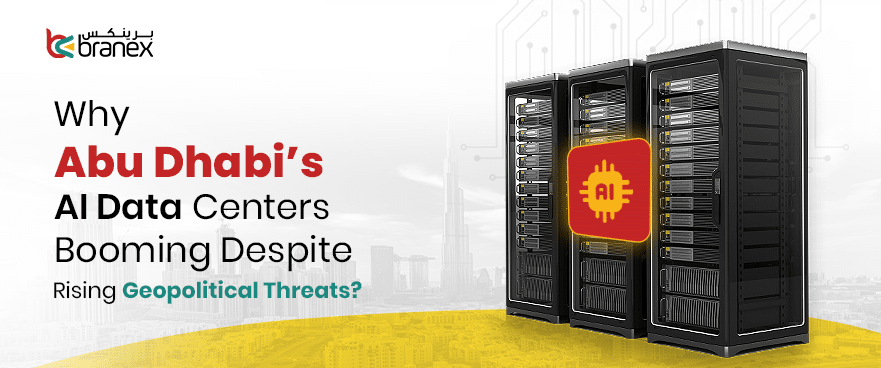
“AI infrastructure is no longer just a technology layer, it has become critical national infrastructure and a source of geopolitical influence, with countries like the UAE positioning their data centers at the center of this global power shift.”
In the high-stakes theater of global technology, a new capital is emerging not from Silicon Valley, but from the shifting sands of the Arabian Peninsula.
AI data centers in Abu Dhabi are rapidly becoming the backbone of next-generation digital power, positioning the UAE as a leading force in AI infrastructure across the Middle East.
While much of the world eyes the region through the lens of geopolitical risk, Abu Dhabi is quietly building a $100 billion+ AI industrial ecosystem designed to scale compute, energy, and global influence.
To translate this advantage into real-world capability, Abu Dhabi is investing in next-generation infrastructure designed specifically for AI workloads.
The ambition isn’t just in theory, but it’s already being developed at scale.
And its clearest expression is in the project called Stargate.
Table of Contents
The Stargate AI Data Center in Abu Dhabi

Stargate is a $30 billion hyperscale AI data center initiative in Abu Dhabi, currently under construction as of April 2026, anchoring the region’s next phase of AI infrastructure growth. The project is being developed through a strategic partnership led by G42, alongside a global alliance that includes OpenAI, Microsoft, NVIDIA, Oracle, SoftBank, and Cisco, with additional backing from MGX, a sovereign investment firm managing over $100 billion in assets. Positioned to host one of the world’s most powerful AI computing stacks, Stargate is designed to strengthen the UAE’s geopolitical role as a neutral digital hub, offering trusted infrastructure supported by U.S.-aligned assurances. The facility is expected to draw approximately 25% of the baseload capacity from the Barakah Nuclear Power Plant, ensuring a stable, large-scale energy supply capable of supporting next-generation AI workloads at scale.
The “Unfair Advantage” – Powering the Intelligence Grid
While Silicon Valley faces a “power wall” where data center projects are delayed by years due to aging electric grids, Abu Dhabi has built a purpose-made energy surplus.
Here’s where the UAE government steps forward with its two-pronged strategy for energy conservation and making UAE the next logical hub for the upcoming AI generation.
Introducing The Barakah Nuclear Power Plant
The Barakah Nuclear power plant is the secret weapon of the UAE’s AI strategy.
As per 2026, the all four units are currently fully operational providing at least 5.6 GW of clean and reliable electricity, an amount significantly enough to cover the data center overall energy requirement.
Many of the AI chips installed in these data centers like NVIDIA’s H100s/B200s require “always-on” power. Unlike solar or wind, nuclear power offers a high-voltage baseload to manage a 200MW data center.
The Affordable Solar “Surge” Edge
Besides the Barakah nuclear power plant, Abu Dhabi’s solar infrastructure is also remarkable, all thanks to the Al Dhafra Solar PV project, one of the largest single-site solar plants in the world.
Previously, Abu Dhabi has successfully broken world records for becoming the lowest cost of solar power. And this makes it a great opportunity for AI Data Center to sign-off long-term Power Purchase Agreements (PPAs) relatively cheaper than the ones offered in Europe or North America.
Liquid Immersion Cooling for AI Data Centers in Abu Dhabi
Furthermore, if you’re setting up a data center in this region means getting into an energy nightmare with temperatures peaking 45°C (113°F) and beyond. Yet, Abu Dhabi is changing the game by transforming air-cooling from traditional “air-chilled” units to liquid immersion cooling systems.
Many facilities powered by Khazna, for instance, are now introducing direct-to-chip liquid cooling. This technology makes the cooling AI-smart and improves efficiency by 20-30%.
This way, UAE wins the edge to achieve a Power Usage Effectiveness (PUE) of 1.2 or lower ultimately outperforming many facilities which are currently operating in much cooler climates.
Global Data Center Energy Readiness Rankings
| Region / Country | Power Access Speed | 24/7 Power Reliability | Grid Constraints | Scalability (5–10 yrs) | Deployment Friction | Verdict |
| Abu Dhabi (UAE) | 1–3 yrs (pre-zoned) | Very High (Nuclear + Solar) | Low | Very High | Low (Gov-backed) | Best-in-Class |
| Saudi Arabia | 1–4 yrs | High (Oil + Solar) | Low | Very High | Low | Strong Alternative |
| Texas (US) | 2–4 yrs | High (Gas-heavy) | Moderate | High | Medium | Scalable but volatile |
| Northern Virginia (US) | 3–5 yrs | High | Severe | Medium | High | Capacity constrained |
| Paris (France) | 3–6 yrs | Very High (Nuclear) | Medium | Medium | Medium | Stable but slower |
| Mumbai (India) | 3–5 yrs | Medium | Moderate | High | Medium | Growing infra play |
| Singapore | 4–6 yrs | High | High | Low | High (restricted) | Limited expansion |
| London (UK) | 5–8 yrs | High | High | Low | High | Policy-heavy |
| Frankfurt (Germany) | 6–10 yrs | High | High | Low | Very High | Energy bottleneck |
| Dublin (Ireland) | 5–10 yrs | Medium (Wind reliance) | Severe | Very Low | Very High | Saturated |
The Geopolitical Shield and the Defense in Depth
In March 2026, the global tech industry was jolted when Iranian drone strikes attributed to regional tensions damaged Amazon Web Services (AWS) facilities in the UAE and Bahrain.
For many, it became a “Suez Canal moment” for data, proving that bits and bytes are now as much a target as oil and gas. Yet, rather than sparking an exodus, these events have accelerated a sophisticated “Geopolitical Shield” which combines high-tech military defense with ironclad diplomatic treaties.
UAE’s Approach to Fortifying the Digital Fortress

Abu Dhabi has officially reclassified AI data centers as Critical National Infrastructure (CNI), putting them on the same security tier as nuclear plants and oil refineries.
Facilities such as the 200MW Khazna campuses are now reportedly integrated into the UAE’s multi-layered air defense umbrella, including the Terminal High Altitude Area Defense (THAAD) and Patriot systems.
These centers are designed for “fault tolerance,” meaning they can withstand individual building damage or total power grid failures without losing a single petabyte of data making them Tier IV standard.
The U.S.-UAE “Tech-Security” Pact
To reduce the risk of being caught between U.S. and Chinese interests, Abu Dhabi has effectively “picked a side” to secure its AI future.
- The Intergovernmental Assurance Agreement: Following Microsoft’s $1.5 billion investment in G42, the UAE signed a first-of-its-kind treaty with the U.S. government. This agreement mandates the removal of all Chinese hardware (like Huawei) from AI data centers in exchange for priority access to Nvidia’s H100 and B200 chips.
- Strategic Alignment: By aligning with U.S. security standards, Abu Dhabi has turned its data centers into “American-standard digital soil.” This makes an attack on these facilities not just a strike against the UAE, but a direct provocation against the global infrastructure of Western tech giants.
The 2030 Vision – From “Oil Wealth” to “Compute Wealth”
Abu Dhabi isn’t just building data centers to host other people’s apps; it is executing a systemic pivot of its entire national identity. By 2030, the goal is for the UAE to be the world’s first Sovereign AI Superpower, where “compute” is exported with the same strategic importance as crude oil was in the 20th century.
The numbers say it all; by 2031, AI is projected to contribute roughly $96 billion to the UAE’s GDP, accounting for nearly 14% of the total economy.
Where oil prices keep fluctuating based on the global demand, AI processing is expected to grow exponentially for the next two decades.
Abu Dhabi is positioning itself as the AI hub for the “Next 5 Billion” people.
While the US and China focus on their own domestic tech wars, the UAE is building the infrastructure to provide AI services to Africa, India, and Southeast Asia & beyond.
Hosting the data and processing power for these emerging markets, UAE gains diplomatic and economic leverage, becoming a critical node in the global supply chain that cannot be easily bypassed.
In fact, this boom is creating a physical home for the world’s most elite engineers.
Setting the foundation with initiatives like the Mohamed bin Zayed University of Artificial Intelligence (MBZUAI), the world’s first graduate-level AI research university and the Hub71 startup ecosystem, UAE is solving its historical problem of “brain drain” by launching them within the region of Abu Dhabi.
Golden Visas & 0% Tax
In an era where tech talent is increasingly mobile and weary of high Western taxes and regulation, Abu Dhabi offers a high-luxury, tax-free city. It is on track to train or attract 20,000 AI experts by 2027.
The government is also aiming for 100% reliance on AI for government services by 2031. For example, in Masdar City, AI-managed grids already reduce power and water waste by 30%.
Using its massive compute power, Abu Dhabi is leading in “Genomic Medicine,” processing the DNA of its population to create AI-driven and personalized healthcare to add years in human lifespan.
Is Abu Dhabi Becoming the Next Digital Front?
The data center boom within the Abu Dhabi region is at its boom. Abu Dhabi is investing around AED 13 billion during the short period of 2025-2027 ensuring it’s turning it into a global “digital fortress.”
Today, it’s fueled by a massive digital strategy, one carefully designed to make UAE the first fully AI-native government by the end of 2030. Such initiatives are carving the path towards attaining sovereignty in space of technological transformation. Abu Dhabi is all geared to install top-tier cybersecurity and making its infrastructure environment a highly secure, data-driven and a very resilient digital ecosystem.
In a world of rising geopolitical threats, it’s powering one of the world’s most advanced intelligences. From Washington to Beijing, it’s aiming to secure itself as a major power within the technological space.