- Who we are
Who we are

Over 100 industry awards, accolades, and achievements showcase our quality and commitment to client success.
- Services
Services
Technologies
- On Demand App Solutions
Who we are
Trusted by 500+ active clients.
- Contact Us


 +971 52 936 1717
 info@branex.ae

Real estate lead generation looks busy on the surface, but most of it quietly leaks. Nearly 80% of leads never convert, and response delays beyond 5 minutes can cut conversions by up to 80%.
And real estate chatbot development is the answer to a significant industry problem.
With rising ad costs, every missed inquiry hurts. As sales expert InsideSales.com research puts it, “Speed to lead is the single biggest factor in conversion.”
If you’re still relying on forms and delayed follow-ups, you’re paying for attention without capturing intent. This is where a well-built chatbot turns passive clicks into qualified, ready-to-convert conversations.
You can learn more about how these technologies are changing property dealing in Dubai to stay ahead of the curve.
Table of Contents
Why Traditional Lead Generation Is Failing?

Low Conversion Rates on Forms
Most real estate forms feel transactional, not helpful. They ask for personal details before offering any real value, which is exactly why average landing page conversion rates sit around 2–3% across industries. For a buyer just browsing options, that’s too much friction too early. As marketing expert Neil Patel often emphasizes, users convert when they feel guided, not interrogated. Forms do the opposite. They stall momentum right when interest is highest.
Slow Response Times
In real estate, timing isn’t important, it’s everything. Research shows that responding within 5 minutes makes you up to 21x more likely to qualify a lead compared to waiting 30 minutes. The problem is, most agents simply can’t keep up with that speed manually. Meanwhile, the buyer has already moved on to the next listing, the next agent, the next conversation. What feels like a small delay on your end feels like silence to them. This gap is why many firms prioritize real estate chatbot development to maintain instant engagement.
Lack of Qualification
Traditional lead capture treats every inquiry the same, but real conversations don’t work that way. Without context like budget, location, or urgency, agents are left guessing. That’s why sales teams report that over 50% of leads are not ready to buy. As Brian Halligan puts it, “Not everyone is ready to buy right now, and that’s okay.” The issue isn’t volume, it’s clarity. Without qualification, you’re busy, but not productive.
What Is a Real Estate Chatbot (And What It’s Not)
It’s Not Just a FAQ Bot
A real estate chatbot isn’t there to answer “What’s the price?” and stop there.
That’s the old model.
A high-performing chatbot behaves less like a helpdesk and more like a smart assistant that guides the conversation forward. Instead of waiting for questions, it asks the right ones, understands intent, and moves the user closer to a decision. Successful real estate chatbot development focuses on this proactive interaction, often utilizing agentic AI systems to handle complex user requests autonomously.
It’s a Conversational Funnel
Think of it as a funnel that doesn’t feel like one. There are no rigid steps or form fields, just a natural flow that mirrors how people actually make property decisions.
- Captures attention – It starts with relevance. A simple, well-placed question like “Looking to buy or rent in Dubai?” instantly pulls the user in because it speaks directly to their intent.
- Engages instantly –The moment a user interacts, the conversation begins. That immediacy keeps curiosity alive and reduces drop-off.
- Qualifies users – Instead of overwhelming users with a form, it asks one question at a time. Each answer builds context (budget, location property type) without feeling intrusive.
- Converts into leads – By the time contact details are requested, the user is already invested. They’ve shared intent, explored options, and see value in continuing. At that point, converting doesn’t feel like a commitment, it feels like the next logical step. Proper real estate chatbot development ensures this transition is seamless.
How to Build a Real Estate Chatbot for Lead Capture?
Establishing the Lead Conversion Workflow

A successful lead capture chatbot functions as an active discovery tool rather than a passive form. You need to design a workflow which must guide a visitor from initial engagement to a confirmed appointment without friction.
Effective real estate chatbot development requires mapping these paths early.
You can start by configuring the real estate chatbot to trigger specific greetings based on the user’s entry point:
- Listing Page Greeting: “I see you’re looking at [Property Address]. Would you like to see the floor plan or school district ratings for this area?”
- Home Valuation Page Greeting: “Thinking of selling? I can give you a real-time estimate of what homes in your neighborhood sold for last month. Want to see the data?”
- General Homepage Greeting: “Welcome! Are you searching for a new home, or are you curious about what your current home is worth in today’s market?”
The conversation should prioritize open-ended discovery questions that identify the user’s specific pain points before requesting contact information.
Once the bot identifies high-intent behavior, such as a request for a property tour, it should execute an immediate handoff to your CRM or alert an agent via SMS to ensure the lead is contacted while they are still active on your site.
This is a core objective of real estate chatbot development.
Data Integration and Knowledge Management

Your real estate chatbot’s utility depends on its access to real-time information.
You must connect the chatbot to your MLS (Multiple Listing Service) using an IDX (Internet Data Exchange) feed. To do this in real estate chatbot development, use a Web API based on the RESO (Real Estate Standards Organization) protocol.
Most modern platforms allow you to authorize your bot through an API key provided by your MLS board. Once connected, the bot uses JSON queries to pull specific metadata like ListPrice, BedroomsTotal, and PublicRemarks.
By mapping these data fields to your bot’s natural language processing unit, the bot can answer specific questions such as “Which homes under $600k have a pool?” by filtering the live database in real-time.
Beyond listing data, integrate your bot with your CRM to track existing leads and prevent duplicate entries. A secondary but vital data source is your local knowledge base.
By uploading your neighborhood guides, HOA documents, and buyer’s checklists, the real estate chatbot can answer nuanced questions about commute times or local regulations that a standard search filter would miss. This creates a more human-like expertise that builds trust with the user.
It creates a more human-like expertise that builds trust with the user, which is a significant advantage of real estate chatbot development.
Essential Bot Functionalities
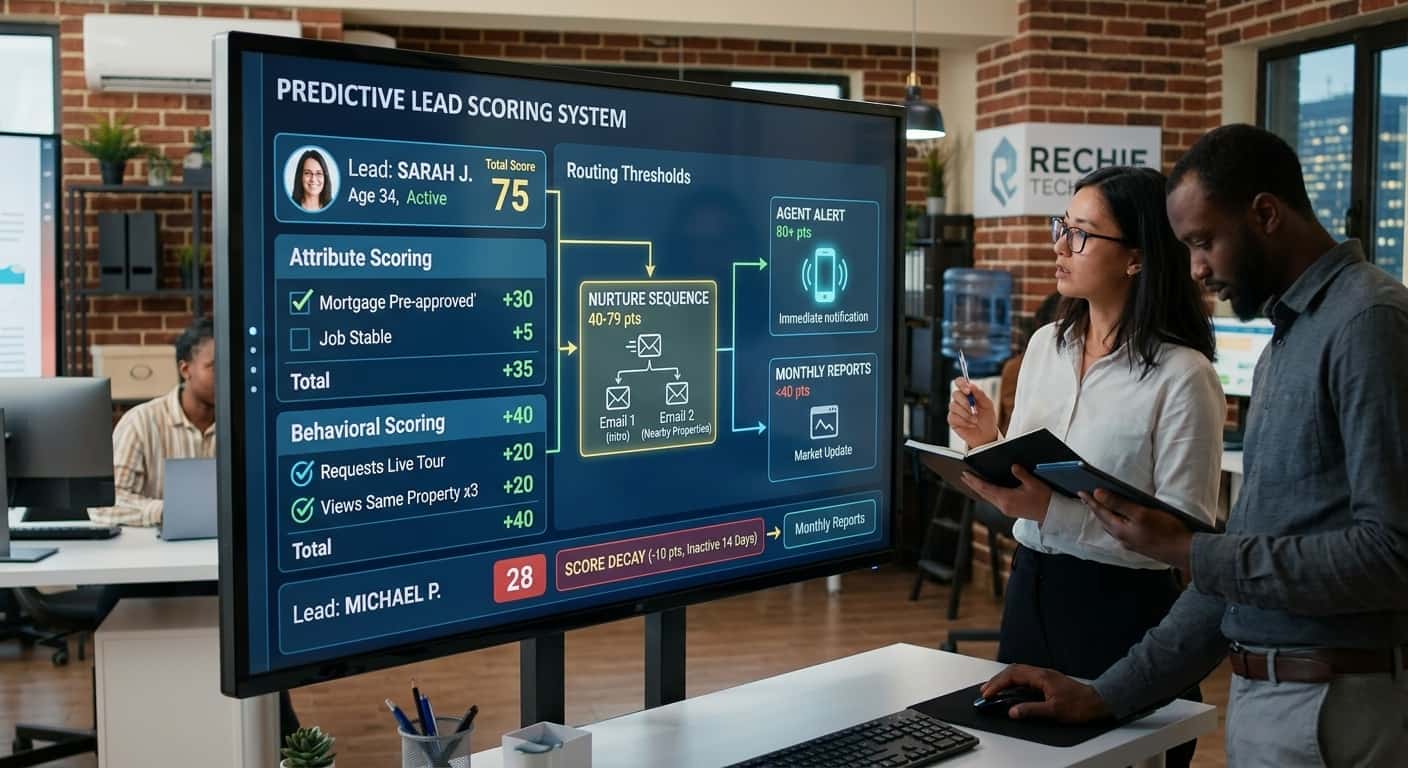
Modern real estate bots must handle complex tasks to be effective. A core feature is predictive lead scoring, which assigns points based on user data and behavior:
- Attribute Scoring: Assign points for profile data. A user with mortgage pre-approval gets +30 points; a user “just browsing” gets +5 points.
- Behavioral Scoring: Add +20 points if a user requests a live tour or views the same property multiple times.
- Routing Thresholds: Set actions for total scores. Leads with 80+ points trigger an immediate agent alert. Leads with 40-79 points enter an automated nurture sequence. Leads under 40 points receive monthly market reports.
- Decay Logic: Automatically reduce scores if a user stops interacting for 14 days to keep your pipeline accurate.
Additionally, embed automated scheduling directly into the chat interface using a calendar integration. It will allow users to book viewings in real-time, removing the delay of manual email coordination.
Also, ensure the real estate chatbot operates across all your digital channels, including WhatsApp and social media, to capture leads wherever they prefer to communicate.
Robust real estate chatbot development accounts for these cross-platform interactions.
Effective Qualification Scripts
To filter out casual browsers, your script should use quick-reply buttons that work efficiently on mobile devices. Focus on these seven core areas during real estate chatbot development with clear, conversational messaging:
- Intent: Determine their primary goal.
- Example: “Are you looking to buy, sell, or rent your next home?”
- Location: Identify specific zip codes or neighborhoods.
- Example: “In which neighborhoods or zip codes are you focusing your search?”
- Budget: Define a clear price range.
- Example: “What price range are we aiming for to keep you comfortable?”
- Timeline: Establish how soon they need to close or move.
- Example: “How soon would you like to be settled into your new place? (e.g., within 30 days, 3-6 months, or just browsing)”
- Financing: Confirm mortgage pre-approval status.
- Example: “Have you already started the pre-approval process with a lender, or would you like a recommendation?”
- Requirements: Capture “must-have” home features.
- Example: “What are your top non-negotiables? (e.g., 3+ bedrooms, home office, large backyard)”
- Contact: Request contact info to send a curated list of matching properties.
- Example: “I’ve found 12 properties that match your criteria. Where is the best place to send the full list and photos?”
Performance and Technical Framework
The following table outlines the expected performance benchmarks and the recommended technology stack for real estate chatbot development as of 2026.
For a deeper look at the industry’s direction, check out our guide on the future of UAE real estate and PropTech.
| Category | Benchmarks & Recommendations |
| Response Speed | Bot must respond in under 2 seconds to maintain engagement. |
| Conversion Lift | Conversational interfaces typically see a 95% increase in leads over static forms. |
| Efficiency | AI agents handle roughly 80% of routine inquiries without human intervention. |
| No-Code Tools | FwdSlash or Jotform AI Agents for rapid deployment of custom knowledge. |
| Team Solutions | Roof AI or Structurely for complex routing and long-term nurturing. |
| Social Automation | ManyChat for managing leads from Instagram and Facebook DMs. |
Maximizing ROI through Response Time
Speed is the most critical factor in online lead conversion. Inquiries responded to within 60 seconds are seven times more likely to convert than those answered even a few minutes later.
By using a real estate chatbot to provide immediate answers and qualify the user’s budget and timeline, you ensure your agents spend their time only on the most promising prospects.
This reduction in manual labor lowers the cost per interaction significantly, moving it from several dollars for human-led live chat to a fraction of that for an automated system.
Strategic real estate chatbot development is key to this efficiency.
What Are the Key Features of a Real Estate Chatbot?
Here are some key features which can make a real estate chatbot a useful integration.
1. 24/7 Lead Capture and Qualification
A real estate bot ensures you never ignore a lead, regardless of the time of day. It uses structured data collection to ask users a specific sequence of questions regarding their budget, preferred neighborhoods, and moving timeline. By applying predefined logic or AI models, the system categorizes and scores these leads based on their readiness to buy. For instance, a user looking to purchase a home within the next 30 days is flagged for immediate agent follow-up.
A practical example is a real estate chatbot that asks, “Are you looking to buy or rent?” followed by “What is your maximum monthly budget?” and then automatically tags the user as a “High Priority Buyer” in your CRM if they specify a budget over $800,000. All collected contact details then sync automatically, which eliminates the need for manual data entry. This is a primary benefit of real estate chatbot development.
2. Instant Property Inquiry Handling
A real estate chatbot connected to your CMS prevents lead drop-off by providing immediate answers to property-specific questions. By accessing your database in real time, the bot retrieves accurate details on pricing, square footage, and availability. Like if a user asks about “123 Maple Street,” the real estate chatbot can instantly confirm its status and mention upcoming open houses. It also verifies specific amenities, such as gym access, by scanning property tags. If a property is a match, the bot can even check your calendar to book a viewing without human intervention.
3. Smart Property Recommendations
Beyond simple keyword matching, advanced bots act as digital consultants by analyzing past interactions and click patterns to identify user preferences, such as natural light or school proximity. By applying complex filters, the real estate chatbot surfaces highly relevant listings. For example, if a user frequently views industrial lofts, the bot might suggest: “I’ve found three new lofts in the Arts District that match your style.” To maintain engagement, the bot creates automated loops, notifying users the moment new properties matching their specific criteria—like a three-bedroom home under $600,000—hit the market.
4. Viewing & Appointment Scheduling
Integrating a real estate chatbot with your calendar allows prospects to book tours instantly without back-and-forth emails. The bot checks for open slots and creates a calendar event for both the agent and the client. For example, after a user expresses interest in a specific listing, the bot can say, “I have availability for a walkthrough tomorrow at 2:00 PM or 4:30 PM. Which works better for you?” Once selected, the real estate chatbot sends an automated confirmation text with the property address and a link to add the event to their Google or Outlook calendar.
5. CRM Integration & Lead Sync
A real estate chatbot’s value increases when it feeds data directly into your existing workflow. By integrating with platforms like Salesforce or HubSpot, the bot ensures that every conversation is logged as a lead activity. For example, when a user provides their phone number and email during a chat, the bot creates a new lead profile and adds a note: “Inquired about 3-bedroom homes in suburban areas with a $500k budget.” This prevents lead leakage and allows agents to see the full context of the conversation before they pick up the phone. Comprehensive real estate chatbot development must include these integrations.
6. Automated Follow-Ups
Consistent follow-up is critical for conversion, and a real estate chatbot can automate this process across various timeframes. If a lead goes cold, the bot can reach out to re-engage them with relevant updates. For instance, if a user hasn’t visited your site in a week, the bot can send a message saying, “The price on the property you viewed last Tuesday just dropped by $15,000. Would you like to see the updated listing?” This keeps the agency top-of-mind without requiring manual effort from the sales team.
7. Multilingual Support
Real estate markets are often global, and a real estate chatbot with multilingual capabilities removes language barriers for international investors. The bot can detect the user’s browser language or allow them to select their preferred tongue at the start. For example, a Spanish-speaking buyer can inquire about luxury villas in English-speaking markets, and the bot will translate property details and answer questions about financing in Spanish. It broadens your reach to non-native speakers who might otherwise struggle to navigate your listings. Real estate chatbot development for international markets should always prioritize this feature.
8. Omnichannel Deployment
Your audience interacts with your brand across multiple platforms, so your bot should be present where they are. Omnichannel deployment means the real estate chatbot maintains a consistent experience on your website, Facebook Messenger, WhatsApp, and Instagram. Let’s say, if a user starts a conversation on your Facebook page and later visits your website, the bot can recognize their previous intent and continue the dialogue. This ensures you capture leads regardless of their entry point into your sales funnel.
9. Document Handling
Simplifying the paperwork process is a major advantage for both agents and clients. Chatbots can distribute standard forms, such as rental applications or disclosure agreements, and even collect basic documentation for pre-qualification. A real estate chatbot can ask, “Do you have your pre-approval letter ready? You can upload it here as a PDF so I can pass it to the agent for a faster viewing request.” This speeds up the transaction and ensures the agent has the necessary files before the first meeting.
10. Virtual Tours
To save time on physical showings, the bot can offer immersive digital experiences within the chat interface. If a user is interested in a property but lives out of state, the bot can provide a link to a 3D walkthrough or a pre-recorded video tour. For instance, the real estate chatbot might ask, “Would you like to take a virtual tour of the penthouse before we book an in-person visit?” and then display a Matterport 3D link directly in the window, helping the user qualify the property for themselves.
11. Personalized Conversations
AI-driven bots can tailor their tone and content based on the specific type of user they are chatting with. A first-time homebuyer might need more educational content about the closing process, while a seasoned investor wants raw data and ROI projections. If the real estate chatbot identifies a user as a first-time buyer, it might offer a “Home Buying 101” PDF, whereas for an investor, it might say, “This property has a projected rental yield of 6.2%. Would you like to see the comparable market analysis?”
12. Analytics & Optimization
Chatbots provide a wealth of data that can be used to refine your marketing and sales strategy. By tracking which properties get the most inquiries and at what point users drop out of a conversation, you can identify bottlenecks in your funnel. For example, your analytics might show that 40% of users leave when asked for their social security number, allowing you to move that question to a later stage. You can also see which zip codes are trending based on user search patterns, helping you decide where to focus your next acquisition or marketing spend. Modern real estate chatbot development uses these insights to decide where to focus next.
The Top 5 Pitfalls to Avoid in Chatbot Development
Here’s the thing about chatbots, they are only as good as their logic. Many real estate chatbots drastically fail not because of the technology on which they are built upon, but because of poor design.
The “Dead-End” Loop
The most frustrating experience for a user is getting stuck in a logic loop where the bot fails to understand a request and repeats the same unhelpful prompt, again and again.
If a user asks a nuanced question like, “Does this building have a pet weight limit?” and the bot responds with “Sorry, I didn’t get that. Are you looking to buy or rent?”, the user will most likely feel frustrated and eventually close the tab.
The only way to by-pass this in real estate chatbot development is by always including a “Fallback” intent. If the bot fails twice on a particular query, it must offer a button to “Speak to an Agent” or “Leave a Message”.
This way, you will ensure the lead isn’t lost to technical friction.
Front-Loading the “Interrogation”
Many developers design bots that act like digital gatekeepers, demanding a name, email, and phone number before providing any property data. It creates immediate friction.
Here’s the thing about real estate, it’s built on value exchange. Users are much more willing to share their contact details, only after the bot has shown them at least 3 listings that fit their criteria. You can overcome this by following a “Value First” approach.
Design your bot to answer property-related questions or show a curated list of homes first during real estate chatbot development.
You can even fine-tune it to an extent that the bot first sustainably fulfills the user’s property search requirement and ask them when they show some level of interest.
Out-of-Sync Data (The “Ghost Listing” Problem)
A real estate chatbot can instantly lose its credibility if it suggests a property that was sold three days ago or quotes a price that has since been hiked.
It happens when the real estate chatbot relies on a static CSV upload rather than a live API connection to the MLS.
When designing your real estate chatbot, you can use the Real Estate Standards Organization (RESO) Web API. It will ensure the moment a listing status changes within the official database, the bot’s “brain” is updated automatically.
Lack of Clear “Human Handoff”
There is an “uncanny valley” in automation where a real estate chatbot tries too hard to pretend it is a human named “Sarah.” When the user realizes they are talking to a machine, the trust is broken.
Worse is when a high-intent lead (e.g., someone ready to book a $2M villa viewing) is forced to keep talking to a bot when they clearly need a licensed agent to step in.
Transparency is key here, confirm that they are interacting with an AI assistant while a real estate agent is actually waiting behind-the-scenes to assist.
This should be a priority in real estate chatbot development.
You can set trigger alerts, especially if a lead mentions stuff like, “cash offer” or “pre-approved,” the system can automatically ping an agent’s phone by sending them an SMS to take over the live chat.
Ignoring Mobile Optimization
Over 70% of real estate searches happen on mobile devices. A chatbot that covers half the screen, has tiny “close” buttons, or requires the user to type long sentences on a mobile keyboard.
If you’re designing a real estate chatbot, you can engage the user more efficiently through “quick reply” buttons. This way, you won’t keep the user typing the entire thing like: “I want to see three-bedroom houses in Dubai Marina,” they may simply choose an option like “3 Bedrooms” and “Dubai Marina.”
The bot can send them multiple options to choose the one from a list of existing options.
Deciding between custom vs white label app development is critical here to ensure your mobile experience is seamless and high-performing.
Measuring Success – The KPIs That Matter
If you want to track whether your real estate chatbot is actually improving your real estate bottomline, you need to closely monitor its specific performance metrics.
Here are a few important indicators to help you move beyond surface-level engagement to understand how the real estate chatbot is affecting your overall sales funnel.
These are the essential KPIs which measures success following real estate chatbot development:
| Metric | What It Measures | Why It Matters |
| Lead Conversion Rate (LCR) | The percentage of total bot users who provide contact information. | Identifies if your script is engaging enough to turn anonymous traffic into known leads. |
| Cost Per Qualified Lead (CPQL) | Total bot operating costs divided by the number of leads that meet your criteria. | Compares the efficiency of automation against more expensive human-led live chat or cold calling. |
| Appointment Set Rate | The ratio of bot conversations that result in a confirmed viewing or consultation. | Directly correlates the bot’s performance with actual revenue-generating opportunities. |
| Bot-to-Human Handoff Speed | The time it takes for a live agent to respond after the bot flags a high-priority lead. | Measures the effectiveness of your internal notification system and prevents high-intent leads from cooling off. |
| Goal Completion Rate (GCR) | The percentage of users who reach the end of a specific flow (e.g., finishing a home valuation). | Pinpoints exactly where users drop out so you can fix friction points in the conversation logic. |
| Inquiry Resolution Rate | How many questions the bot answers successfully without needing agent intervention. | Shows how much manual labor the bot is saving your administrative and sales teams. |
If you want to get the most out of these KPIs, you can sync your chatbot analytics with your CRM.
Let’s say, if your CRM shows that leads generated by the bot have a 15% higher closing rate than static web forms, you can justify increasing your ad spend on pages where the bot is most active.
By constantly monitoring, it will allow you to adjust your “Quick Reply” buttons and design triggers based on real user behavior instead of assumptions.
Compliance & Security Involved in Building a Real Estate Chatbot
In real estate, a chatbot isn’t just a simple marketing tool, it’s a legal representative of your brand.
If you’re planning to integrate a real estate chatbot, you need to become a part of this highly regulated industry. Failing to comply can often lead to heavy fines, lawsuits and permanent damage to your reputation.
UAE Federal Decree-Law No. 45 of 2021 (PDPL)
The PDPL works as an equivalent to the GDPR which applies to any business processing personal data of any UAE residents. The law instigates that:
You cannot assume consent which means your chatbot must contain the first message in clear and bilingual (English/Arabic) opt-in. If your bot is sending a simple, “By chatting with us, you agree…” then that is no longer sufficient. The user must actively click, “I Agree” or “Start Conversation.”
If a user provides their phone number in order to receive information about a specific villa in Dubai, you cannot automatically add them to a WhatsApp broadcast list for other projects.
While the law is open to cross-border data transfer, it still prefers sensitive data to stay in UAE or in “adequate” jurisdictions.
If you’re using a US-based chatbot builder, then you must follow their adequacy standards.
RERA & Trakheesi Regulations
The Real Estate Regulatory Agency (RERA) in Dubai is strict about how properties are advertised.
- Every property advertised by your bot must have a valid Trakheesi permit. If your bot pulls data from an IDX feed, it must display the permit number to remain compliant with Dubai Land Department (DLD) rules.
- RERA penalizes “bait and switch” tactics. If your bot quotes a price or availability that isn’t reflected in the official DLD “REST” app or the official project escrow account details, the agency can face heavy fines.
TDRA & Central Bank Telemarketing Rules (2024–2026)
There are also new regulations issued from the Telecommunications and Digital Government Regulatory Authority (TDRA) and the Central Bank specifically target automated marketing.
The points for this newly instigated rule are:
- If your chatbot triggers an automated “follow-up” call or SMS, it must only occur between 9:00 AM and 6:00 PM.
- You’re restricted from contacting a lead more than once per day and twice per week via automated systems.
- Before your bot or CRM triggers a cold outreach, our system must cross-reference the UAE’s “Do Not Call” registry.
Free Zone Specifics (DIFC & ADGM)
If your real estate agency is registered in the Dubai International Financial Centre (DIFC),you are subject to the DIFC Data Protection Law No. 5 of 2020.
This law is even more aligned with international standards and requires you to appoint a Data Protection Officer (DPO) if you are processing high volumes of lead data.
Need a Fully Functional Real Estate Chatbot for Business?
The real estate market is growing faster than you think. A chatbot solves the “speed-to-lead” crisis by providing the 24/7 immediacy today’s buyers demand.
By automating routine inquiries and using property filtering through live API integrations, you ensure your agency never misses a high-intent lead. The key to your success is a “value-first” approach.
This allows your bot to answer questions and solve problems before asking for contact details.
In a world where response time defines conversion, a well-built chatbot is a necessity for forward-thinking businesses. If you want to build a real estate chatbot and create a leak-proof sales funnel, Branex offers the technical expertise in real estate chatbot development. Click here to speak with a Branex expert today.