- Who we are
Who we are

Over 100 industry awards, accolades, and achievements showcase our quality and commitment to client success.
- Services
Services
Technologies
- On Demand App Solutions
Who we are
Trusted by 500+ active clients.
- Contact Us


 +971 4 2417179
 +971 52 181 0546
 info@branex.ae
For almost two decades, Software as a Service (SaaS) has emerged as one of the dominant architectures in the enterprise software industry.
It exists in multiple forms such as customer relationship management systems, finance platforms, HR tools, analytic dashboards, and even workflow applications.
They all follow the same blueprint: cloud-hosted applications accessed through subscription models.
And for a time, this model worked extremely well.
In fact, research indicates the global SaaS market surpassed $400 billion in annual revenue by 2025. A forecast further suggests it is expected to grow to around $1.3 trillion by 2035, driven by enterprise cloud adoption and ongoing digital transformation.
However, beneath this massive facade, the success of SaaS has structural limitations that no one openly discusses. SaaS optimized software delivery, but it struggled to provide intelligent enterprise automation, which is why AI native enterprise systems are emerging.
This gap or paradigm is best overcome by many of today’s AI native enterprise systems powered by autonomous agents and multi-agent orchestration.
We are now shifting from an era where software applications were manned by humans. The next generation of AI native enterprise systems consists of complex networks of intelligent agents capable of reasoning and executing complex workflows autonomously.
This very shift is the next stage in the evolution of enterprise software.
Table of Contents
A Quick Look at the Evolution of Enterprise Software Over Decades
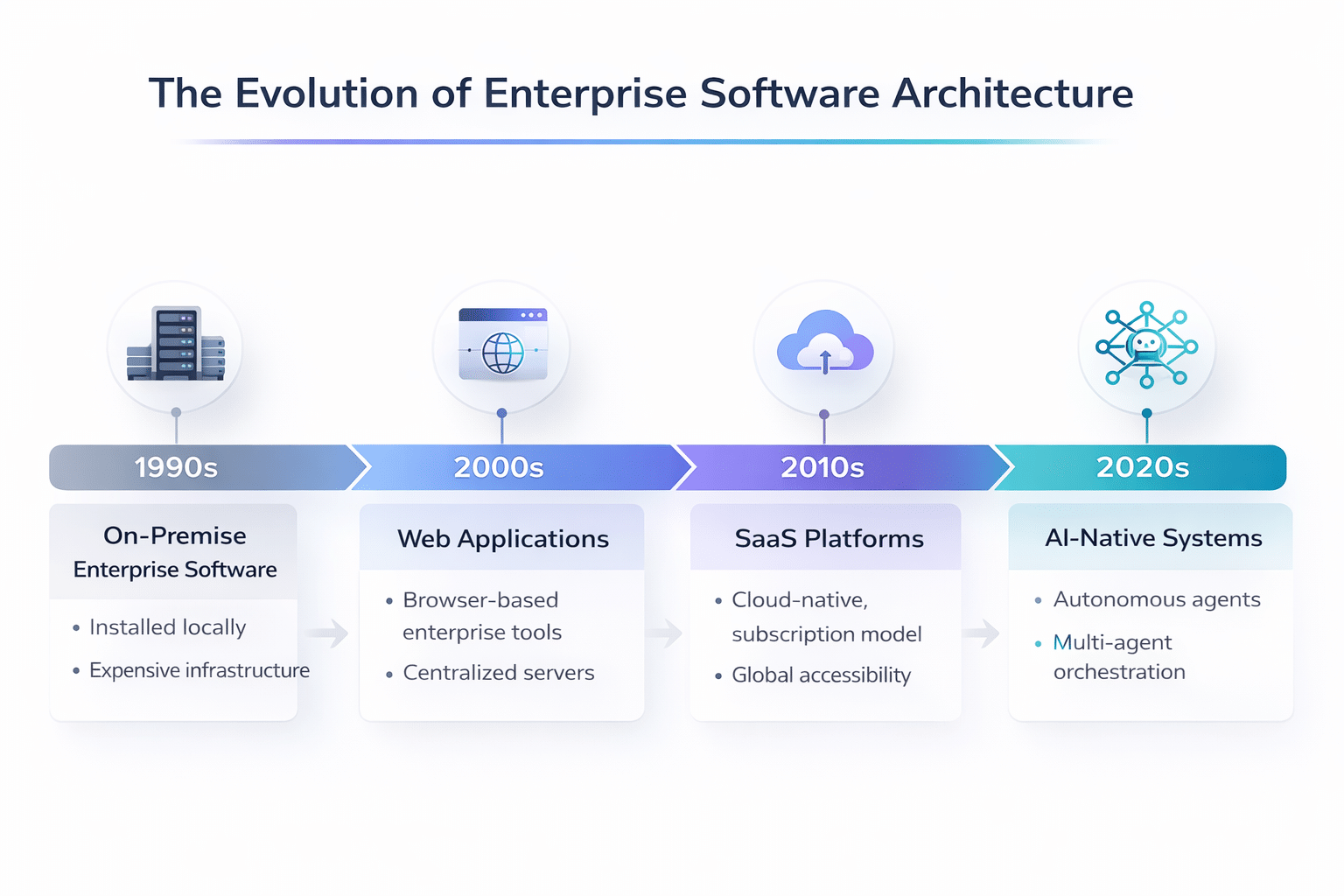
As the data shows, SaaS dramatically reduced infrastructure costs, which in turn made enterprise tools more widely available and accessible to the masses. Just in 2024 alone, it was identified that 99% of organizations were using at least one SaaS-based application to perform their active organizational duties, whether it be marketing, design, or development. According to a more recent report, an average enterprise is expected to have more than 100 SaaS apps working coherently across departments.
Such proliferation was beneficial, but it gave rise to a new problem: fragmentation. Organizations, although working proficiently with SaaS-powered tools, are often operating in an environment with disconnected applications. One department holds significant data while another suffers from being unable to access it. Each department has its own workflows and generates its own insights based on what its SaaS-powered tool recommends, without understanding the broader context.
What businesses were combatting was the paradox of abundance; SaaS tools were cheap to deploy but coordination was simply becoming a hindrance. However, with AI native enterprise systems & multi agent AI, the gap was filled by resolving the infrastructure intercommunication problem.
The Limitation of SaaS Architecture – How Multi-Agent Systems Can Overcome?
Many SaaS platforms rely on a simple underlying architecture: CRUD workflows.
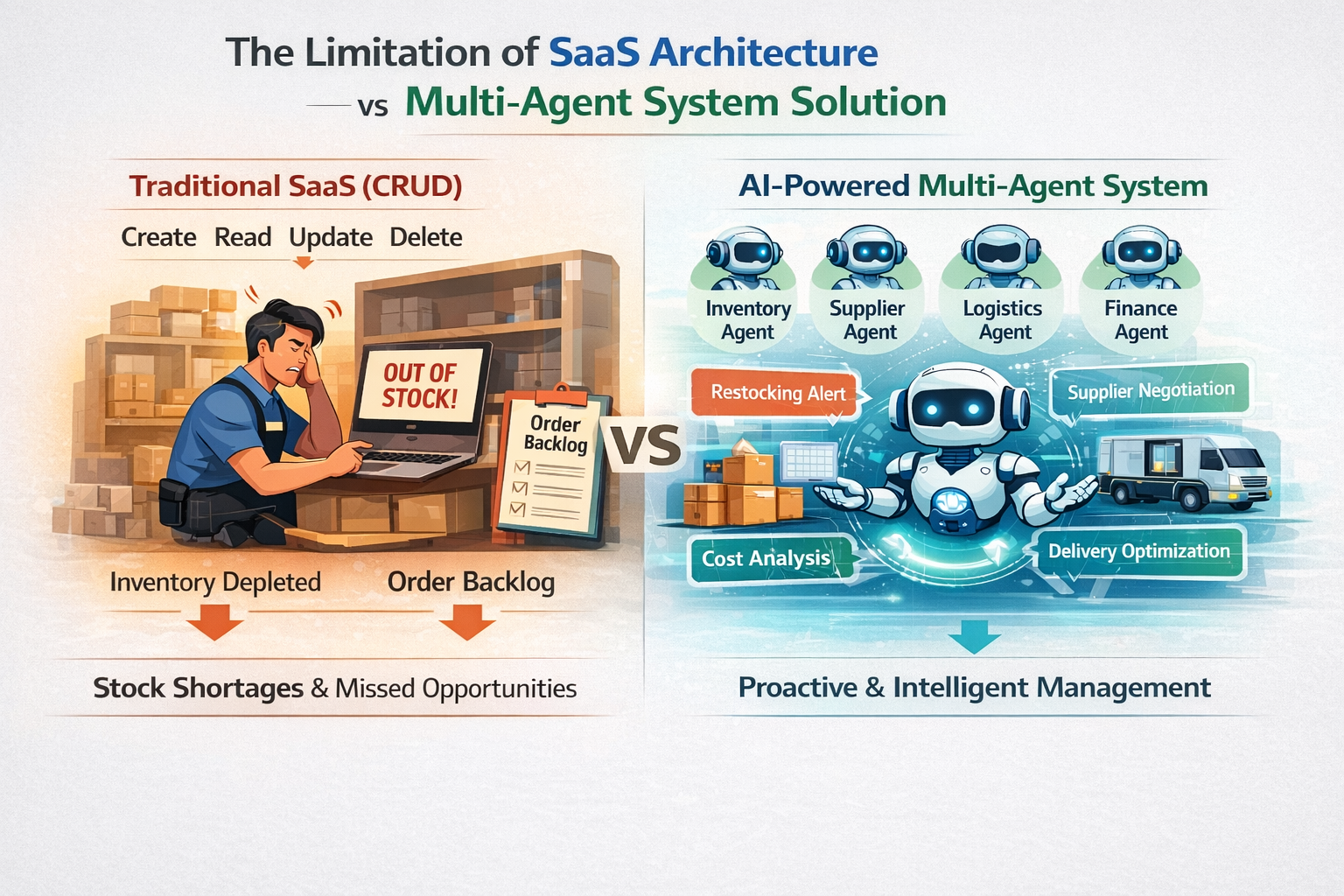
For those who aren’t aware of CRUD, it stands for Create, Read, Update and Delete. The CRUD workflow sets the rules for an enterprise SaaS powered application to interact with databases. Although CRUD is great for keeping everything recorded, CRUD architecture often faces struggles with complex decision-making and navigating dynamic environments.
Let’s assume that you’re a business running an inventory. You have a robust traditional inventory management system powered by SaaS to manage stocks in your inventory. Apparently, your inventory has started running out, but your SaaS-powered system is unable to detect it. It doesn’t quite know what steps it needs to take to restock the depleting inventory.
From a technical standpoint, the system is still performing its basic CRUD operations, it creates inventory records, reads stock levels when needed, updates quantities as orders are placed, and deletes outdated entries when products are discontinued. However, it simply records these changes without understanding what they imply for the business.
On the other hand, you do not receive any notification or update regarding the depleting inventory, and you keep booking orders. Eventually, your inventory hits the bottom line and your stock dries up, leaving you with a list of orders to be fulfilled and an empty inventory. Now, if only your SaaS-powered system already knew which stocks were running out. What if it was capable or smart enough to identify which items need restocking and take possible measures? This is where a multi-agent system can rewrite enterprise software.
An agentic AI architecture integrates with your enterprise software solution and continuously reads the CRUD activity happening within the system. It detects inventory shortage early on & in real-time, analyzes supplier pricing, and negotiates procurement terms on your behalf. That’s not all, but imagine it can optimize delivery schedules and even manage your finances.
This is what a multi-agent system can do for your enterprise software solution.
| Capability | Traditional SaaS | AI Native Enterprise Systems |
| Data Handling | Structured inputs only | Structured + unstructured |
| Logic | Rule-based workflows | probabilistic reasoning |
| Decision Making | Human-driven | AI-assisted or autonomous |
| Learning | Static | continuous learning |
| Integration | app-to-app integrations | cross-system orchestration |
What is the Enterprise Data Fragmentation Problem?
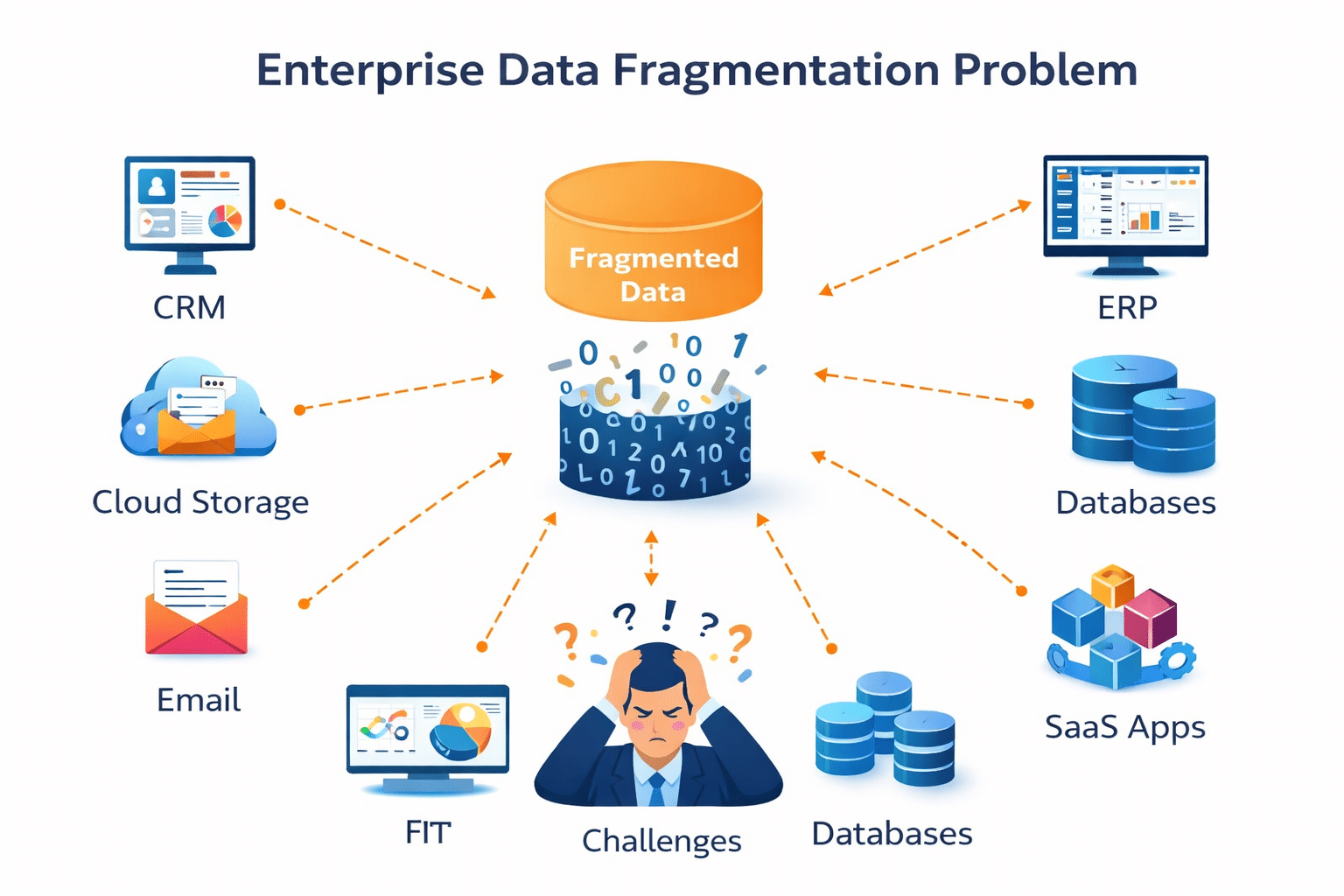
Now, it’s no secret that modern organizations generate large volumes of data.
This data exists within the enterprise across independent networks and workflows. You can think of enterprise systems like a big city, each with its own specific roadmap, pipeline structure, and power lines. Even though everything works locally, the overall environment becomes difficult to navigate. This is essentially what we call the enterprise data fragmentation problem.
At the same time, the absurd amount of data generated by modern organizations requires more centralized and interconnected governance. Every activity leaves behind a digital trace, whether it is a sales call, a shipment, an invoice, a marketing click, HR records, or IT support tickets. With access to such extensive information, companies should theoretically become incredibly intelligent. Yet, the case is completely opposite.
Every team maintains its data in a separate database structure, following its own set of rules and terminologies. Sales has all its precious data secure inside CRM platforms. Whereas, HR keeps payroll management and financial management within ERP systems. Marketing mostly has its database in marketing automation platforms and analytics dashboards. So even though all the data exists, it is scattered across isolated city blocks.
Although, a CRM might know which customers are buying. An ERP knows inventory and revenue numbers. A supply-chain system tracks delivery timelines. And marketing platforms track campaign performance…
But these systems rarely talk to each other in a meaningful way. And it’s where operational friction initiates. When leadership needs an answer to a seemingly simple question, something like: “Which marketing campaigns are driving the most profitable customers based on fulfillment costs?” teams are often blindsided and cannot pull up information from a single source of truth. Analysts have to export reports, reconcile fields, clean datasets, and manually stitch information together. Although the insight appears, it arrives late and expensive.
As per an industry report, 82% of organizations cite data silos as a major barrier to AI adoption. And only about 5% of generative AI services create measurable impact, predominantly because of poor integration with enterprise workflows.
The problem isn’t AI, it’s the architecture.
Introducing AI Native Enterprise Systems
The enterprise software market is going through a weird but fascinating evolutionary time. For decades, software has mostly behaved like a polite but dumb clerk. You asked it to do something by filling out forms, menus, or dashboards, and the system will return exactly what it’s programmed to return. In short, there’s no specific learning curve to the system but a continuous reiteration of the same process running.
But now, a new philosophy is emerging called AI native enteprise systems. Instead of adding AI as a feature on top of traditional software, the entire system is designed around machine reasoning from the start.
Imagine you start with a calculator which later learns to become a spreadsheet and eventually turns into your digital assistant, slowly and gradually learning more and more until it becomes a digital analyst capable of reading, interpreting, and acting across the entire organization without much assistance.
Speaking of traditional enterprise software solutions, the workflow may appear something like this: Human decision → open software → search data → analyze → decide.
But with AI native enterprise systems, the model flips.
Instead of simply displaying data, the software actually understands the context of the data and assists you with critical decision-making.
You can submit requests in natural language, connect multiple systems, and get action proposals.
What AI-Native Software Means for Enterprise Systems?
Enterprise tools often work through structured interfaces. You get forms to input data, dashboards to visualize metrics, and rule engines that trigger predefined workflows. Most of these systems function on fixed logic. If condition A is fulfilled, the system performs condition B, or you can expect nothing. However, AI-native software works on an entirely different model. The core system is a reasoning engine powered by machine learning algorithms capable of understanding language, context, and patterns.
There are three capabilities that define an “AI-native software.”
Autonomous Agents – An AI agent is a software entity that can perform tasks independently. Instead of waiting for human oversight or manual input, it can run processes on its own. The agent can monitor systems, collect information from several data points, and execute tasks like generating reports, scheduling logistics, or responding to inquiries.
Contextual Understanding – While traditional software has the limitation of reading structured input only (mostly numbers and designated fields), AI native enterprise systems have a better understanding of unstructured data like emails, conversations, documents, or support tickets. It allows the system to interpret user queries or intent more thoroughly rather than just create randomized output.
Dynamic Decision Making Capability – Unlike traditional tools that rely on static rules, AI systems are more capable of analyzing situations through a dynamic viewpoint. AI native enterprise systems can analyze past outcomes, detect existing patterns in data, and adjust decisions accordingly, leading to more sound decision-making capability.
For many years, the digital era of the enterprise workflows appeared as a linear pipeline.
Human → Software → Database.
An agentic AI architecture introduce a new operational layer between humans and software infrastructure. The workflow started to look something like this:
Human → AI Agent → Entire Enterprise Stack.
How This Shift Became Possible?
It wasn’t an overnight change, a shift that happened randomly or all on its own. There were several technological breakthroughs that made AI native enterprise systems emerge.
Large Language Models – We saw models that trained on enormous datasets of text and code, giving them the capability to understand and generate human language. LLMs, in time, transformed from a chatbot experience to a more nuanced system capable of understanding and interpreting user queries, summarizing long-form content, and analyzing conversations to produce structured and valuable outputs. In other terms, the LLM became capable of communicating with humans using natural language instead of rigid responses.
Multimodal AI – We saw traditional AI models working on massive datasets of text, images, and audio. Multimodal AI took things a step further by introducing more robust processes through the integration of multiple data types simultaneously. It meant AI systems became capable of not just interpreting walls of text or audio/video content; they became more interconnected in their analysis of reports, charts, documents, emails, and voice conversations to arrive at relevant conclusions with logical and accurate reasoning. For enterprises, it streamlined complex data environments into extremely valuable information.
Reinforcement Learning – As time passed, AI became capable of using a technique called improved decision-making through feedback loops. It was able to decide which of two options was a better decision and gradually learned more effective strategies to implement. What does it mean for an enterprise? Well, it lets AI optimize workflows, automate important processes, and improve operational decisions.
Today, many major LLM platforms provide the foundation for these capabilities.
Some of the most popular examples include models like OpenAI, Google (through its Gemini models) and other open-weight systems such as Llama from Meta or Grok from X. Certain models like Claude push the reasoning capability of these engines a step beyond which AI native enterprise systems software can integrate as part of their operational systems.
Zoom out a little and you can watch the interesting twist in cybernetics, the science of feedback and control systems. Here, you receive a powerful system, one that can observe itself, reason about its state, and act accordingly, resembling a kind of organizational nervous system.
Multi-Agent Systems – Introducing the New Enterprise Architecture
Nowadays, enterprise software has started to appear more like a digital team of specialists working together rather than a rigid machine. This specific shift brings us to the important next step, which is, by far, the most interesting one: architectural ideas emerging in modern AI systems called multi-agent systems.
The Multi-Agent System Architecture
As enterprises start growing, working through a single AI assistant is no longer enough. Businesses want AI solutions that operate in different domains such as finance, marketing, design, development, HR management, and so on. They want AI agents in enterprise that come with specific specialized reasoning and learning curves.
Instead of relying on a single AI agent, a generic system to take care of the organizational tasks, they want a solution backed by multiple specialized AI agents that collaborate with each other effectively. The approach of using multiple AI agents in enterprise to perform a number of organizational tasks is called the multi-agent architecture.
What Are Multi-Agent Systems in Enterprise AI?
In easier words, a multi-agent system is a network of AI agents that work together to solve complex organizational routine tasks and perform them.
Every agent works autonomously as an independent digital worker with a defined role within the organization. Instead of depending on one monolithic AI calling all the shots, a team of specialized AI agents handles specific responsibilities and coordinates with one another.
For example, a single organization may include multiple AI agents in enterprise in the form of:
| Agent | Responsibility | Example Actions |
| Finance Agent | monitor spending | detect anomalies |
| Supply Agent | demand forecasting | reorder inventory |
| Marketing Agent | campaign optimization | adjust targeting |
| Compliance Agent | regulatory monitoring | audit policies |
Individually, these agents are useful, but their real power appears when they start interacting with each other through a well-regulated and coordinated system.
How Multi Agents Collaborate?
Multi-agent systems are complex, but they operate in a well-coordinated and structured manner. Instead of operating as a single entity, multi-agents continuously exchange information and perform the necessary actions.
A common mechanism they predominantly follow is called task delegation. In this scenario, one of the agents becomes a senior agent responsible for following the broader objective of the organization, assigning and managing subtasks to other agents with specializations. This agent works as the supervisor, project manager, or digital marketing manager of a relative and specific team, ensuring all the tasks are performed thoroughly and accordingly.
There’s also the concept of consensus building in the multi-agent system through which they collaborate. When multiple agents are required to perform repetitive tasks or tasks falling within the same domain, they may compare their findings and choose the best option. This step improves their decision-making accuracy, especially in complex working environments.
Agents are also capable of resolving conflicts among themselves with minimal human governance. When they are tasked with enterprise operations, their goals can sometimes overlap, and they may start competing with one another. For example, a finance agent might believe they want to reduce the budget for ad spend, but a marketing agent might recommend increasing it. A multi-agent architecture may use predefined coordinated rules to fix this.
How are Multi-Agent Systems Changing the SaaS Model?
The interesting thing about multi-agent systems is how they quietly challenge the status quo behind traditional SaaS technology. Many SaaS tools nowadays operate the same way as a digital file cabinet: structured dashboards and optimized reports. Multi-agent systems behave more like a team of analysts working behind the scenes.
Dynamic Adaptation – Agents respond to situations automatically because they are not tied to a single rigid workflow. Many traditional SaaS systems rely on predefined rules. For example, if A takes the following step, then initiate B.
Agents don’t follow that rigid logic sequence; they monitor incoming data streams, transactions, user behavior, and operational metrics to interpret what changes are required and when they should be implemented.
Assume a supply chain agent notices shipping delays from a specific vendor. It can quickly adjust the delivery forecast and notify procurement systems so they can find an alternate supplier to save the supply chain department from a supply shock.
The system isn’t just waiting for humans to manually assist; it triggers action based on the environment.
Contextual Intelligence – Contextual intelligence is where an agent can extract useful information from different data sources and understand the correlations.
For example, a marketing dashboard may show certain campaigns, CRM data helps track customer communications, whereas an ERP records financial streams from customers. Separately, each of these systems tells only part of the story, but a multi-agent system integrated with each department will be able to collect information from all these data sources and synthesize it to determine the best course of action.
A smart marketing agent will combine campaign performance from analytic tools with customer lifetime value from CRM and assess fulfillment costs from ERP, enabling it to make better overall decisions. Instead of simply reporting isolated metrics from campaign performance, the agent will produce better and more profitable suggestions. It may suggest removing elements that are draining the budget.
This intelligence appears because the agent understands context across systems instead of relying on one source.
Autonomous Decision Making – Traditional software can have its fair share of problems which may surface up once you have purchased the subscription. Apparently, there’s no preordained or well defined system to fix the concerning problem.
Users often find themselves stuck with making the necessary improvements or adjustments to keep things working. However, when an AI agent is working or evaluating behind-the-scenes, it evaluates better options by studying historical patterns, understanding user objectives and applying probabilistic reasoning.
Let’s say, if there’s an anomaly appearing in a SaaS powered system, the system may be able to flag it early on and provide the necessary improvements. For example, if a finance agent detects an anomaly in a transaction, it can halt the transaction process and may run fraud detection checks; at the same time, it may also notify the compliance agent to take corrective actions.
Continuous Learning – An AI Agent is capable of improving itself with the passage of time because it has complex machine learning algorithms working at the backend.
It follows a system called learning from feedback loops which make each interaction a source of training data. For instance, a support agent can use every interaction with a customer in its database as a particular model which it can study later on to provide a solution to a similar or advanced query.
With continuous learning, an AI agent can quickly solve problems and provide better results eventually becoming capable of providing accurately correct responses to user queries. The step of reinforcement learning and model training is what refines the agent’s behavior, making it smarter with each session it runs compared to static traditional enterprise software sessions.
Cross System Orchestration – Strange but exciting, multi system agents are designed to operate across entire enterprise tech stacks rather than work inside a single application.
They can interact with multiple systems such as CRM platforms which contain customer relationship information, ERP systems with records for financial and operational data, HR tools which manage employee information, analytics platforms to measure user performance, and external data sources like the ones for market signals or logistic feeds, etc.
It can access all such datapoints and create a well coordinated workflow which previously required interconnecting several departments and a lot of manual iterations to make it happen.
An AI agent does not only collect information from these multiple data sources but utilize a multi agent setup with dozens of specialized agents coordinating across systems behaving like a single digital workforce.
A Framework for the Enterprise to Adopt Multi Agent System within an Organization
The funny thing about enterprises starting to think about introducing multi-agent systems within the workplace is how they jump straight to AI automation in business. It usually backfires because most departments adding AI agents in enterprise often want to sit back and let the AI agent take up responsibility.
But enterprise systems are complex, and they behave more like an ecosystem rather than a standalone entity. If you introduce a lot of new species into your ecosystem, the balance of your enterprise will collapse.
The smart move is a staged evolution in different phases.
| Phase | Description |
| Assisted Agents | AI copilots analyze data |
| Collaborative Agents | Agents execute limited tasks |
| Autonomous Systems | Multi-agent orchestration |
Here’s a practical framework to help organizations integrate fully autonomous systems without losing operational control and, at the same time, achieve their respective end goals.
Step # 1 – Find out High Impact Workflows
Your first step should be to identify business workflows where automation and intelligent coordination are most needed. These can be areas of your business where you’ve made your greatest investments.
They are usually areas where a lot of data is present, and decisions are made repetitively across multiple systems. It could be your supply chain, customer support triage, finance department, or sales pipeline.
You can start by mapping existing workflows and checking where a human can be replaced with a specialized agent. Whether you need to remove entire teams or just individuals, that’s up to you. Your end goal should not be to immediately automate everything but to target AI segmented augmentations.
Step # 2 – Deploy Agents, But Assisted Agents
Once you have identified high-impact workflows, it’s time to introduce assisted agents into your enterprise ecosystem. In this phase, you work with agents primarily by framing them as analytical copilots.
They collect useful data from multiple systems, analyze existing patterns, and provide the best recommendation or necessary course of action, all under the supervision and governance of an expert.
For instance, if you’re planning to add a finance agent to flag anomalies in your company’s financial transactions or to forecast cash flow risks, you can implement one under human supervision.
In this phase, humans remain in charge and control the execution. However, this becomes the honeymoon phase for the AI agent in AI native enterprise systems, where it starts adapting and learning quickly.
Step # 3 – Initiate Collaborative Autonomy
As soon as the agent demonstrates reliability, your next step should be to enable collaborative autonomy.
Here, the agents begin taking on bigger responsibilities, such as handling complete small operational tasks themselves. They will still operate under a predefined set of rules and within specified guardrails with human supervision; however, there will be enough room for these agents to coordinate with each other to complete multi-step tasks easily.
For example, a marketing agent may find a spike in product demand, eventually notifying a supply chain agent to adjust inventory levels and approve the adjustment. A finance agent can evaluate the budget impact and provide the necessary financial assessments.
In this stage, the specific agents are no longer just recommending actions; they are performing them on behalf of enterprise operations.
Step # 4 – Transition to Full Agentic Systems
As soon as they earn your confidence, it’s time to transition into the final stage, which involves deploying fully agentic systems capable of orchestrating workflows that support the entire enterprise stack.
Now, smart agents are capable of monitoring systems, collaborating with one another, and autonomously executing important tasks. Only the most ambiguous and complex cases require human oversight.
For example, an end-to-end supply chain running on MAS might perform all actions automatically; however, if it comes to adjusting logistics routes or setting up production schedules based on a third-party vendor or factors dependent on external sources, the system may notify a human to check and optimize.
Human intervention will mostly be specific to strategic supervision, overseeing system behavior, and defining policies.
| Software Model | Role of Humans | Role of Software |
| On-Premise | operate systems | record data |
| SaaS | manage workflows | store + display |
| AI Native Enterprse Systems | supervise strategy | reason + act |
Concluding Thoughts
Enterprise software has always evolved in waves.
Each wave changed how organizations interact with information, decisions, and operations.
The first wave was on-premise systems where software lived inside company infrastructure, tightly controlled but right and difficult to scale.
Then came the second wave, the cloud and SaaS era, where software shifted to the cloud dramatically reducing infrastructure barriers and making enterprise tools accessible at global scale. Organizations took advantage and gained flexibility. They saw integrations improve and new applications emerged although following the same architecture: forms, dashaboards, and CRUD workflows.
Now a new stage is beginning. Advances in artificial intelligence are pushing enterprise software beyond passive tools into AI native enterprise systems capable of reasoning, collaboration, and action. Instead of interacting with dozens of disconnected applications, organizations are now deploying a large network of intelligent agents who can interpret data and coordinate across systems.
FAQs
What is SaaS in enterprise software?
Software-as-a-Service (SaaS) is a cloud-based software delivery model where applications are hosted by providers and accessed through the internet via subscription. Instead of installing software locally, businesses use web-based platforms for functions like CRM, HR management, finance, and analytics.
Why is SaaS becoming limited for modern enterprises?
SaaS platforms typically rely on predefined workflows and CRUD-based architectures (Create, Read, Update, Delete). While scalable, these systems struggle with real-time reasoning, cross-platform intelligence, and autonomous decision-making required in complex enterprise environments.
What are AI native enterprise systems?
AI native enterprise systems are software architectures built around artificial intelligence rather than traditional rule-based workflows. They integrate reasoning, learning, and automation directly into the system’s core, enabling intelligent decision-making and adaptive workflows.
What is an AI agent?
An AI agent is an autonomous software entity capable of perceiving data, reasoning about tasks, and executing actions to achieve specific goals. In enterprise systems, agents can automate workflows such as supply chain optimization, customer support, or financial analysis.
What is a multi-agent system (MAS)?
A multi-agent system is a network of AI agents in enterprise that collaborate and solve complex problems. Each agent specializes in a specific task, such as logistics, finance, or customer service, while coordinating with other agents to optimize overall business operations.
How do multi-agent systems differ from traditional enterprise software?
Traditional enterprise software requires humans to trigger workflows and interpret results. Multi-agent systems can autonomously analyze data, coordinate across systems, and execute actions without requiring manual intervention.
Will AI agents replace SaaS platforms?
AI agents are unlikely to replace SaaS immediately. Instead, many organizations will adopt hybrid architectures where AI agents in enterprise operate on top of existing SaaS systems, gradually automating workflows and integrating fragmented data.
What industries will benefit most from AI native enterprise systems?
Industries with complex operations and large data flows will benefit the most, including:
- healthcare
- finance
- manufacturing
- logistics
- retail
These sectors rely heavily on real-time decision-making and cross-system coordination.
How will AI native enterprise systems change enterprise workflows?
AI native enterprise systems can automate complex workflows, enabling organizations to shift from manual process management to autonomous optimization. Employees increasingly supervise AI systems rather than operating software directly.
What are the main challenges of adopting AI native enterprise systems?
Key challenges with adopting an Ai native enterprise systems include:
- integrating with legacy systems
- regulatory compliance and governance
- data privacy concerns
- organizational resistance to change
- infrastructure requirements for large-scale AI systems
How should companies start adopting AI native enterprise architectures?
Organizations typically adopt AI native enterprise systems gradually by:
- Deploying AI assistants for decision support
- Automating selected workflows with agents
- Scaling to multi-agent orchestration across departments
This phased approach reduces operational risks and builds trust in AI native enterprise systems.
What is the future of enterprise software?
Enterprise software is likely evolving toward AI-driven ecosystems where autonomous agents manage workflows, analyze data, and coordinate decisions across the organization. Instead of operating applications, businesses will manage networks of intelligent systems within a highly focused and empowered AI native enterprise systems architecture.