


As we enter the AI revolution, AI-powered websites are becoming the new normal.
It can understand the customer’s intent, help you fix a budget, recommend similar outfits, answer questions about sizing, suggest accessories, and guide shoppers to complete the purchase.
That difference captures where ecommerce website development is heading.
Artificial intelligence is no longer just a chatbot added to a website. It is becoming an intelligence layer that influences search, product discovery, personalization, content, customer support, inventory, pricing, security, and even how ecommerce websites are built.
The shift is already visible in the shopping behavior of consumers.
Salesforce reported that 39% of consumers were using AI for product discovery in 2025, including more than half of Gen Z shoppers.
For businesses investing in Ecommerce Website Development, this isn’t simply another technology trend to watch out for. It is changing how customers expect an ecommerce website to be.
So, what exactly is AI changing in ecommerce website development, and what should businesses be preparing for?
Table of Contents
What Does AI Mean for Ecommerce Website Development?
Ecommerce website development Dubai is robust. Here, agencies are using technologies such as machine learning, natural language processing, and AI agents for a robust shopping experience.
The important distinction is that AI can influence both sides of an ecommerce website.
For customers, it can improve:
- Product search
- Recommendations
- Personalization
- Customer support
- Product discovery
- Checkout
- Navigation
On the other side, it can:
- Demand forecasting
- Inventory management
- Product content
- Fraud detection
- Pricing decisions
- Analytics
- Website optimization
In other words, AI isn’t simply another feature in a website. But it is the real foundation of the website that connects customer behavior, product data, business systems, and real-time decision-making.
Traditional Ecommerce vs AI-Powered Ecommerce
| Traditional Ecommerce | AI-Powered Ecommerce |
| Keyword-based search | Semantic and intent-based search |
| Static recommendations | Personalized recommendations |
| Rule-based chatbot | Conversational AI assistant |
| Manual content creation | AI-assisted content creation |
| Historical forecasting | Predictive forecasting |
| Fixed customer journey | Adaptive customer journey |
The difference isn’t simply automation. It is the ability to understand the context of the query and respond accordingly.
Read more: How AI is Transforming Modern Web Development
How AI Is Changing Ecommerce Website Development
1. AI Is Making Product Search More Intelligent
Search has always been one of the most important components of an ecommerce website. But traditional search only focuses on matching keywords rather than understanding the context of shoppers.
For example, a customer may search:
“Comfortable black running shoes for daily 5K runs under AED 500.”
A basic search engine may focus on black, running shoes, and AED 500. An AI-powered search engine can interpret your preference in no time. It is most likely to suggest products based on:
- Product type: Running shoes
- Color: Black
- Use case: Daily 5K running
- Budget: AED 500
- Preference: Comfort
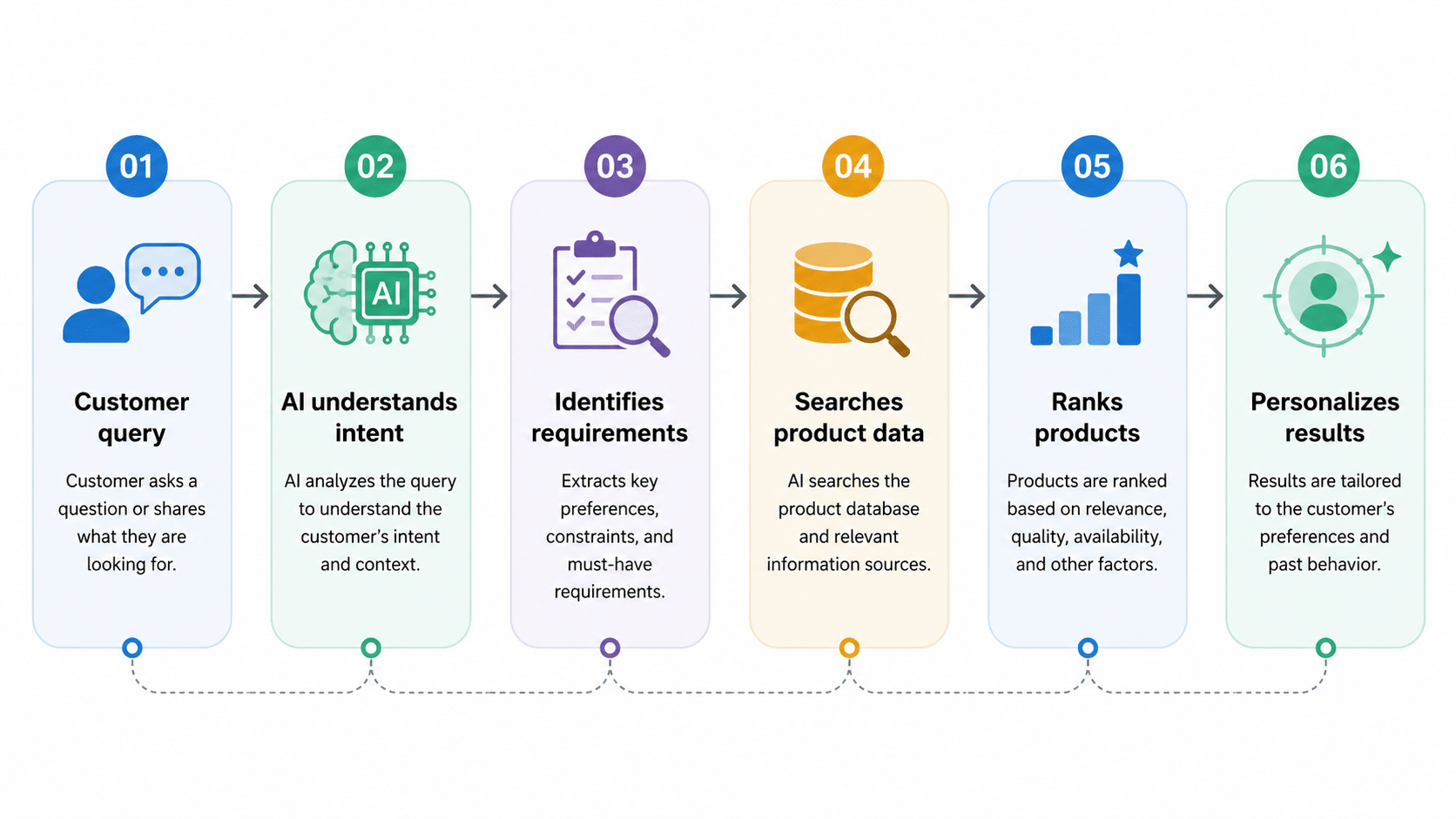
It then ranks products according to the intent of the query. This is where semantic search and natural language processing become important.
AI can also help ecommerce search by checking:
- Misspellings
- Conversational queries
- Synonyms
- Natural-language questions
- Voice searches
- Product attributes
- Previous shopping history
For shoppers, the result is less time spent filtering through products. For businesses, better product discovery means lower bounce rates and better conversions.
How AI Understands a Shopping Query?
This is one of the areas where custom ecommerce web development can create an edge.
Instead of relying entirely on generic search functionality, businesses can build search experiences around their specific product catalog, customer data, and buying patterns.
2. AI Is Turning Personalization Into a Real-Time Experience
“Recommended for you” is not a new thing, but it is evolving.
What is changing is how deeply personalization can be integrated into an ecommerce website.
AI can analyze signals such as:
- Previous purchases
- Browsing behavior
- Search history
- Product interactions
- Cart activity
- Location
- Device
- Purchase frequency
- Customer preferences
It can then adjust elements of the website based on what it learns. For example, two customers visiting the same ecommerce store may see different:
- Products
- Product recommendations
- Category rankings
- Promotional offers
- Bundles
- Content
- Search results
The goal isn’t to make the website look aesthetically appealing but to make the customer journey more immersive.
That last point matters. Personalization is only good if you’ve got the right data behind it.
3. AI Shopping Assistants Are Replacing Basic Chatbots
Remember the old ecommerce chatbot that could answer:
“What are your delivery timings?”
AI shopping assistants are moving beyond predefined answers. These modern AI assistant can understand in-depth and meaningful questions like:
“Which laptop is best for a graphic design student under AED 4,000?”
The more detailed the product information is, the better the search will be. AI bots can now spot differences, narrow down options, and help customers make better choices.
Depending on how it is integrated, an AI shopping assistant can help with:
- Product comparisons
- Recommendations
- Size related queries
- Product specifications
- Delivery information
- Returns
- Order tracking
- Cross-selling
- Upselling
This is particularly useful for stores with large categories. Instead of making customers navigate dozens of filters, AI powered websites can give accurate searches based on conversational queries.
4. AI Is Changing How Ecommerce Websites Are Designed
AI isn’t only changing what customers see. It is also changing how designers and developers approach website development.
AI-assisted design tools can help teams:
- Generate wireframe concepts
- Create interface variations
- Analyze user behavior
- Identify potential UX friction
- Develop content structures
- Generate design ideas
- Test different layouts
But there is an important distinction here.
AI can suggest a design. It doesn’t automatically understand your entire business model. It help create a brand and conversion strategy that aligns with your long term business goals.
That is why human expertise remains essential.
A strong ecommerce design process combines AI-assisted experimentation. Human decisions around usability, accessibility, branding, and information architecture help achieve business goals.
Find Out: Benefits of Professional Ecommerce Website Development Services
5. AI Is Speeding Up Ecommerce Development
The website development process no longer takes AI is also becoming part of the development workflow.
Developers can use AI-assisted tools for tasks such as:
- Generating repetitive code
- Debugging
- Creating test cases
- Writing documentation
- Explaining unfamiliar code
- Building API integrations
- Refactoring code
- Automating repetitive development tasks
This can reduce the time developers spend on routine work and allow them to focus more heavily on architecture, security, integrations, performance, and business logic.
But faster coding doesn’t automatically mean better ecommerce development.
An AI-generated code snippet may work perfectly in isolation and still create problems when integrated into a complex ecommerce environment.
That is why an experienced ecommerce web development company Dubai should treat AI as a development accelerator, not a substitute for engineering expertise.
6. AI Is Making Product Content Easier to Scale
Large ecommerce stores can have thousands, or even millions of products. Creating unique product content for every SKU manually can take an enormous amount of time.
Generative AI can assist with:
- Product descriptions
- Product titles
- Meta descriptions
- Category copy
- FAQs
- Product comparisons
- Promotional content
- SEO content
This is especially useful when businesses need to update or expand their catalog quickly. However, AI-generated content still needs human review.
Product specifications, prices, technical claims, warranty details, dimensions, and other factual information should come from reliable product data rather than being invented by a language model.
IBM specifically warns that AI implementations trained on inadequate or inappropriate data can create poor experiences and damage consumer trust.
The best approach is simple:
Let AI scale the content process. Let humans protect accuracy and brand quality.
7. Predictive AI Is Improving Inventory Management
Here’s where AI moves beyond the website interface.
Imagine a retailer preparing for a major seasonal shopping period. Instead of looking only at last year’s sales, an AI system can analyze multiple signals to estimate future demand.
These may include:
- Historical sales
- Seasonal patterns
- Customer behavior
- Current demand
- Product trends
- Geographic demand
- Inventory movement
The system can then help businesses make better decisions about stock levels.
That can reduce two expensive ecommerce problems:
Too much inventory → higher holding costs
Too little inventory → lost sales
For ecommerce businesses operating across multiple locations, predictive inventory management can become even more valuable because demand may vary significantly between markets.
8. AI Can Support Smarter Pricing and Promotions
Pricing is another area where AI can analyze large amounts of information faster than manual processes.
Depending on the business model, AI can consider:
- Demand
- Inventory levels
- Competitor pricing
- Customer behavior
- Seasonality
- Product performance
This can help businesses determine when certain products may need a promotion, when demand supports a higher price, or which products could work well as bundles.
However, dynamic pricing needs monitoring.
Businesses need to consider customer expectations, pricing transparency, fairness, and applicable regulations.
AI should inform pricing decisions, not become a black box that makes decisions nobody can explain.
9. AI Is Strengthening Ecommerce Security
Security becomes more complicated as ecommerce businesses process more transactions and customer data.
AI can help identify unusual patterns that may indicate:
- Payment fraud
- Account takeover
- Suspicious purchasing behavior
- Unusual transaction frequency
- Abnormal login activity
Instead of relying entirely on fixed rules, machine-learning systems can identify patterns and flag transactions that look unusual.
For customers, this can mean safer transactions.
For businesses, it can mean reducing financial losses while minimizing unnecessary friction for legitimate customers.
Explore: Top 7 Ecommerce Web Design Companies
What Does an AI-Powered Ecommerce Tech Stack Look Like?
AI doesn’t operate in isolation. It needs to connect with the systems already running the business.
A simplified AI ecommerce architecture might look like this:
Frontend: Experience Layer
- AI search
- Personalized interface
- Conversational assistant
- Dynamic product recommendations
- Adaptive UX
Backend: Core Layer
- Ecommerce platform
- APIs
- CRM
- ERP
- Order management
- Inventory management
AI Layer: Intelligence Layer
- Large language models
- Recommendation engines
- Machine-learning models
- Predictive analytics
- Computer vision
- AI agents
Data Layer: Foundation
- Customer data
- Product catalog
- Behavioral data
- Transaction history
- Inventory data
- Analytics
Business Systems: Connected Ecosystem
- Payment gateway
- PIM
- Marketing automation
- Shipping
- Analytics
This is why AI integration can be more complex than simply adding an AI chatbot.
The intelligence needs access to reliable information, and that information needs to move securely between different systems.
What Are the Benefits of AI-Powered Ecommerce Development?
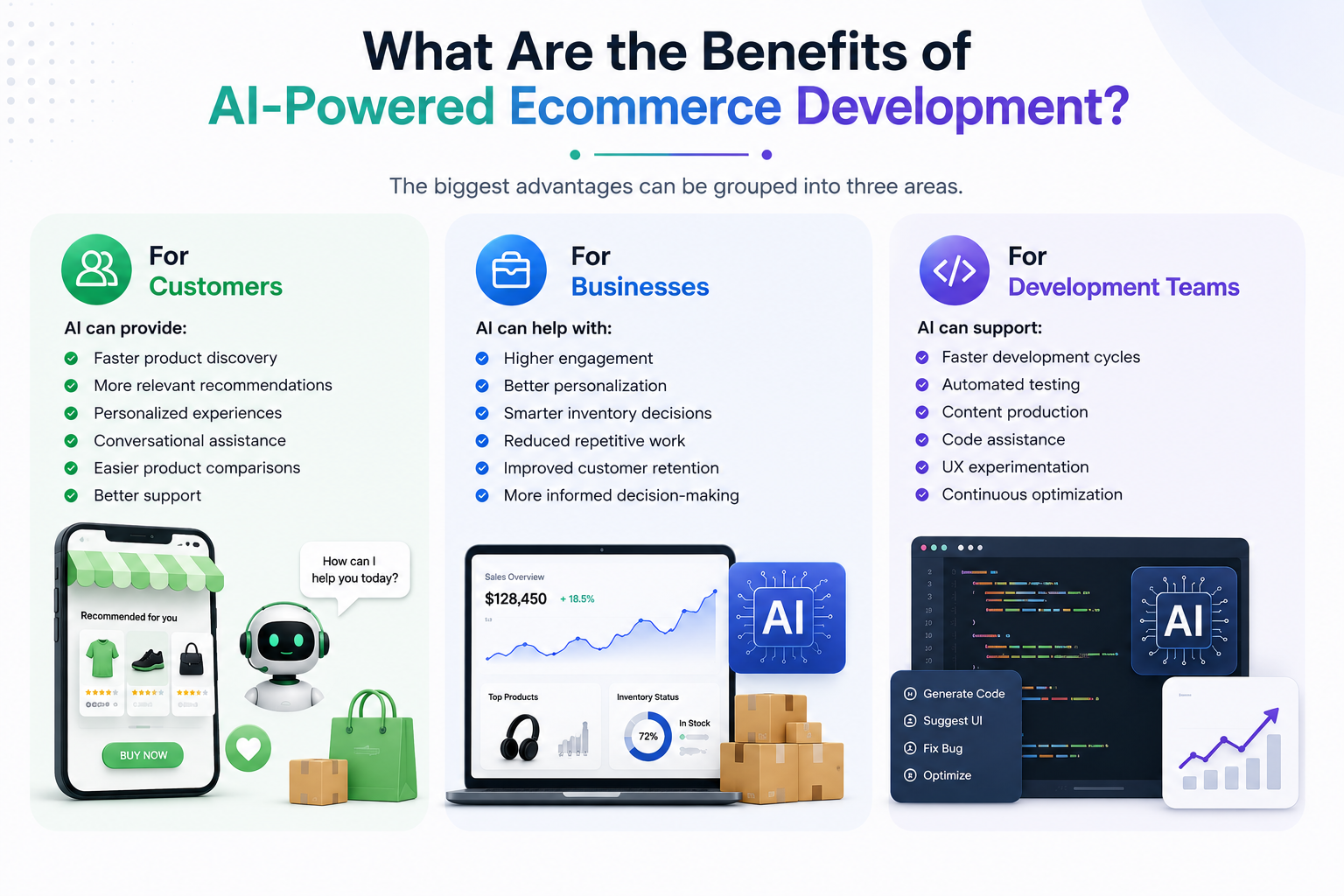
The biggest advantages can be grouped into three areas.
For Customers
AI can provide:
- Faster product discovery
- More relevant recommendations
- Personalized experiences
- Conversational assistance
- Easier product comparisons
- Better support
For Businesses
AI can help with:
- Higher engagement
- Better personalization
- Smarter inventory decisions
- Reduced repetitive work
- Improved customer retention
- More informed decision-making
For Development Teams
AI can support:
- Faster development cycles
- Automated testing
- Content production
- Code assistance
- UX experimentation
- Continuous optimization
These numbers don’t mean every AI feature will automatically increase conversions. They do show why ecommerce businesses are paying attention to the channel.
What Are the Challenges of AI in Ecommerce Development?
AI does create multiple opportunities, but it comes with challenges too. Some of the most prominent ones are:
-
Data Quality
AI needs reliable data.
Incorrect product information can lead to incorrect recommendations, inaccurate answers, or poor search results.
-
Privacy and Security
Ecommerce platforms handle valuable customer information. Businesses need clear rules around what data AI systems can access, process, and retain.
-
Integration Complexity
AI may need to connect with CRM, ERP, PIM, inventory, payment, analytics, and ecommerce systems.
The more systems involved, the more important architecture becomes.
-
AI Hallucinations
Generative AI can produce convincing but incorrect information.
For ecommerce, that could mean recommending a product based on a feature it doesn’t actually have.
Grounding AI responses in trusted product and business data is therefore critical.
-
Cost
AI implementation involves more than the initial development cost.
Businesses may also need to account for:
- API usage
- Infrastructure
- Data management
- Monitoring
- Model updates
- Security
- Maintenance
This is why businesses should focus on ROI rather than adding AI simply because it is fashionable.
How to Implement AI Into an Ecommerce Website
You don’t need to transform your entire ecommerce website overnight.
A better approach is to start with a specific problem.
Step 1: Identify the Business Problem
Ask:
Where are customers struggling?
Maybe they can’t find products quickly.
Maybe customer support receives thousands of repetitive questions.
Maybe inventory forecasting is unreliable.
Start there.
Step 2: Audit Your Data
Review your:
- Product catalog
- Customer data
- Sales history
- Inventory information
- Search data
- Analytics
If the underlying data is messy, fix the foundation before adding advanced AI.
Step 3: Prioritize High-Value Use Cases
Good starting points include:
- AI search
- Product recommendations
- Customer support
- Product content
- Demand forecasting
Choose the feature with a clear business case.
Step 4: Select the Right Technology
Depending on the use case, you might need:
- An existing AI API
- A recommendation engine
- A large language model
- Machine-learning models
- Computer vision
- Custom AI development
Step 5: Integrate It With Your Ecommerce Stack
AI should work with the systems you already use rather than becoming another disconnected tool.
APIs and well-designed architecture become particularly important here.
Step 6: Test With Real Customers
Measure what actually changes.
For example:
- Search-to-purchase rate
- Conversion rate
- Average order value
- Cart abandonment
- Customer satisfaction
- Support resolution rate
Step 7: Optimize Continuously
AI implementation doesn’t end when the feature goes live.
Monitor results, identify errors, review customer feedback, and improve the system over time.
How to Measure the Impact of AI
Adding an AI feature is not the same as creating value.
Businesses should establish measurable KPIs before implementation.
| AI Feature | Metrics to Track |
| AI Search | Search success rate, conversion |
| Recommendations | CTR, conversion, AOV |
| AI Assistant | Resolution rate, satisfaction |
| Personalization | Engagement, conversion |
| Inventory AI | Stockouts, excess inventory |
| Fraud Detection | Fraud rate, false positives |
| AI Content | Organic traffic, engagement |
| AI UX | Bounce rate, session duration |
The goal is to answer a simple question:
Is AI actually improving the customer or business outcome?
If the answer is no, the feature needs to be refined, not simply kept because it uses AI.
How Should Businesses Choose an Ecommerce Development Partner for AI?
AI can make ecommerce development more powerful, but it also makes the technical side more demanding.
When evaluating the best ecommerce website development company for an AI-powered project, don’t focus only on whether the company can build a visually attractive storefront.
Look for expertise in:
- Ecommerce architecture
- API integrations
- AI and machine learning
- Data management
- UX/UI
- Security
- Performance optimization
- CRM and ERP integrations
- Analytics
- Scalability
Ask potential development partners questions such as:
How will AI connect with our existing ecommerce platform?
Where will customer and product data be stored?
How will AI-generated responses be validated?
How will the system scale as our catalog grows?
What metrics will determine whether the AI feature is successful?
These questions help separate a team that simply adds AI features from one that understands how to build a reliable AI-powered ecommerce ecosystem.
For businesses looking for custom ecommerce web development, this distinction is particularly important. Custom development can provide more control over integrations, data flows, personalization logic, and AI functionality than a one-size-fits-all approach.
Read more: How to Build a Remarkable Brand in the Age of AI
FAQs
How is AI changing ecommerce website development?
AI is making ecommerce websites more intelligent by improving search, personalization, product recommendations, customer support, content creation, inventory forecasting, security, and analytics. It is also helping developers automate parts of the development and testing process.
What are the most common AI applications in ecommerce?
Common applications include AI-powered search, product recommendations, conversational shopping assistants, personalization, predictive inventory management, dynamic pricing, fraud detection, and AI-assisted content creation.
Can AI help build an ecommerce website faster?
Yes. AI-assisted development tools can help developers generate code, create tests, debug problems, document systems, and automate repetitive tasks. However, professional development expertise is still necessary for architecture, security, integrations, and quality assurance.
Bottom Line
AI is changing the ecommerce website development process.
It is making search more intuitive, recommendations more relevant, customer support more conversational, inventory more predictable, content easier to scale, and websites more adaptive.
But the real opportunity isn’t simply adding an AI chatbot or generating product descriptions.
The bigger opportunity is to build an ecommerce website that can understand what customers need and respond intelligently.
The future of ecommerce won’t be defined by how much AI a website contains. It will be defined by how intelligently that AI solves real business problems.